I'm again honoured to be teaching at the DKC Winter Workshops, being held February 5th and 6th at Metro Hall in Toronto.
I'm teaching the following classes:
Cables 101 - suitable for newer knitters who are looking to tackle cables. I cover both written and charted instructions.
Cabling without a Cable Needle - speed up your cable knitting and expand your skills. Suitable for knitters who have a little experience with cable knitting.
Lace 101 - suitable for newer knitters who are looking to tackle lace. I cover both written and charted instructions, and share tips for making lace knitting easier and more fun.
Next Steps in Lace Knitting - for knitters who have worked one or two lace patterns, I provide more insight into addressing mistakes, discuss more complex patterns like two-sided lace, and focus on building your confidence and your skills.
Design Your Own Custom-Fit Socks - Toe up, or top-down, design a sock that fits you precisely! We'll talk about special fits like wider or narrow ankles; odd feet and knee socks.
Crochet for Knitters - Crochet is an excellent skill to have for a knitter - pick up dropped stitches, create decorative and functional edgings, and work very fast seams. Suitable for all levels of knitters who don't know how to crochet.
Full schedule and registration information here.
Monday, January 24, 2011

Thursday, January 20, 2011
Expanding My Own Skills; Giving Yourself Permission to Be Awful
The Harlot posted recently about the process of learning, and how we forget that we have to be bad at something before we can get good at it.
I see this all the time in my knitting classes; as adults we expect, I think, that we'll be proficient at everything right from the get-go. I see knitters get frustrated with themselves because they don't get something straight away; I see knitters angry with their work because it doesn't look like the work on my needles, or the samples in the shop.
It's easy to be patient with my students, because I know it's going to get better. I explain, first of all, that everything looks better if you give it a wash (it does! really! next time you knit two of something - socks, mittens, sleeves - wash one and not the other and compare). And I explain that everyone's first efforts were fairly dreadful.
I really wish I'd kept my earliest attempts at knitting, to show off in my classes. They'd be great for comedy value, but also to reassure knitters that they're doing very well!
There was that purple cotton cardigan... oh dear... And those first socks, those red worsted weight socks. And I can remember so very clearly asking the very patient woman at my then-LYS how on earth you were supposed to know what size the hat was going to be when it was done.
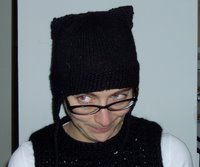 (This hat, BTW. It turned out to be the perfect size.)
I've been expanding my own skills of late, challenging myself to learn techniques outside my comfort level. And as is always the way, we are hardest on ourselves. When ripping out the swatch for the fourth time, cursing loud enough to wake the dog, I realized that maybe I shouldn't be so hard on myself... and that maybe I should take a lesson from myself.
I see this all the time in my knitting classes; as adults we expect, I think, that we'll be proficient at everything right from the get-go. I see knitters get frustrated with themselves because they don't get something straight away; I see knitters angry with their work because it doesn't look like the work on my needles, or the samples in the shop.
It's easy to be patient with my students, because I know it's going to get better. I explain, first of all, that everything looks better if you give it a wash (it does! really! next time you knit two of something - socks, mittens, sleeves - wash one and not the other and compare). And I explain that everyone's first efforts were fairly dreadful.
I really wish I'd kept my earliest attempts at knitting, to show off in my classes. They'd be great for comedy value, but also to reassure knitters that they're doing very well!
There was that purple cotton cardigan... oh dear... And those first socks, those red worsted weight socks. And I can remember so very clearly asking the very patient woman at my then-LYS how on earth you were supposed to know what size the hat was going to be when it was done.
 (This hat, BTW. It turned out to be the perfect size.)
I've been expanding my own skills of late, challenging myself to learn techniques outside my comfort level. And as is always the way, we are hardest on ourselves. When ripping out the swatch for the fourth time, cursing loud enough to wake the dog, I realized that maybe I shouldn't be so hard on myself... and that maybe I should take a lesson from myself.
Sunday, January 09, 2011
Continental Knitting; the Norwegian Purl
I taught a couple of classes on Continental knitting this past weekend in New Hamburg. Now, some may question my qualifications to knit such a classes, since by default I knit English-style - that is, with my yarn in my right hand. I learnt that way, when I was very young, and I find that although it might not be the fastest method, it's very comfortable for me.
But that doesn't mean I don't use and enjoy the Continental method when it suits me. I'm all about having options!
Continental knitting has you hold your yarn in your left hand, like so:

English-style knitters, like me, usually find the Continental knit stitch easy to manage - it's easy to work, and the benefits are immediate and obvious.
Because the working yarn is stretched behind your needles, it's pretty easy to "pick" the stitch. Like so:

Just put the right-hand needle into the stitch, and swing the tip of the needle over top of the working yarn to the right, and bring the working yarn back through the stitch. Easy!
It's much more efficient in movement, since you're not moving the yarn at all, and barely moving the needles.
I like to use the continental knit when I'm working a piece entirely in garter stitch, or when my hands are tired.
My gauge is quite different between the English and Continental methods, however, so I have to be consistent about which method I'm using in a project. This is true for many knitters - continental knitting is often looser than English knitter.
I must confess, however, that although I could (and would) do it, until recently I'd never really been fluid with the Continental purl.
No matter what method they learn, it seems that a lot of newer knitters dislike purling - they find it cumbersome and sort of unnatural. (They're not wrong; there is a theory among knitting historians that knitting in the round was invented first, and then the purl was a later adaptation to make it work flat.) A purl seems fiddly in English knitting, but downright unpleasant in Continental knitting. It's the pesky wrap.
What you save in movement in a Continental knit seems to get spent in the purl, trying to man-handle the yarn over the needle point and make it stay still while you move the needles.
There are a couple of common ways of wrapping the yarn for the Continental purl.
With your index (or middle) finger:

Or with your thumb (less "traditional", but I find this easier - I can pivot my thumb and let my fingers worry about holding the needles):

These work well, but don't feel elegant to me.
And then there's the Norwegian purl. I did some experimenting with it and reading about it before I taught the New Hamburg class, and I think it's changed my life.
In essence, instead of moving the yarn to work the purl, you move the needle. It's much closer to the method you use for the Continental knit stitch, in fact.
It goes like this...
Leave the yarn at the back (Yes, pause to think about that. No moving the yarn at all. Imagine how easy ribbing could be!) and put the needle into the stitch as normal for purling (that is, from back to front)...

And, leaving the yarn in place, move the tip of the right hand needle around the working yarn (as you do for a knit; think on that, too - makes it very easy and familiar)....

Then once the yarn is wrapped around the needle like this:

push the wrapped needle back through the stitch (from front back through to the back), like this:

For some knitters, it's a world-changer. I know it was for me. If you've been struggling with a Continental purl, try it.
Some knitters do still find it easier if you bring the yarn to the front, but still use the same basic technique.
You can read more about it, and see more pictures here and here on the blog of Knitty's Teresa.
Play with it and see how it works for you. Let me know how it goes!
But that doesn't mean I don't use and enjoy the Continental method when it suits me. I'm all about having options!
Continental knitting has you hold your yarn in your left hand, like so:
English-style knitters, like me, usually find the Continental knit stitch easy to manage - it's easy to work, and the benefits are immediate and obvious.
Because the working yarn is stretched behind your needles, it's pretty easy to "pick" the stitch. Like so:

Just put the right-hand needle into the stitch, and swing the tip of the needle over top of the working yarn to the right, and bring the working yarn back through the stitch. Easy!
It's much more efficient in movement, since you're not moving the yarn at all, and barely moving the needles.
I like to use the continental knit when I'm working a piece entirely in garter stitch, or when my hands are tired.
My gauge is quite different between the English and Continental methods, however, so I have to be consistent about which method I'm using in a project. This is true for many knitters - continental knitting is often looser than English knitter.
I must confess, however, that although I could (and would) do it, until recently I'd never really been fluid with the Continental purl.
No matter what method they learn, it seems that a lot of newer knitters dislike purling - they find it cumbersome and sort of unnatural. (They're not wrong; there is a theory among knitting historians that knitting in the round was invented first, and then the purl was a later adaptation to make it work flat.) A purl seems fiddly in English knitting, but downright unpleasant in Continental knitting. It's the pesky wrap.
What you save in movement in a Continental knit seems to get spent in the purl, trying to man-handle the yarn over the needle point and make it stay still while you move the needles.
There are a couple of common ways of wrapping the yarn for the Continental purl.
With your index (or middle) finger:

Or with your thumb (less "traditional", but I find this easier - I can pivot my thumb and let my fingers worry about holding the needles):

These work well, but don't feel elegant to me.
And then there's the Norwegian purl. I did some experimenting with it and reading about it before I taught the New Hamburg class, and I think it's changed my life.
In essence, instead of moving the yarn to work the purl, you move the needle. It's much closer to the method you use for the Continental knit stitch, in fact.
It goes like this...
Leave the yarn at the back (Yes, pause to think about that. No moving the yarn at all. Imagine how easy ribbing could be!) and put the needle into the stitch as normal for purling (that is, from back to front)...

And, leaving the yarn in place, move the tip of the right hand needle around the working yarn (as you do for a knit; think on that, too - makes it very easy and familiar)....

Then once the yarn is wrapped around the needle like this:

push the wrapped needle back through the stitch (from front back through to the back), like this:

For some knitters, it's a world-changer. I know it was for me. If you've been struggling with a Continental purl, try it.
Some knitters do still find it easier if you bring the yarn to the front, but still use the same basic technique.
You can read more about it, and see more pictures here and here on the blog of Knitty's Teresa.
Play with it and see how it works for you. Let me know how it goes!
Tuesday, January 04, 2011
A Return to Shall We Knit: Two Socks, and Continental Knitting
I'm off to Shall We Knit again this coming weekend, Jan 8 & 9, for two new classes. (It looks like the weather will be ok, but we have scheduled a snow date, just in cast Mother Nature decides to have some fun with us.)
Two Socks at the Same Time. The Normal Way, on Magic Loop. Like this:

And Continental Knitting. Speed up your knitting by learning a new technique!
Details here.
Two Socks at the Same Time. The Normal Way, on Magic Loop. Like this:

And Continental Knitting. Speed up your knitting by learning a new technique!
Details here.
Saturday, January 01, 2011
Looking forward to 2011
Here and at the KnittyBlog, I've written some thoughts about 2010.
(You do read the KnittyBlog, don't you? You should. I write there at least once a week.)
But what of 2011? Things I'm looking forward to in this new year...
(You do read the KnittyBlog, don't you? You should. I write there at least once a week.)
But what of 2011? Things I'm looking forward to in this new year...
- my name in a number of publications (and on the front cover of one of them, I hope)
- experimenting with more colourwork
- teaching further afield (Starting with Shall We Knit again next week! Yay! Two-socks at once on magic loop, and continental knitting, if you're wondering.)
- spinning
- knitting with wire
- more crochet; I started a crochet shawl about 6 months ago, and I really would like to finish the damn thing
- teaching the dog to stop playing with my yarn.
Thursday, December 23, 2010
2010: Thank You!
2010 is coming rapidly to a close. What a year!
This is the year I went pro. I finally gave up the day job, and have been working full-time as a knitting professional. It's been challenging and busy, but I'm so very glad I did it.
I can't believe all the things I've done this year:
I've taught classes at
-Lettuce Knit
-The Purple Purl
-PassionKnit
-the dearly departed Naked Sheep
-two DKC events
-the Creativ Festival
-Shall We Knit in New Hamburg
And I've had speaking engagements at
-the Kawartha Lakes Knitting Guild
-the Kitchener Waterloo Knitting Guild
I've written for
-this blog
-the Knittyblog
-the Signature Needles blog
I've had designs published in
-Knitty
-Yarn Forward Mag
I've appeared in several books, including
The Perfect Finish
Behind the scenes, I've done:
-technical editing & production support for 4 issues of Knitty
-editing for 4 issues of A Needle Pulling Thread Magazine
-various other tech editing work for yarn companies and publishers
I've published a bunch of new designs, including
-the Heirloom Baby Bonnet
-the Roasted Carrot Sock
-the Walking on Sunshine socks
And I've loved every single minute of it.
Thanks a million to everyone I've worked with and for, and everyone who has bought my patterns, and everyone I've met this year. Your support means so much to me.
I can't tell you how much I'm looking forward to 2011. 2011 brings new challenges and ideas and publications - not least of which is my very own book. More details on that as we get closer, but we're hoping for spring/summer publication.
Tuesday, December 14, 2010
Crowdsourcing: Thank you!
Big thanks to my readers and Twitter followers for some help they've provided me recently: I have lots of babies' head measurements, and some great feedback on the catnip-stuffed mouse pattern.
I have learned several things: my readers are helpful and generous, babies' head vary greatly in size, and some cats are pretty vicious!
I have learned several things: my readers are helpful and generous, babies' head vary greatly in size, and some cats are pretty vicious!
Friday, December 10, 2010
May I Please Measure Your Baby's Head?
A few months ago I worked on the pattern for the Heirloom Baby Bonnet. It's been a winner - people love knitting it, and I love seeing the adorable results.

I've been asked about writing it for multiple sizes. The original pattern was sized to match the original bonnet. (See story here.) It fits about a 3 month old.
It's not as easily resized as a standard hat, because of the way it fits. I've found useful tables of head circumferences only - the Craft Yarn Council of America site has a great page here.

(The graphic comes from their site.)
But head circumference isn't immediately helpful for this design. I need the other direction - around under the chin and up over the top of the head, and then the partial circumference around the back of the head at about cheek height.
I've been grumbling that I don't have access to a baby to measure, and I'm pretty sure I'd be arrested if I started trying to measure the heads of babies in the street.
And then it occurs to me - out there in internet land, there are babies! And mamas of said babies who might be willing to help me.
Mamas? Can you help?
I'm looking for the following info, for babies up to 18 months old: age of the babe, circumference of the head around the chin and up over the top of the head, and measurement around the back of the head from cheek to cheek.
Please leave a comment or email me the info. Free copy of the multi-size baby bonnet pattern to anyone who can help.
Thank you!
I've been asked about writing it for multiple sizes. The original pattern was sized to match the original bonnet. (See story here.) It fits about a 3 month old.
It's not as easily resized as a standard hat, because of the way it fits. I've found useful tables of head circumferences only - the Craft Yarn Council of America site has a great page here.
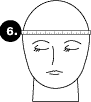
(The graphic comes from their site.)
But head circumference isn't immediately helpful for this design. I need the other direction - around under the chin and up over the top of the head, and then the partial circumference around the back of the head at about cheek height.
I've been grumbling that I don't have access to a baby to measure, and I'm pretty sure I'd be arrested if I started trying to measure the heads of babies in the street.
And then it occurs to me - out there in internet land, there are babies! And mamas of said babies who might be willing to help me.
Mamas? Can you help?
I'm looking for the following info, for babies up to 18 months old: age of the babe, circumference of the head around the chin and up over the top of the head, and measurement around the back of the head from cheek to cheek.
Please leave a comment or email me the info. Free copy of the multi-size baby bonnet pattern to anyone who can help.
Thank you!
Thursday, December 09, 2010
Happy Birthday Lettuce Knit - Still Reasonably Local

I moved into the Kensington Market neighbourhood of Toronto 7 and a half years ago. At the time, I remarked to my hubby that it seemed perfect - everything we needed was in walking distance - except a yarn shop.
This said was purely in jest, as there was a very good yarn shop 1.6km (1 mile) away, a very nice 15 minute walk through a park.
And lo and behold, 6 months later, Lettuce Knit opened. On the very street on which I live! Just over 200m (about 230 yds) away. I was in heaven.
Over the 7 years the shop has been open, it's moved twice, each time to larger premises. Sadly, it's been moving further away.... now it's at number 86 Nassau Street, a whole 70m (75yds) further down the street.
Despite this extra distance, I may well be the luckiest knitter in the world - I don't know many who live quite that local to their local yarn shop. It's less than a skein's distance away!
And I'm even luckier to be part of the Lettuce family: I've been teaching and working there for 4 of its 7 years. Happy Birthday to my most local yarn shop, and the great team that works there!
Anyone live closer to a yarn shop? (Megan, who lives about 50m away, doesn't count, she's the owner!)
Thursday, December 02, 2010
Being Rude Again/A Victim of Geography
I had a Twitter conversation with a friend this morning, and N. pointed out it me that it looked from the outside like I was being rude about a designer. Specifically, I said that I thought the designs of Debbie Bliss are "gorgeous... her write-ups not so much".
I do have a bit of a big mouth - my opinions can be strong, and I sometimes type before I think. I don't take back my statement, but let me add some context.
I love love love the designs of Debbie Bliss. She has a genuine gift for simplicity and elegance. She understands that less is more in a way that few other designers do. I've knitted a number of her designs over the years, and I buy her magazine and her books.
But I have been known to grumble about her pattern writeups - and today I did. Her instructions are known to be fairly... shall we say... minimal. It's not about mistakes or problems, not at all. As a knitter and a teacher I've never encountered any actual mistakes or problems with any of them. The issue is always about the level of detail in the instructions.
I don't actually blame any of this on Debbie Bliss or her technical editors. I blame geography. And it's not just Debbie Bliss - the Rowan pattern books are similar in the way they are written.
I've recently been doing some technical editing for a yarn company, helping them convert some patterns published in Europe to a more North American standard.
The standards for pattern writing are wildly different between Europe and North America. And the UK patterns fall somewhere in between.
It's about space. European pattern books typically print their patterns in multiple language, and therefore where they can edit to be more concise, they do. And that conciseness results in patterns that require a little more knowledge and experience to successfully follow them, that's all.
Consider the following example, taken directly from a pattern published in Europe.
Back:
Cast on 117(129) sts, then work over the 39(45) sts at each outer edge as foll: edge st and st st, in pattern mix foll chart A over the 39 center sts, dec 4 sts evenly across as given = 113(125)sts. When work measures 32 cm, on 103rd row patt mix, bind off for armholes at each end 3(5) sts once, then on every 2nd row 2 sts once and 1st 3 times = 97(105) sts.
It's perfectly correct, and it's perfectly knittable, but there's a lot of information packed into those few words. And it's not just about denseness, it also requires a fair bit of experience. For example, it tells you to bind off sts for armholes "at each end... every 2nd row". Taken at face value, that instruction could be tricky... after all, it's not possible to bind off at the start and end of a row (without doing some "stitch gymnastics", anyway).
Re-written to a style more familiar to North American knitters, the instruction becomes:
Using 3.5mm (US 4) needles, cast on 117 (129) sts.
Row 1 (RS): K 39 (45), work Chart A row 1 across center 39 sts (including decreases as charted), k to end. 113 (125) sts.
Row 2 (WS): P 39 (45), work Chart A row 2 across center 35 sts, p to end.
Continue in pattern as established until pattern row 102 is complete.
Bind off 3(5) sts at the start next 2 rows, continuing to work Chart on center 35 sts as established. 107 (115) sts.
Bind off 2(2) at the start of the next 2 rows. 103 (111) sts.
Decrease 1 st at each end of the following 3 RS rows. 97(105) sts.
Compare a typical Debbie Bliss or Rowan pattern to this European example - it's positively voluble!
Patterns published in the UK don't necessarily have the same space constraints as other European patterns, as they are only publishing in one language, and therefore they do provide a fair bit more detail. It's just that it's not necessarily the level of detail that you see in typical modern North American patterns.
Really, the biggest issue with this is that because Ms. Bliss's gorgeous designs appeal to newer knitters in their simplicity, but the pattern instructions can challenging.
There's a longer discussion here about how much knowledge is appropriate to assume on the part of the knitter... I know that there have been, and there will always be, discussions about whether simplifying and adding more detail is "dumbing down".
Despite my somewhat cranky demeanor, I'm all about encouragement. I want knitters to feel confident and be successful with their projects - and if that means taking a few extra lines to explain something in more detail, then I'm all for it! After all, we knit for pleasure - we shouldn't make it any more difficult than it needs to be.
Wednesday, December 01, 2010
And so the Holiday Season Begins...
Happy December!
It's a time for celebrations and feasting and decorating and giving of goodies. No matter what you celebrate, I hope the closing of the year finds you well and happy and surrounded by what gives you joy.
Me, I'm surrounded by knitting, delicious treats and a warm, sleepy dog. We're a bi-festive family, celebrating both Christmas and Hanukkah.
For the past couple of years, I've designed a couple of holiday treats for my lovely friends at Signature Needle Arts, one of each of the holidays I celebrate.
This year there's the Argyle Stocking.

And the Hanukkah Mitten and Sock Garland - for decorating, and filling with gelt.


Visit the Signature Needle Arts Website to get the patterns.
Monday, November 29, 2010
More On the Majesty of Mattress Stitch
(Ok, so the alliteration ran out there...)
Loving the comments on my Knittyblog post about Mattress stitch. Some very helpful suggestions!
Loving the comments on my Knittyblog post about Mattress stitch. Some very helpful suggestions!
Thursday, November 25, 2010
The Precious: Snowflower Shawl
For several weeks this summer I was working on a secret project... That's the (only) problem with knitting designs for publications - I can't blog about them.
This was a big project. By yardage, it's one of the biggest things I've knit, calling for about 1500m of lace weight cashmere. And being 1500m of lace weight cashmere, it's also one of the most precious things I've knitted.
It's finally been published, and I'm thrilled to be able to show it off...
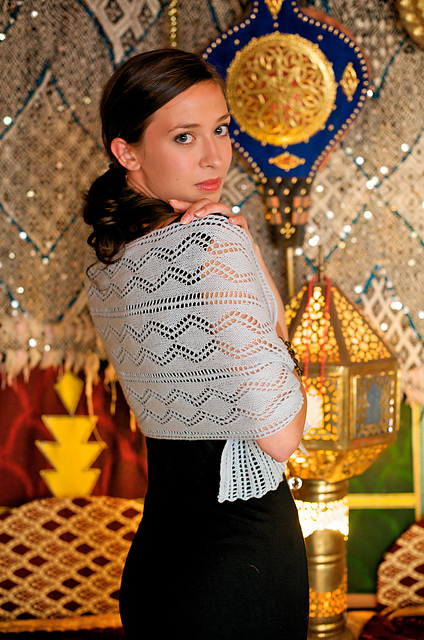
The Snowflower Shawl, for Yarn Forward Magazine Issue 31.
 (All images courtesy Yarn Forward Magazine, copyright St Range photography/Darren Strange.)
It's the last part in a three-part series on how to expand your lace knitting skills.
The first was the Double Diamond stole, in issue 29.
 The second part was the Falling Leaves triangle shawl, in issue 30.

And the finale is this circular shawl, based on Elizabeth Zimmerman's Pi shawl shaping.
One of the reasons I love designing for Yarn Forward - other than the fact they send me such gorgeous yarns to work with - is that the publications are available digitally. The publication is based in the UK, but anyone can buy a copy, and the issues remain for sale long after the print copies have sold out.
This was a big project. By yardage, it's one of the biggest things I've knit, calling for about 1500m of lace weight cashmere. And being 1500m of lace weight cashmere, it's also one of the most precious things I've knitted.
It's finally been published, and I'm thrilled to be able to show it off...
The Snowflower Shawl, for Yarn Forward Magazine Issue 31.
 (All images courtesy Yarn Forward Magazine, copyright St Range photography/Darren Strange.)
It's the last part in a three-part series on how to expand your lace knitting skills.
The first was the Double Diamond stole, in issue 29.
 The second part was the Falling Leaves triangle shawl, in issue 30.

And the finale is this circular shawl, based on Elizabeth Zimmerman's Pi shawl shaping.
One of the reasons I love designing for Yarn Forward - other than the fact they send me such gorgeous yarns to work with - is that the publications are available digitally. The publication is based in the UK, but anyone can buy a copy, and the issues remain for sale long after the print copies have sold out.
Tuesday, November 23, 2010
Harumph, I say; harumph!
Minor guilty confession of the week: I read the Dear Prudence advice column on Slate.
Or at least I used to.
In a live chat column she wrote this week, a reader enquires:
It's the answer that made my hair stand on end:
On behalf of all the sock knitters in the world, I am truly offended that Ms. Prudence thinks that the socks we make are "lumpy, itchy and droopy". Perhaps we should launch a campaign to send her some socks so she can see the quality of what we make - and understand how very very wrong she is.
What do you think?
Or at least I used to.
In a live chat column she wrote this week, a reader enquires:
- Q. Help! Advice on Gift-Giving: I am a knitter who is knitting socks for my son's preschool class. I intend to give these socks as Christmas gifts this year. I am keeping them a secret as I would like them to be surprises. The only one who knows is the teacher as I needed her help getting the kids' feet sizes. My question revolves around the note I am going to include with the socks. Of course it will include washing and drying instructions (cold water and low heat); however, I am stumped about how to ask for the socks back if the kids don't like them, so they can be redistributed. Now, I don't really want the socks back for my own son; I would like the socks to go to someone who'd actually wear them. What would you do in this instance?
It's the answer that made my hair stand on end:
- A: In this instance, I would stop with the socks and knit a sweater for my own child. While many people enjoy handmade scarves, there's a reason people stopped wearing lumpy, itchy, droopy handmade socks as soon as industrial looms were invented. It's sweet of you to want to make gifts for the entire class, but you're investing way too much time in a gift that won't be appreciated. If you want to do something handmade, maybe you should bake some treats. Or you could offer to come in and do a knitting lesson for the kids. Unless you're making socks they can hang by the fireplace for Christmas, no one wants handmade socks in their Christmas stocking.
On behalf of all the sock knitters in the world, I am truly offended that Ms. Prudence thinks that the socks we make are "lumpy, itchy and droopy". Perhaps we should launch a campaign to send her some socks so she can see the quality of what we make - and understand how very very wrong she is.
What do you think?
Monday, November 22, 2010
Someone Else's FO: Kureyon Basic Triangle Shawl

Another lovely example of my Basic Triangle Shawl, in Noro Kureyon. Gorgeous - and thanks to Kathleen for the picture. I do so love this yarn - look at those stripes!
Wednesday, November 17, 2010
Heel: For Feet Worthy of Hand-Knit Socks
Earlier this fall, I handed a giant bag of my hand-knit socks over to a friend... my sock drawer sat practically empty for a couple of weeks, as the temperature dropped. It was a bit scary, I have to admit. I had to resort to wearing store-bought socks for a while.
And why on earth would I do something so silly?
My socks went off to modelling school to become famous.

The lovely people at Soak have just launched a new product - Heel - a wonderful foot cream - "for feet worthy of hand-knit socks". (I've been using it for a few weeks, and it's great.)
They needed some socks for the packaging art, and I'm honoured to say that they chose mine!
There's a great post on the Soak blog about the photo shoot, and some really gorgeous shots.

Tuesday, November 16, 2010
Off Topic: Christmas Cake
Updates: No nuts, no! The original recipe doesn't call for them, and although I love them, hubby has some allergies. Re: loaf pans & sizes. I've used a variety of pans and it works great. 8 by 8 square plans, big loaf pans, small loaf pans.... I don't worry about the size of pan, I just start checking for doneness at the 2 hour mark.
I've been tweeting about this often enough and had enough questions that I figured I should just blog about it...
Like many Canadians, I'm an immigrant in a culturally mixed marriage, and Norman and I try to honour the holidays and traditions of both our cultures. One cultural tradition I've brought to the relationship is fruitcake. I absolutely adore fruitcake. I know it's not to everyone's taste, but I also insist that many haven't tasted it the way it's supposed to be made.
And in my opinion, that's boozy. (Apologies to the non-drinkers in the crowd. I know and respect that there are some who don't drink or use alcohol. You can actually get a very similar effect by using a mixture of strong coffee and fruit juice for soaking the fruit, and then soaking the cakes in fruit cordials and syrups.)
My Mum makes the "proper" cake every year, the one we eat during the actual festive meals. I make what I've come to refer to as the "standby" cake. The one we can eat in the run up to Christmas, the one we can offer to guests, the one I can cut up and take to parties and get-togethers during the season. Although Mum's is more traditional, the way I love it, I've found that many fruitcake skeptics enjoy my slightly unorthodox (pun intended?) version. My cake is very dark, sticky and fudgy in texture - and fairly moist with dark rum.
As I tweeted, the recipe I use is, oddly, Canadian. When we first arrived in Canada, my Mum bought of a copy of the now-out-of-print Madame Jehane Benoit's Encyclopedia of Canadian Cooking.
Shortly after I finished university, I decided I wanted to try making fruitcake, but being an inexperienced baker with a minimal kitchen and budget, I wasn't sure I was up for trying the full thing. Mum found me a recipe in Madame Benoit's book - called, amusingly enough, My Mother's Fruitcake.
I've been making it for years now, and I think it's pretty good.
The book seems to be long out of print, and so, with full credit, here's the recipe:
“My Mother’s Fruit Cake” from Madame Jehane Benoit’s Encyclopedia of Canadian Cooking
2 cup currants
2 cups seedless raisins
1 cup mixed peel
1/4 cup rum or orange juice
2 cups butter
2 cups fine granulated sugar
6 eggs, well beaten
2 cups molasses
7 cups all purpose flour
1 tsp baking powder
1 tsp ground nutmeg
1 tablespoon cinnamon
1 tablespoon ground cloves
Put fruit and juice/rum in a bowl and soak for 12 hours, covered, stirring a a few times.
Preheat oven to 240 deg F. (Yes, very low.) Line cake tins with greaseproof paper.
Cream butter with sugar until very light. Add eggs one by one, stirring hard each time. Add molasses.
Sift together dry ingredients.
Add half of flour to creamed butter, mix well.
Add rest of flour alternately with fruit.
Stir until thoroughly blended.
Bake for 3 hours or until cake tester comes out clean.
My notes:
1. I play fast and loose with the fruit. I usually cut back on the raisins and currants and make up the amount with dried cranberries (or glace cherries, but the cranberries are better). I put some finely chopped candied ginger in one year, that was nice. If you don 't like the mixed peel, ditch that and use more cranberries and even dried cherries and blueberries.
2. 1/4 cup juice or rum for 12 hours.... I use about 1/2 to 3/4 cup of booze – whatever is in the bar: rum, gold tequila, rye, bourbon, Southern Comfort, cheap scotch, brandy – and soak for about a week.
3. I use strong dark molasses – the blackstrap variety – because I love the dark and slightly bitter taste it brings. If you’re less about molasses, use the lighter kind.
4. I bake it at least three or four weeks early then store it in the fridge in containers and pour dark rum on it every few days. It will seem fairly soggy, that's ok. Stop watering it about a week before you want to start serving it so the top dries out a bit. This is really the key to making it more interesting and fun than "normal" fruitcake.
5. The batter gets very hard to stir once you’re adding the flour & fruit in. Use serious wooden spoons. I usually lose at least one spatula or wooden spoon to it every year.
6. I bake in loaf pans and it takes 2 to 2 and a bit hours. It’s hard to tell if it’s done – I do the tap the underside trick, like loaves of bread.
I've been tweeting about this often enough and had enough questions that I figured I should just blog about it...
Like many Canadians, I'm an immigrant in a culturally mixed marriage, and Norman and I try to honour the holidays and traditions of both our cultures. One cultural tradition I've brought to the relationship is fruitcake. I absolutely adore fruitcake. I know it's not to everyone's taste, but I also insist that many haven't tasted it the way it's supposed to be made.
And in my opinion, that's boozy. (Apologies to the non-drinkers in the crowd. I know and respect that there are some who don't drink or use alcohol. You can actually get a very similar effect by using a mixture of strong coffee and fruit juice for soaking the fruit, and then soaking the cakes in fruit cordials and syrups.)
My Mum makes the "proper" cake every year, the one we eat during the actual festive meals. I make what I've come to refer to as the "standby" cake. The one we can eat in the run up to Christmas, the one we can offer to guests, the one I can cut up and take to parties and get-togethers during the season. Although Mum's is more traditional, the way I love it, I've found that many fruitcake skeptics enjoy my slightly unorthodox (pun intended?) version. My cake is very dark, sticky and fudgy in texture - and fairly moist with dark rum.
As I tweeted, the recipe I use is, oddly, Canadian. When we first arrived in Canada, my Mum bought of a copy of the now-out-of-print Madame Jehane Benoit's Encyclopedia of Canadian Cooking.
Shortly after I finished university, I decided I wanted to try making fruitcake, but being an inexperienced baker with a minimal kitchen and budget, I wasn't sure I was up for trying the full thing. Mum found me a recipe in Madame Benoit's book - called, amusingly enough, My Mother's Fruitcake.
I've been making it for years now, and I think it's pretty good.
The book seems to be long out of print, and so, with full credit, here's the recipe:
“My Mother’s Fruit Cake” from Madame Jehane Benoit’s Encyclopedia of Canadian Cooking
2 cup currants
2 cups seedless raisins
1 cup mixed peel
1/4 cup rum or orange juice
2 cups butter
2 cups fine granulated sugar
6 eggs, well beaten
2 cups molasses
7 cups all purpose flour
1 tsp baking powder
1 tsp ground nutmeg
1 tablespoon cinnamon
1 tablespoon ground cloves
Put fruit and juice/rum in a bowl and soak for 12 hours, covered, stirring a a few times.
Preheat oven to 240 deg F. (Yes, very low.) Line cake tins with greaseproof paper.
Cream butter with sugar until very light. Add eggs one by one, stirring hard each time. Add molasses.
Sift together dry ingredients.
Add half of flour to creamed butter, mix well.
Add rest of flour alternately with fruit.
Stir until thoroughly blended.
Bake for 3 hours or until cake tester comes out clean.
My notes:
1. I play fast and loose with the fruit. I usually cut back on the raisins and currants and make up the amount with dried cranberries (or glace cherries, but the cranberries are better). I put some finely chopped candied ginger in one year, that was nice. If you don 't like the mixed peel, ditch that and use more cranberries and even dried cherries and blueberries.
2. 1/4 cup juice or rum for 12 hours....
3. I use strong dark molasses – the blackstrap variety – because I love the dark and slightly bitter taste it brings. If you’re less about molasses, use the lighter kind.
4. I bake it at least three or four weeks early then store it in the fridge in containers and pour dark rum on it every few days. It will seem fairly soggy, that's ok. Stop watering it about a week before you want to start serving it so the top dries out a bit. This is really the key to making it more interesting and fun than "normal" fruitcake.
5. The batter gets very hard to stir once you’re adding the flour & fruit in. Use serious wooden spoons. I usually lose at least one spatula or wooden spoon to it every year.
6. I bake in loaf pans and it takes 2 to 2 and a bit hours. It’s hard to tell if it’s done – I do the tap the underside trick, like loaves of bread.
Wednesday, November 10, 2010
On The Road Again: Shall We Knit

This weekend I'm back to teach some classes at Shall We Knit in New Hamburg, just outside of Kitchener.
I had a marvelous time when I was there in April, and I'm thrilled to have been invited back.
I'm teaching my ever-popular Fearless Finishing class, and my Yarn Knowledge class. Yarn Knowledge is a newer class on my list, and I developed in response to the questions I hear regularly from knitters - newer and established alike...
- Mystified by all these terms - double knitting, worsted, aran? Unsure whether fingering is a potato or a yarn? Wondering why you should care about whether a yarn is superwash or not? How do you go about finding a substitute yarn for a pattern? This class will explain yarn terminology, help you understand yarn substitution and gauge, and make you a more confident yarn shopper and knitter.
Info on both classes here.
Some spaces are still available.
And I'll be back there in January for Continental Knitting, and my wild and crazy Two Socks In One Class.
Monday, November 08, 2010
Qiviut Sock Yarn
Go look at today's Knitty Blog post - Qiviut sock yarn! And if you don't know why that's exciting, that's extra reason to read it.
The Naked Sheep: So Long and Thanks for All the Fish
Yesterday I taught my last class at The Naked Sheep in Toronto. I've been teaching there since it opened, in mid 2004.
This wonderful little yarn shop in Toronto's Beaches district is closing this month, and I'm sad to see it go.
I am so very grateful to both Lorena, the original owner,
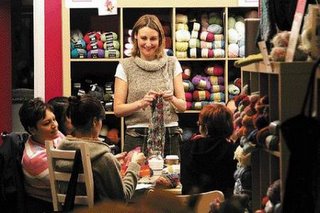
and Lisa,

the current owner, for the opportunity to teach there all these years.
The Naked Sheep gave me my big break - it was the first shop I taught at. The Naked Sheep introduced me to Noro. The Naked Sheep allowed me to mingle with so many wonderful people. I will miss my classes there, and my Sunday morning gang, and the excellent team who worked there.
It's thanks to the Sheep that I am the knitter and teacher and designer I am. Without the Sheep, I'd still be stuck in a cubicle somewhere in IT-land, wishing I could knit during conference calls.
The Sheep was one of the first of the current generation of knitting shops in Toronto - shops that appeal to newer knitters, to a younger crowd. In the 1990s in Toronto many of the knitting shops closed down, and only a few hardy stores remained. When she opened in 2004, Lorena had a store that appealed not only to established knitters, but also created an environment that lured in younger non-knitters. The Sheep's beginner classes and Wednesday knit nights remained amazingly popular all throughout the life of the store. When Lisa purchased the store, her enthusiasm and energy took the store to a new level and she did an amazing job of running it while holding down a full-time job and being a mother to two very active kids.
Many, many knitters in Toronto are knitters because of the Sheep.
All I can say is thank you.

This wonderful little yarn shop in Toronto's Beaches district is closing this month, and I'm sad to see it go.
I am so very grateful to both Lorena, the original owner,
and Lisa,
the current owner, for the opportunity to teach there all these years.
The Naked Sheep gave me my big break - it was the first shop I taught at. The Naked Sheep introduced me to Noro. The Naked Sheep allowed me to mingle with so many wonderful people. I will miss my classes there, and my Sunday morning gang, and the excellent team who worked there.
It's thanks to the Sheep that I am the knitter and teacher and designer I am. Without the Sheep, I'd still be stuck in a cubicle somewhere in IT-land, wishing I could knit during conference calls.
The Sheep was one of the first of the current generation of knitting shops in Toronto - shops that appeal to newer knitters, to a younger crowd. In the 1990s in Toronto many of the knitting shops closed down, and only a few hardy stores remained. When she opened in 2004, Lorena had a store that appealed not only to established knitters, but also created an environment that lured in younger non-knitters. The Sheep's beginner classes and Wednesday knit nights remained amazingly popular all throughout the life of the store. When Lisa purchased the store, her enthusiasm and energy took the store to a new level and she did an amazing job of running it while holding down a full-time job and being a mother to two very active kids.
Many, many knitters in Toronto are knitters because of the Sheep.
All I can say is thank you.
Subscribe to:
Posts (Atom)


