Saturday, August 17, 2013

Following up: On Working Two at Once

Following up on my previous post, answering a reader question about working my Basic Ribbed Sock two at a time on two circulars... Part one of the discussion is here.

As with working on two circulars, I've also written on the topic of working two socks at the same time, in the Summer 2013 issue of Sockupied.

Here's a quick summary of the process: The two socks sit side-by-side on two circular needles.


(My usual stellar photography...)

And you work as follows: across the first half of the first sock (green in the photo), across the first half of the second sock (white in the photo), across the second half of the second sock (white in the photo), across the second half of the first sock (green in the photo).

As labelled:


So once you're cast on, it's simple! No pattern mods required. Just keep track of which side you're on. I tend to use removeable stitch markers or safety pins to keep track of which sock is which - a green marker on the first sock, an orange marker on the second.

(As for casting on, I usually cast them on separately and slip them to two needles in the setup above. 

Turning the heel is easy: work them one at a time! Really! 

I do know knitters who separate the socks for turning the heel and picking up the gusset stitches.  That can make it easier to visualize and set up.

The only tricky bit is the gusset pick up: it has to be done in two steps. With the first needle, finish the heel on the first sock, and pick up the sts on the first side of the heel. Then turn the heel on the second sock, and with that same needle pick up the heel on the first side of the second sock. Then with the second needle, work across the instep of the second sock, then the first.  Then back to the first needle, and pick up the second half of the gusset on the first sock, work across the rest of the sole. And lastly, with that same needle, pick up the second half of the gusset on the second sock, and work across the rest of the sock.

It seems odd at first, but if you think through it, it's actually pretty logical. It's exactly how you do it for a single sock: first side of gusset pickup, work across instep sts, then second side of gusset sts. It's all about keeping the sole stitches grouped together on one needle, and the instep sts grouped together on the other.

And then once that's done, it's easy!


Friday, August 16, 2013

Reader Mail; On questions in comments; converting a sock pattern to Two Circulars Two-at-a-Time

A bit of housekeeping: I've had a few comments with questions of late. I can't always email you back - depending on how you logged in to leave the comment.

In particular, two very good questions:

On my post about avoiding holes in top-down sock gussets - I've been asked if there's a video. YES!  I did a quick video for Interweave - you can download it here.

And on the February Lady Sock, a reader is seeking some help. I always love helping out sock knitters, and you can always email me at kate at wisehildaknits dot com with specific questions. You can also email me through the Contact form at my website kateatherley.com. If you've not knit a sock before, I highly recommend starting with my top-down training sock pattern.  If you've got a specific question, let me know!


And then a reader has left a comment asking about converting my Basic Ribbed Sock to two-at-a-time, on two circulars. I'm going to tackle that question in two steps: first, on working a sock on two circulars.

With the exception of the aforementioned Training sock pattern (and its toe-up counterpart), I write all my sock patterns to be needle-agnostic. That is, the instructions are written so that you can use DPNs, magic loop or two circular needles - or even those teeny-tiny little 8 or 9 inch long cicular needles. I've written on this before, so please excuse any possible repetition. Ultimately, the needles you use for working small circumference pieces like socks is entirely a personal choice. There's actually no difference in the process, no matter which needles you're using.

The analogy is give is that it's like writing - I don't mind which hand you hold your pen in, and how your wrap your fingers around it - the result is still the same.

Now, writing patterns this way does assume some knowledge on the pattern of the knitter... that the knitter has a sense of how to distribute the stitches across the needle configuration of choice for ease of working, but since socks generally aren't a beginner's project, I feel that's a safe assumption. I've written on this in detail, in KnitEdge magazine - issue two.

That having been said, the original Basic Ribbed Sock pattern was written many years ago, and I believe it did refer specifically to DPNs - I think that's all I knew at the time. I've since revised and updated it - with multiple sizes, and with non-needle-specific instructions. You can get that newer version on Ravelry here.

As to working two at a time... Well, it's an interesting question. If I was feeling glib, I'd say that once you've worked a few pairs that way, then it becomes obvious. But that's not entirely fair...   I'll finish this in a second post in the next day or two - stay tuned!


Friday, July 26, 2013

New Sock Design: Cross My Path

It's no secret I love Noro. And I love socks. And I adore cabled socks. And I feel a particular passion for interesting socks... you know, the sorts of patterns that have different right and left legs.

I'm also rather fond of the colors orange, grey and black.

So, really, this was meant to be:


Cross My Path. Worked in Silk Garden Sock, colour 349.

Top down. As usual, the pattern is written for multiple sizes, and can be worked on your choice of DPNs, magic loop or 2 circulars. Suitable for knitters with a cable knitting experience, the patterns are charted.

Has all my favourite details - different left and right, a patterned heel and toe. Some nice cabling down one side, not too difficult, but just enough to keep the knitting engaging.

Two notes on the yarn: To keep the color run neat down the front of the foot, I pulled from the center of the ball for the heel. The color runs in the Silk Garden sock are long enough that you can make a (just about) perfectly matched pair. If you're so inclined.

And also note that this yarn is a little heavier than a standard fingering weight, so if you're making a substitution, keep that in mind. Really, why wouldn't you use the Silk Garden Sock, if you're not allergic to it? Not judging your choices or anything, but it's rather lovely stuff. Great colors, and warm!

Pattern available for purchase from Ravelry and (soon!) Patternfish, $5.

Once again, thanks to Claude La Rue for the photography, and to Ruth for the tech editing.

Wednesday, July 24, 2013

On Fit and Alterations: Webinars

A couple of weeks ago I did a live Webinar for Interweave on garment sizing and fit. The session, Knitting Designs with Custom Fit: The Basics of Sizing Knitting Patterns for Garments, was a one-hour live conference call and presentation. I tackled the fundamental questions: how to read and understand the sizing and fit information given in a pattern, and choose the right garment and the right size.

I covered
  • How to choose what size garment to knit using sizing information and other pattern clues to make sure the complete garment fits as intended.
  • Key concepts of ease, fit, and styling to explore what type of garment and size would fit best for your personal style.
  • How to measure yourself properly.
  • Tips for easy garment alterations to make a garment flattering.
  • And more!
I had a great time, and I got some terrific questions from the audience.

It's available through the Interweave store for on-demand viewing, so if you weren't able to attend live, you can watch it on your own time.


Next week, I'm doing a follow up:
Knitting Alterations: Easy Techniques for Knitters of All Skill Levels
This webinar gets into the knitty-gritty (pun intended!) of diagnosing what alterations a pattern need, and how to make them. We do do a little math, but I also talk about strategies for avoiding or minimizing the amount of math you need to do.

It runs July 31st, 1pm EST.

If you attend live, you'll have an opportunity to ask questions. But if you can't make it, you'll be able to purchase it for on-demand viewing at any time. Viewers who attend live will also have access to the on-demand version.

Tuesday, July 02, 2013

A few of my favourite things...


I'm thrilled to announce that the Purple Purl is hosting an evening event with me, July 24th. It will be a combination trunk show/meet and greet/talk/coffee evening. I'll be giving a presentation, sharing my favourite tips and techniques, and then I'll open the floor for questions.

All attendees will receive a gift bag! It's a bag of goodies that include some of my favourite things, knitting tools and accessories, and it will include a brand-new pattern for most favouritest thing of all:  a pair of Cabled Noro socks!


(They're so brand new that the samples are still blocking, drying out in the sunshine on my patio. They're so new, in fact, that I don't have a name for them... any suggestions?)  (The pattern will be available for sale after the event, for those of you who can't attend.)

More info in their newsletter.

Note that if you come wearing one of my designs, not only will I demand to photograph it, but you'll also be entered in a draw for a special prize.


Brenna of Lettuce Knit told me an excellent story... she was visiting a yarn shop in her home state of Minnesota, and she ran into a knitter who told her about the best sock pattern she'd ever encountered...

Turns out? It was mine! My classic Basic Ribbed Sock, which I published WAAAAY back when.

If you don't already have it, you can download for free, here. No Ravelry log in required.


And speaking of socks... recent sock knitting student J. has taken to it with aplomb, and socks have become her favourite thing to knit. (It happens. It's got to the point where I warn people: spend enough time knitting with me and you'll start knitting socks, whether you want to or not.)

I saw her this weekend, and she showed me the most fantastic thing: she's created a cheat sheet for my top down sock pattern, small enough to carry in her knitting bag. This way, she doesn't have to carry the full pattern sheet. She's put clear tape over the instructions, but left checkboxes "untaped" so she can fill them with pencil as she works, and then she can erase them when she starts the next sock.

This makes me so happy!

Monday, June 17, 2013

Garment Sizing and Fit: Two Webinars

Many knitters avoid making garments out of fear... fear about fit. Early in my knitting career, I made several garments - a terrific cabled cardigan, an excellent raglan-sleeved pullover, and a lightweight summer cardigan - and I have never worn any of them.

Why not? Because they don't fit.

There is nothing sadder than a knitter with a sweater that can be worn...

I'm excited to announce that I'm doing two webinars this summer to help you learn from my mistakes, and avoid this awful problem.

The first, "Knitting Designs with Custom Fit", running June 27th at 1-2pm Eastern Time tackles the fundamental questions: how to read and understand the sizing and fit information given in a pattern, and choose the right garment and the right size.

You'll learn:

  • How to choose what size garment to knit using sizing information and other pattern clues to make sure the complete garment fits as intended.
  • Key concepts of ease, fit, and styling to explore what type of garment and size would fit best for your personal style.
  • How to measure yourself properly.
  • Tips for easy garment alterations to make a garment flattering.
  • And more!

You can attend the webinar "live", or if the timing doesn't work for you, that's ok - it's being recorded, and you can register and watch it at your convenience.

More info and registration here!

The second session, "Knitting Alterations: Easy Techniques for Knitters of All Skill Levels", runs July 31st at 1pm Eastern Time. In this, I'll go deeper into pattern alterations with simple adjustments that you can make to ensure the resulting garment is a perfect fit.

You'll learn:
  • How to adjust sleeve length and fit.
  • How to change the body length of any sweater.
  • How to make your garment the most flattering with waist shaping techniques.
  • And more!

More info and registration on that one here!  And again, if you can't attend live, you can watch the recorded event at your convenience.

Friday, June 14, 2013

Knit Along With Me!

We're having a summer-long knitalong for all the Cooperative Press titles over on the Ravelry group starting July 1st!

As long as you're signed up to Ravelry, you can participate. Come join me here.

I'll provide support and answer questions as you go - happy to consult on yarn choices, provide tips for working the patterns, give guidance on techniques. And post pictures of your projects as you go, and share

Cooperative Press has an amazing range of book titles, so now's your chance to explore them! Knit up some quick gifts, pick up some new skills, take it easy, push yourself.

Needless to say, I'd love it if you want to knit along with me on one of my book projects, but I'm just as excited about seeing projects from other books, too. All of the discussion threads can be found here.

All of the e-books are available for download on Ravelry or you can order a print copy with a digital version here.

The best part? There are prizes for participation! Don't you want a prize?

Tuesday, June 11, 2013

New online classes: Fixing Mistakes, and 'Gapless Gussets'

I'm thrilled beyond words to announce the launch of two more video classes.

Fixing Mistakes.

Knowing how to find and fix your mistakes - and when you don't have to - is what makes you a truly empowered knitter. I'll share tips and techniques for finding mistakes, fixing them - and perhaps more importantly - preventing and avoiding them in the first place.

It's available as a video download or a DVD, so you can watch over and over again, as often as you need!

You can see a preview of the Fixing Mistakes class here.


And the second class is Kate's Fantastic and Unbelievably Easy Technique for Avoiding Holes in Top-Down Sock Gussets, also known as "Gapless Gussets". This quickie video share the trick that I've been using for years to make better looking, and better fitting gussets in top-down socks.


Monday, June 10, 2013

Very red-faced.

In addition to being a knitter, designer and teacher, I am a technical editor. I edit other designer's patterns, with the objective of ensuring that the patterns are accurate, easy to follow, and that they produce the results intended.

So it was a huge humbling moment for me when I had an email from a knitter last week informing me that there were a couple of mistakes in the numbers in one of the patterns I hand out in my classes. She was completely right, and I was completely mortified.

I'd been using this pattern for years, and it was good. But then I decided to get clever: about a year ago, I added to it an extra size that I'd developed for my second book, and in doing that, I made a 'simple' typing error - 28 instead of 38. I didn't have the pattern re-edited, because it was such a simple change. But it doesn't matter how simple it is, if it's not right!

I connected again this weekend with another student who'd taken my class, and she said that she assumed the problem was with her, and so she'd had to abandon the pattern. I know that when something goes wrong in pattern, I tend to assume it's me - as did this particular knitter. She couldn't figure it out, so she'd found another pattern and started again.

I'm glad I was able to talk to her: to apologize, to reassure her that it wasn't her, and to provide her with the fixed pattern.

But I also asked her - begged her, in fact - to get in touch with me next time. Yes, sometimes the mistakes are our own causing. I know I've cast on the wrong number of stitches, decreased one too many (or too few times), and lost track of what row I'm on in the pattern. But sometimes the problem is in the pattern. And if it is, as a designer, I want - need - to know, so I can put it right, and make it right for all the knitters who might be struggling.

I'm very sorry to all knitters who've run into problems with this version of the pattern. If you've taken a Top Down Sock class from me in the past year or so, send me an email at kate at wisehildaknits dot com, and I'll send you a new version of the fingering weight version of the pattern.

And if there's ever any question about one of my patterns, don't hesitate to get in touch. I include my email address on my patterns and class hand outs for a reason.


To fix the pattern and get you the fixed version is the least I can do to thank you for spending time and money on me and my work. I owe you that.

And it's not just me - all the designers I know feel the same way: if you see something, say something, so we can make it right.

Thank you!

Monday, May 27, 2013

The Very Definition of Intrepid Knitter

Knitter K. recently took my class on Knitting Two Socks on Two Circulars, just before she left on a cycling vacation.

She wound up two balls of yarn, threw them in her backpack, and got on her bike. She cast on as she started on her trek in the Czech Republic, and as she cycled into Hungary, the heels were done and now she's into the foot.

Love it! I look forward to the follow-up photo, of her wearing the socks on her bike.


Thursday, May 23, 2013

KnitEdge Magazine - My Sock Column

I'm proud to have published my two books with Cooperative Press, the brainchild of KnitGrrl herself, Shannon Okey. Shannon's latest fabulous initiative is Knit Edge magazine. A digital magazine, Knit Edge brings together the best in new and modern design, and columnists on a broad array of topics.

Shannon has been kind... brave?... foolish? enough to give me a column - Wisehilda on Socks.

See a preview of one of my columns here, on the Knit Edge blog...


Shannon's also offering a special discount for subscribers for my readers: $3 off a full year subscription with the coupon code "wisehilda" if you sign up for a year here... Yes, that's right - 3 issues for $11.99, saving you nearly 6 dollars off the per-issue price!

But it's not just about me. Shannon has assembled some great talent to work on the magazine, and designers in the current issue include Brenda Castiel, Elinor Brown and Joelle Hoverson. Designers like Annie Modesitt, Sarah Wilson and Lara Neel have been in previous issues. To see the designs in the new issue, look at Ravelry. Back issue patterns are here.

In the inaugural issue, I talked about how to get started with sock knitting. But I'm not afraid to tackle the controversial topics: In Issue 1, I discussed the whys and wherefores and the pros and cons of toe-up vs. top down. And Issue #2 was all about the various needle configurations - DPNs vs. Magic Loop vs. Two circulars, as you can see in the excerpt above. In the latest issue, I talk about yarns for sock knitting.

Are there topics you'd like to see discussed? Questions you want answered about the world of sock knitting? Bones you want to pick with me...
Yes, that's right, I don't graft the toes of my socks... wanna fight about it?


Tuesday, May 21, 2013

Sea-going Shenanigans with the Cooperative Press team!


It's true! We're going to the Caribbean and we'd love to take you with us. Join CP authors me me me me me!!, the very clever and very talented lace designer Anna Dalvi and the inimitable Shannon Okey for 7 days in the Caribbean next January. Price includes 3 whole days of knitting classes, too -- no hidden fees.

We leave from Miami January 25th, 2014. Can I just point out that that's January... and it doesn't snow in Miami or on a cruise ship in the Caribbean? If it's usually snowing where you usually are in January, you might want to consider joining us...

Click the image above to email Linda of Viva Spain Travel, who is organizing the travel arrangements for this cruise.

Sunday, May 19, 2013

A long weekend, knitter-style...


Sunny patio brunch, with knitting.


Roadtrip, with knitting.

Friday, May 17, 2013

'Magic Socks' Online Class: Learn the War & Peace method in the comfort of your own home!

I'm thrilled to announce the launch of my first online video class - "Magic Socks" with Annie's. This sock teaches you the secrets of working two socks at once, using the double knitting method, also known as the "War and Peace" method. It's so-called, is it's mentioned - somewhat oddly, in passing - in his masterwork novel, War and Peace.


If you've ever wanted to learn the War and Peace method of making 2 socks at once, but were a little intimidated - this class is for you!

If you've ever wanted to take one of my classes in person but haven't been able to - this class is for you!

If you want to be able to rewatch my lessons over and over again - this class is for you!

Join me as I explain and demonstrate this seemingly magical technique step-by-step using two different colours of yarn so you can see exactly how to knit each separate sock on the same needles. As is my way, instructions are given for double-point needles, magic loop and 2 circular needles.

To make the project a little more manageable and accessible for online learning, we're using DK weight yarn, and it's a simplified sock construction, with a short-row heel and a simple star toe. Once you've mastered that, you'll be ready to tackle other versions, including the full-on fingering-weight gusseted-heel directional-decreases version!

This was my first experience doing a video class, and it was an enormous amount of fun. It was definitely challenging at times... where am I supposed to look? what was I saying? is there more coffee?... but I dearly love teaching, and I'm so happy that my classes can reach a broader audience.

The class is $24.95, and you can watch a free preview of the class at the website.

Thursday, May 16, 2013

New Design: Asking for Flowers


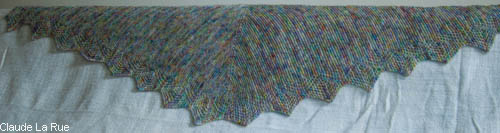
A sideways shawl with biasing garter stitch makes for a beautiful drape, and a dramatic Shetland lace edging adds interest to the knitting – but not too much – and to the finished product. Short-row wedges create a nice curved shape.

I used Rhichard Devrieze's wonderful hand-dyed 100% merino fingering weight yarn. The colourway, “The Flowers” brings to mind all the joys of a summer garden – wear the shawl in the spring, to hasten the arrival of the season, and in the winter, to remind you of the glories to come.

Suitable for knitters with a little lace experience, but you don’t need to be an expert!


Uses a bit less than 3 skeins of the yarn - about 550yds - and the finished item is 62 inches wide, and 20 inches deep.

More info on Ravelry, or

Also available on Patternfish.

Thanks much to Claude La Rue for the terrific photography!

Monday, May 13, 2013

New Design Coming Soon: Asking for Flowers


Thanks to Claude LaRue for the photography.

Tuesday, May 07, 2013

On Magic Loop and Two Circulars

If you've taken a sock knitting class with me, you've likely heard this "mini rant" from me before.

Although I learned to knit socks on DPNs, and that remains my needle configuration of choice, I recognize that there are other ways to do it: Magic Loop and Two Circulars. I recently wrote a blog post for my friends at Signature Needle on precisely that topic... using circular needles to work small circumferences in the round.

Some knitters aren't comfortable with DPNs, and in some situations, DPNs aren't ideal. If you're travelling, for example, you really don't want to be in position to lose a needle.

Magic Looping a sock

I feel pretty strongly that although which method you use is a point of personal preference, there is no difference in the methods. It's like whether you hold your pen in your right or left hand. What results is still words on paper, so why should we worry about the difference in how you get it done?

With different needles, you still get socks (or mittens, or the tops of hats, or sleeves, or what-have-you), so it shouldn't matter what needles you use.

This informs a key piece of my pattern writing and editing strategy... I believe that where possible, patterns should be "needle agnostic". We don't distinguish if you're working flat on straights or circulars, so why should we distinguish if you're working on DPNs or magic loop or two circulars?

But it's amazing how many patterns - indeed, I think most of them - still distinguish. But I believe pretty strongly that you're cutting off a piece of your market that way. If a pattern is written for DPNs, a magic looper might not be able (or want) to do the work to think through how to make it work 'their way'... I've seen DPN-knitters avoid a DPN pattern because it uses five rather than the four they're used to. This saddens me - I want everyone to be able to knit everything!

I do absolutely recognize that your first sock (or mitten, or whatever) pattern needs information on how to arrange the stitches, just to get you familiar with the process and structure. But once you've done one or two, then you should be able to work however you want, without being constrained by how the designer did it.

Call me an idealist, but if I ran the world, knitters could use whatever needles they want, and the patterns would allow that!

Thursday, May 02, 2013

The DKC Frolic; Fantastic?

As always, it's such a good time. The event is a major highlight of the year for me, and not just because it's at the start of the summer.... but because of the shopping and the classes and the people.

I was pretty busy this year, with four fun classes.

I ended the weekend with a gang of intrepid knitters, teaching the War and Peace socks. I love this class, as it's a fabulous challenge and fun experience - not nearly as hard as it seems, and at the same time much more fun and much cooler.


As for shopping, I didn't have a ton of time, but I did manage to add to my book collection. As a designer, I love stitch libraries for inspiration, and I picked up another Japanese stitch libraryfrom Marsha at the Needle Arts Book Shop. I also got a booklet of wonderful vintage lace designs.


But the highlights came from Kim and Ron of indigodragonfly - not only my own colourway! - but also this GENIUS button, destined to be loved and worn by knitting designers and teachers everywhere.

It stands for "Knit a fantastic gauge swatch". Or perhaps "Knit a fair-sized gauge swatch". Or whatever "f" word you might wish to substitute....

Wednesday, May 01, 2013

I've Made It! I've Made It!

Lovely readers, do you know indigodragonfly yarns?

Kim and Ron, the geniuses behind the company, are known for their beautiful yarns, their fantastic colours - but perhaps most of all, they are known for their hilarious, bizarre and yet always apt colour names.

Their names are often inspired by pop culture - there's a Buffy series, a Firefly series, a High Fidelity series - and sometimes just by ridiculous things people say.

And I'm proud to announce that I am one of those people that has said ridiculous things... a ridiculous thing that gets it own yarn!

When I did a design for Kim's project club, I carefully wrote up the pattern, and submitted it to her chosen tech editor for review - the eminently sensible Jaya.

I often use a safety pin in my lace projects, as a way to mark the right side of the fabric.

But I often type faster than I think....

So instead of "safety pin" I typed "safety pint".

That in itself is funny enough.

But with me being a relatively well-known tech editor with a passion for precision, and it being a design for Kim's club (where strange things have been known to happen), the typo stopped Jaya in her tracks.

She actually contacted Kim to check whether it was a typo, or whether I actually meant it...

We've been laughing about this ever since.  It's become a short-hand for "beware: this is the sort of pattern that might drive you to drink".

And when Kim was creating new colours for this spring, she and her team created a truly fantastic orange. The sort of orange I adore wearing and knitting. My favourite colour!

And so:

"Safety Pin or Safety Pint: Discuss"