Tuesday, March 26, 2013

Can't blog, am on vacation.

 Lace on a plane!

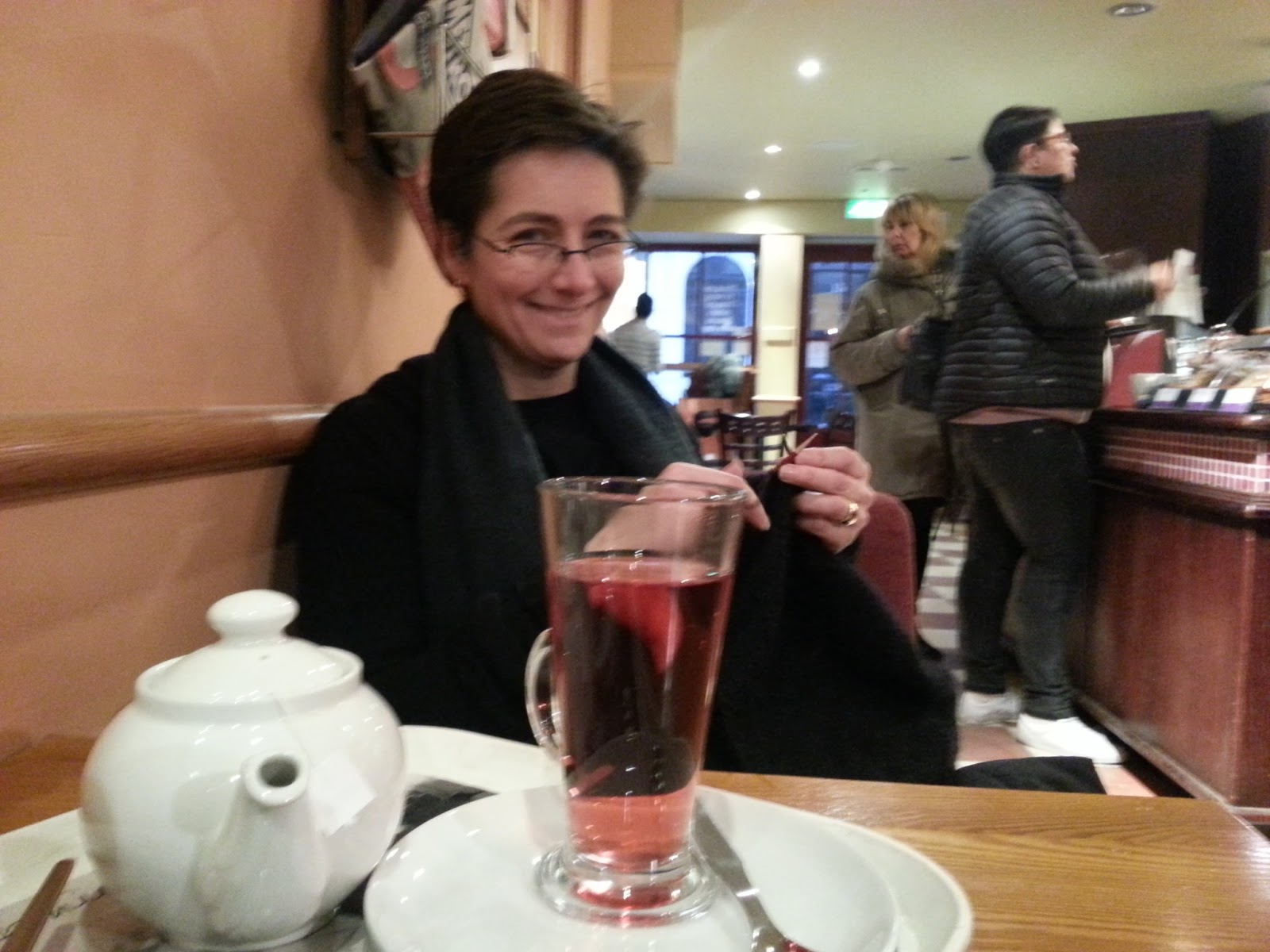
Lace in a coffee shop!

Thursday, March 21, 2013

What Else Would Madame DeFarge Knit?

An excellent question indeed....

image courtesy Wikipedia
Madame Thérèse Defarge is a character in the Dickens book A Tale of Two Cities. She is a knitter, sitting by the gallows with her needles always close, through personal and political upheaval chaos during the French  revolution.

Brilliant designer, teacher, podcaster and all-around clever person and good egg, Heather Ordover, of CraftLit, published What Would Madame DeFarge Knit a couple of years ago. A genius blend of craft and literature, the book provides patterns inspired by great characters and books of literature. It's one of those knitting books that you can keep beside your bed, and read like a novel.

I loved the book when it came out, and was thrilled when Heather asked me to contribute to the second volume, What Else Would Madame DeFarge Knit?


It’s more than just a pattern book — it’s a treasure of links, essays, and designs to entertain your hands AND your mind. In its 200+ pages, you’ll find more than 25 knitting patterns (and one weaving pattern!) designed to delight your inner bibliophile.

There was no question which book, and indeed, which character, I was going to choose... Can you guess?

Book available for preorder here, it's shipping next month.

If you're interested in the book, sign up for the newsletter here. Even if you're not, sign up anyway! Free patterns! Free pattern for a really lovely pair of mittens, which apparently we'll need forever now, because summer is never coming.

Monday, March 18, 2013

On the Road Again: Waterloo Classes and then a Holiday

This weekend I'm loading up my car with Nutella muffins and heading to see my friends at Shall We Knit in Waterloo.

I've got four classes on the slate:
Continental Knitting: Knit faster! Master 2-handed colorwork! Rest your strained hands!
Intro to Lace Knitting: Yarnovers, lifelines and blocking - oh my! Suitable for adventurous newer knitters, or knitters looking to expand their repertoire, I'll introduce you to the joy and wonder of lace knitting. We'll learn how to read and work lace patterns (including charts), and I'll share tips and tricks with you for successfully working lace projects, and producing shawls and scarves you're proud to wear.
Top Down Socks 101: A very good place to start if you've never made socks before. Suitable for knitters who are confident with knit and purl - experience knitting in the round preferred but not mandatory. Also good if you live in the land of the toe-up, and want to broaden your horizons. Adventurous sock knitters like to go both ways, you know!
Fixing Mistakes: Because Knit Happens. Suitable for knitters of all levels - come and learn how to save your work. You'd be amazed about what we can fix without undoing - and if you do have to undo, I'll show you ways to make it painless and safe.

And as a bonus, the very wonderful Kim McBrien of indigodragonfly is going to be there at the same time - she is teaching a few classes, and running a yarn tasting! She'll also have a special pop-up shop with lots of delicious yarns.


And then after that, we're jumping on a plane to the UK for a bit of a holiday, and a wedding. Planned highlights include: the Kaffe Fasset exhibit at the Fashion and Textile Museum, the David Bowie Exhibit at the V&A, and an Argi Bhaji sandwich or three.

Delicious. Seriously.

Monday, March 04, 2013

Awesome Things: Y is for Yarn; Fantastic x 2

I'm beyond thrilled with two things that have come my way recently.

The first is a write up about me and my second book in the Spring/Summer 2013 issue of Vogue Knitting.


 I blush... "followed her fantastic first book... with an equally fantastic second"... Wow.

The second is a postcard sent by my brother T. from the Manchester Art Gallery.


"Y is for Yarn"
To business men in Manchester
The Yarn is daily bread,
They talk of hanks and mules and counts,
And throstle-frames and thread,
As did their grandsires long ago
Who now, of course, are dead.
It's from "Manchester Alphabet", 1906, by Roger Oldham. This book of comic drawings and verse was ostensibly created as a child's alphabet, but clearly was designed for the fun of the adults. The book contained drawings of the then very gritty and industrial city, delicately drawn and coloured, with dry verse to accompany. 

I was born in the environs of Manchester, and my mother's family goes back a long way in the area. My Mum remembers well this industrial past, and the phrase "trouble at' mill" is not just a Monty Python punchline.

More detail on the publication here.

Monday, February 25, 2013

Finished: The Leopard Hat


Subtle? Nope!

But I LOVE IT.

Just the ticket for cheering up the last weeks of winter.

More here.

Saturday, February 23, 2013

Have You Had Lunch? "The Sandwich Theory of Colour Selection"

I made a presentation a couple of weeks ago at the KW Knitter's Guild meeting, on the topic of colour.

Colourwork is a topic that worries people. I get amazingly experienced knitters in my Intro to Colourwork classes.  I always start the class by asking if anyone has tried working with multiple colours in any way, and usually at least half the class has. Indeed, there's usually a couple of people who've made entire Fair Isle sweaters....
"But I'm not sure I'm doing it right." 
Even knitters who've done colourwork in the past feel like they need help, because they want to do it better.

I get it – bad colourwork is an awful experience. It’s not the easiest type of knitting to do, and the results can be either terrible, or just plain disappointing.

The problem is that it’s not just about being able to read a pattern and successfully work the stitches... and that it itself is challenging, when you're trying not to tangle (or to tangle appropriately)...

... but it’s also about TASTE. In that, it's about appropriate colour choices. It always makes me worry: are those good colours? Are they the right colours for me? Does it look good?

And for me, that's where I start to worry. When I gave my talk at the KW Guild, I focused on building confidence. Confidence with the techniques, sure, but perhaps more importantly for me, confidence about choosing colours.

The lovely Annie Bee, member of the KW Guild, (and fellow rescue hound owner), had written about colour theory on the Rock + Purl blog a couple of weeks ago. I thought her post was great, but I know that even using the words "colour theory" still frightened some people.

Annie, thrilled with the great response to her post to the Rock + Purl blog (well deserved, it's terrific) was inspired to start a series of posts about colour on her own blog. And she asked for guest contributors.  Always seeking listeners for my myriad opinions, I leapt at the opportunity.

And so: The Sandwich Theory of Colour Selection. Make sure you're not hungry before you read it.

Monday, February 18, 2013

New personal website!

I've finally properly put together my personal website - kateatherley.com

Go visit! 

You can see my Twitter feed there, get in touch with me, read my blog posts, and see a list of all my upcoming classes and events.


Saturday, February 16, 2013

File under: Crazy

I have a bit of thing for leopard prints.

A couple of weeks ago the lovely Sue brought this pattern to my attention: Stray. It's a stranded colourwork hat, in leopard print. 

I bought the pattern that day, and immediately went stash diving for yarn.

Well, naturally, I didn't have much of a selection of yarn in that gauge, but I did manage to find three skeins of Berroco Ultra Alpaca Light, a yarn I love very much. It's warm, and blocks beautifully, and it has a great little halo I thought would be nice for this design, to suggest a bit of 'furriness'.

The problem, however, was that I didn't have anything like appropriate colours. Oh sure, I had a nice medium brown - but the contrast colour choice was limited. I had a couple of shades of orange. (This should not come as a surprise to anyone who knows me.)

So I did what any sensible knitter would do: I cast on anyway.

So herewith, an orange leopard print hat.


I've been working on it as I've been riding Go Transit this week, and it's been an ideal travel project. It needs a lot of attention, but it's not a big project.


The colours, however, aren't the craziest thing about this project.

It's that it's THREE COLOUR stranded colourwork.  Yes, three colours per round.


It is one of the most fun projects I've ever knitted, but it is a hair, shall we say... 'toothy'...

If you're looking for a challenging and engaging colourwork project... if you're feeling emboldened by my presentation last Tuesday... or if you just need something to do to frighten your other knitter friends... Stray is it!

(P.S. Fab project bag is from Pip N Milly Creations - I adore this design for colourwork as the yarnballs sit neatly side-by-side in the flat bottom, and the clear front means I can more easily keep track of potential tangles.)

Wednesday, February 13, 2013

On Knitting in Public

I had an interesting discussion with a couple of newer knitters last week.

I've been knitting seriously and shamelessly since the mid 1990s. And with that, comes knitting in public. I knit in public all the time - most often when commuting around the city on the TTC.

I used to knit on the TTC every weekday when I still had a day job at rush hour, and on the New York subway when I lived there. Sometimes, the vehicles were a bit crowded, but working on a sock project doesn't need much room.

picture courtesy Brent Gilliard, on a Creative Commons license
Now I use the TTC at least four or five times a week, most often on streetcars.

Streetcars - also known as trams - are, IMHO, the best public transport vehicle for knitting. They have them in various cities around the world, and I've personally ridden them in Toronto, Boston, Stockholm, Helsinki, Portland, OR, and Manchester - all while I'm knitting.

Streetcars are great for knitting because you're most often above ground - natural light! And if what you're knitting doesn't require much attention, there's always something good to look at. Streetcars are significantly steadier and smoother than buses, being on rails. I tend to motion sickness, so this is a huge advantage to me. It's also useful if you're trying to balance a chart on your lap.

The other knitters in the conversation are newer knitters, and have taken up transit-knitting only recently. They were telling me that they feel that knitting on the TTC draws attention - that they get stared at.

I've had the odd odd exchange with an interested fellow passenger, it's true, but I think that I've been knitting on public transport for so long that not only do I not notice whether people are paying attention to me (usually because I'm paying attention my knitting), but I'm not even sure I remember how people reacted to me when I wasn't knitting. I can't remember the last time I was on/in any kind of vehicle without knitting...

I'm riding trains a few times this week - Tuesday heading to Kitchener Waterloo to speak to my friends at the Guild today, and Saturday off to Spun in Burlington. You know I'll be knitting up a storm the entire way.

Do you get stared at when you knit in public? Do you notice?

Sunday, February 10, 2013

Mod Squad Mods

It's always a thrill to see an FO from one of my patterns; even more of a thrill when someone takes the idea and runs with it.

Long-time friend and knitter W. was intrigued by the slip stitch colourwork technique in my Mod Squad hat, but she was unsure if she wanted to knit a hat. Her daughters have lots of big curly hair, so they like headbands.

So W. made headbands.


These are the second and third.


More are on the needles as we speak. Love it!

W. has used Tanis Fibre Art's Green Label aran weight, worked on 4.5mm needles. The blue is the Cobalt  colour, the purple one is the Grape colour. Both worked with Tanis's natural as the contrast colour.

If you want to make your own headband variant, follow the pattern as written until you've complete 2 repeats of the 12-row pattern, and works Rows 1-6 once more.
Knit 1 round, purl 1 round.
Work a decrease round as follows:
Decrease round, size small only: (K2, k2tog, k3, k2tog, k2, k2tog) 8 times around. 80 sts.
Decrease round, size large only: (K3, k2tog, k2, k2tog, k3, k2tog) 8 times around. 88 sts.
Purl 1 round, knit 1 round.
BO purlwise.

Buy the Mod Squad Pattern - On Ravelry, On Patternfish

Wednesday, January 30, 2013

On Sock Sizing; Idea re: Leg Length

Being a glutton for punishment - or an attention junkie, not sure which - am working on my next book.

This one's about socks. (The first one was going to be about socks, but I got a bit distracted.)

Specifically about custom-fit socks. And I want to make sure I'm addressing the sorts of fit challenges knitters regularly run into.

I'd love your input!

What questions do you have about custom-fitting socks? What fit problems do you encounter with patterns? Are there standard modifications you find yourself having to make?

Leave your questions as a comment - or email me at kate at wisehildaknits dot com. The best 5 questions (for which I have contact info) will get a digital copy of the book when it's released!

I've been digging into sock sizes and looking at patterns, and something occurred to me: sock leg length (for typical calf length socks) seems to be always related to foot circumference. But I'm not sure this is the best way of doing it... wouldn't it make more sense to articulate leg length relative to height/leg length of the wearer? As petite/average/tall? After all, we size socks by foot circumference, and foot circumference isn't always correlated to height of wearer. I know very narrow size 12s who need the same sock circumference as wide size 7s. And those two wearers might not want the same leg length....

What do you think? Am I crazy? Would this make it too complicated?

Tuesday, January 15, 2013

Flu is Yucky; Once I've Recovered...

I've been living life like a cat the last little while: staying indoors, and sleeping 16 hours a day. I know there is debate about the merits of the flu shot, but all I have to say is that flu is nasty. It is, plain and simple, exhaustion. Having a shower requires a 20 minute rest. Walking the dog wiped me out for the afternoon. And let's just say I didn't get a lot of knitting done, let alone any work.

Still, I'm on the mend. And I've got enough energy now to start thinking about my plans for the next few weeks, and I'm excited.


The weekend of January 25th to 27th I'm at Shall We Knit, in Waterloo.
Friday night they are hosting a signing of my new book, Knit Accessories.
And over the weekend I'm teaching four classes:

  • Continental Knitting
  • Entrelac
  • Fearless Finishing
  • War and Peace Socks

More info here.


Sundays February 10, 17, 24 and March 3rd I'm teaching a special session of the Project Class at The Knit Cafe in Toronto.


Saturday February 16th I'm going to be at Spun Fibre Arts in Burlington, teaching two classes, Fearless Finishing and Top Down Socks 101.

More info here.


Saturday February 23rd I'm at The Stash, a newer store in Campbellville, Ontario. Two classes there, Socks 102 and Lace 102. More info here.


And then there's the Vancouver Retreat, and stay tuned for some other announcements in the near future.

And of course, there is my regular teaching schedule at Lettuce Knit and The Purple Purl.

Sunday, January 06, 2013

New Designs: 2 Skeins, 2 Hats

I have an on-again, off-again relationship with colorwork. When I was a newer knitter, I relished in the design possibilities of using multiple colors in my work. I striped things; I put polka dots on things; I made abstract geometric patterns. I think it pleases my mathematical mind.


But then as I got more experienced, I started working patterns in other ways: lace and cables, mostly. And for years I worked only in one colour.

Inspired by the work in my own book, I've been revisiting colorwork of late. First there were the Campbell Glen Fingerless Mitts.

And then I developed a Fair Isle hat design as an idea for a new class. This is a classic Fair Isle pattern: 2 color corrugated ribbing (which I adore), and a couple of very traditional yet straightforward stitch patterns combined to great effect.

The Cherry Fizz Hat


I'm very pleased with how the crown decreases look on this one.


And then sparked by a question from a student, I started playing with Mosaic knitting.

If you haven't tried Mosaic knitting, or are simply nervous about colourwork, then I encourage you to give it a go! It's an excellent cheat - I mean, alternative - for Fair Isle, in that you only work a single color in a given round. The stitches of the second color are slipped. Two rounds are worked knitting the MC and slipping the CC, and then two rounds are worked slipping the MC and knitting the CC. Four pattern rounds equals 2 complete rounds in each color. Barbara Walker is the queen of Mosaic Knitting, and this stitch pattern comes from one of her treasuries. Its unusual in that it's worked in stockinette stitch; most Mosaic patterns are at least partially garter stitch. I adore this particular stitch pattern for two reasons: in stockinette it really does feel like cheater's Fair Isle, and it's just so very mod.

And so, The Mod Squad Mosaic Hat


Sized for adults - small and large sizes. And both patterns include a tutorial for working that particular colorwork technique, and tips for working from charts and blocking. Mod Squad has instructions both written and charted; Cherry Fizz is charted only.

Either pattern can be worked from one skein each of two colours of Cascade 220... in fact, one skein of each is enough for both hats!

Cherry Fizz Pattern - On Ravelry, On Patternfish

Mod Squad Pattern - On Ravelry, On Patternfish


Saturday, January 05, 2013

The Finished Shawl

Very happy with it!


It's about 70 inches in wingspan, 35 inches deep. I wanted a bigger shawl, I definitely got a bigger shawl!
 

(Still trying to figure out how to rotate this pic...)

Wednesday, January 02, 2013

We're going to need a bigger mat.

I adore my Wings of the Pigeon shawl, and I wear it a lot. It's modestly sized, and just perfect for wearing with a dress when it's cool indoors, or with a light coat.

But as the weather inevitably turns arctic, I enjoy a larger shawl. The original is made from a single ball of Zauberball, and it's about 42 inches across.

When I was at The Needle Emporium last year I picked up two balls of Marks and Kattens Fame Trend yarn, in the "Party" colorway. The yarn is pretty much identical to the Zauberball - it's a slightly fuzzy 75% wool/ 25% nylon blend single, with very long stretches of color. It's ostensibly a sock yarn, but I think it's a bit too fine and certainly too fragile for socks.

The "Party" colorway is like my beloved Noro Kureyon 242, but without the green, and I thought it would be perfect for a larger, shawl. It will go with everything in my wardrobe, and be a real statement piece.

I've been working on the shawl on and off over the past year, and decided for my break between Christmas and New Year that I would try to finish it.

I did some math to see how much larger I thought I could make the shawl with a second ball -I reckoned that if the first one gets me about 140 rows, accommodating the ever-growing stitch count a second ball could get me about 60 rows. So I've been working away. The rows get longer as the piece gets bigger, and I started to try to figure out how long it was going to take me to finish the second ball... about 16 hours, I expected.

So I do what all obsessed knitters on a deadline do (don't we??): set a daily objective. The morning of New Years' Day, after good three hours of knitting into the second ball, I decided to weigh it. I had 112gms left. Of a 100gm ball.

I shook my head, blamed in on the hangover, and weighed it again. Yup. 112 gms left. So not only do I have a second ball of the yarn to use, it's significantly larger than expected. Exciting, I thought! A much larger shawl!

I thought I should check my progress against the original. You know what's it like when you're working a large small on a not-very-long circular needle - it's all bunched up and you don't get a sense of the size.

So I dug out the original, and laid them out together.

In addition to having significantly more yardage than I expected, my gauge is looser in this yarn - I actually think it's a bit thicker than the Zauberball.

I decided to keep going. New Year's Day is a quiet day on the couch here, and so I got a good five hours knitting done.

The original plan had been to work until I'd use the second ball. Realizing that I probably wouldn't find the time I needed to finish the second ball, the slightly revised plan was to work until the end of my Christmas break, the end of this weekend, and then call it done.

After looking at it this morning, I think it's done. (The new one is laid out, not even faintly stretched. Wingspan will be about 55 inches after blocking, I expect.)


Can't quite get the colours to read true in this light but this should give you a good idea of the patterning.  I can't wait to wear it!


Friday, December 14, 2012

History on Two Needles - Mine and Annie's

I had the distinct pleasure this summer and fall of working with Annie Modesitt on her new book, History on Two Needles.

Please forgive me if what is supposed to be a book review turns into a blog post about me...

I've been a serious knitter since the mid 1990s, in my early years as a knitter, resources available were scarce. There were few magazines, few books being published, and those books that were in print were hard to find.

I don't remember where I heard about Annie Modesitt - likely on the KnitList. I had read about Annie's self-published book "Confessions of a Knitting Heretic" and I knew I had to own it. I treasure my copy, and have only ever let it out of my house once - to a very special friend/private student H., who hails from Iran, and needed some emotional (rather than technical) support as a combination knitter.

I loved both Annie's clear and pragmatic approach to knitting, and her personal stories about her knitting experience. Annie made me feel like a clever and informed knitter.

Her approach suited my needs perfectly: she likes to explain the how and why, rather than just give blanket instructions without context. This is how I teach my classes, and I have carried over this approach into my own books.

I am a better knitter and teacher because of Annie.

I nearly fell off my chair this summer when Shannon asked me if I'd be interested in tech editing Annie's upcoming book.

I must confess, I was a little intimidated. Annie's work is of such great intelligence and creativity that I was worried I wouldn't be able to understand it. Her style is so distinctive that I was worried that I would ruin it. And her work is so wonderfully detailed and meticulous that I was afraid I'd make stupid mistakes.

However, the chance to to get an advanced peek at her work: I couldn't possibly say no. This new book has been in development for some time. It's an ambitious project: a set of garment and accessories inspired by historical images, blending Annie's love of art, history and art history - and the preview pictures had blown me away.

The process of working with Annie was wonderful. I loved that we could have discussions about what knowledge was safe to assume her knitters had; it was great to be able to use the mount-independent notation I'd been obsessed with since I'd seen it in her original book (k2tog-L and k2tog-R); I relished the challenge of complex patterns and constructions.

And once I got over the "surely I can't have found a mistake in Annie's work, it must be *me*" factor, it was an easy process, too. Annie was a very willing subject for my reviews, always happy to check her math when I suggested that something might not work, always open to my suggestions about clarification. And along the way, I learned a lot.

There's a huge variety of items in the book, drawing inspiration from art ancient and modern. Although all the projects are fabulous, I have two particular favourites.

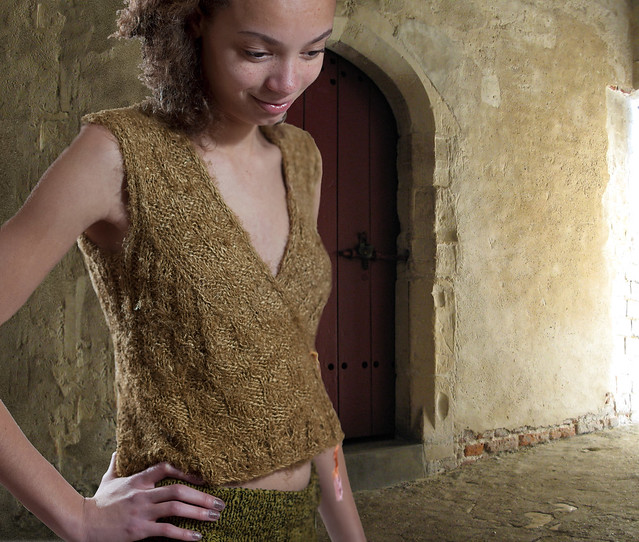
As a knitter, I adore the  Minoan Surplice: it's simple, it's elegant, and so utterly modern.


I'm hoping to get time to make my own over the Christmas break.

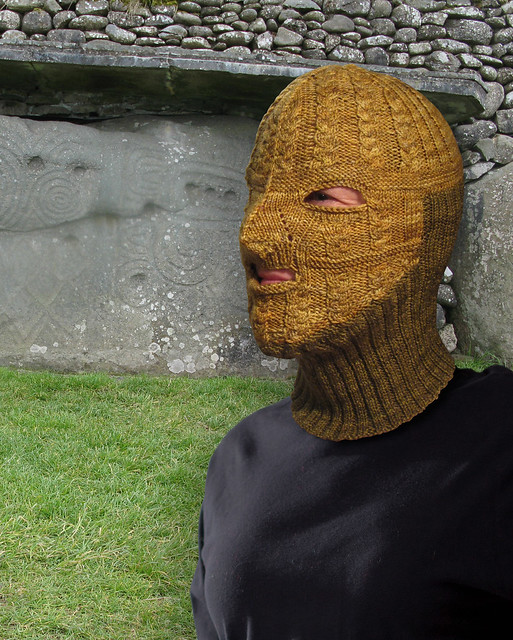
And the other end, as a designer and an editor, I am in awe over the Sutton Hoo Helm. It's a masterwork of construction, absolutely fascinating piece.


(And if the weather is going to be as bad this winter as they say it is, I might have to knit one of these too.)

What I love most about the book - even more than the thrill of seeing my name in the acknowledgements list! and it is a big thrill! - is that Annie's love of the history comes through loud and clear. She has given a history and context for all of the items, with details on her inspiration.

It was an honour to be part of the process and I can't wait to wear my own Modesitt original.

Wednesday, November 28, 2012

Upcoming Weekend Classes

Sunday December 2nd I'm making a special appearance at the Knit Cafe in Toronto to teach an Introduction to Colourwork class. Fancy making my Campbell Glen mittens? Or ready for a curling sweater? Come and join me!

The class is suitable for knitters of any level who want to experiment with colourwork. All you need is to be confident with knitting and purling.

Details here.


And the weekend after, Saturday December 8th, I'm at the Needle Emporium in Ancaster with the lovely Julie and Beth for two classes: Fixing Mistakes and Toe-up Socks.

Fixing Mistakes: Suitable for knitters of all experience levels, I talk about how to deal with mistakes of all kinds - when and how to fix 'em, and when you don't need to! Bring any mistakes you might have. (Not to imply you make mistakes, not at all... )

Toe Up Socks: This is an ideal next step in your sock knitting adventures. Suited to intermediate knitters, or knitters who have experience with top-down socks.

Info here.

Monday, November 26, 2012

"Unlike most knitters do"; on Slipping


I've been having a fascinating conversation with a knitter on Ravelry. My correspondent, the clever Patty-Joy, left a comment on my Bigger on the Inside pattern, suggesting a correction to the pattern.

I quote her comment here (emphasis hers):

"Another urgently needed pattern update is to indicate at the very start of the pattern that, unlike most knitters do, you must not slip the first stitch as if you do you won’t have nearly enough stitches to pick up the Tardis section."
This surprised me enormously, I'll be honest.The section of the pattern she's referring to is charted, and there isn't a single slipped st in the chart. The first st of every row is worked in stocking stitch.  I wouldn’t have thought, when writing the pattern, that I needed to make a note to not slip, since the instruction is specifically to knit (or purl) the stitch. And nowhere anywhere do I talk about slipping stitches.

What struck me was that Patty-Joy was suggesting, effectively, that knitters routinely ignore my chart...

Now, as a teacher and long-standing knitter, I'm well aware that there is a school of thought that you are to slip the first stitch of every row. But I didn't think that it was that common in practice.

As a designer, I only expect knitters to slip a stitch when I tell them to. And as a teacher, I tell knitters to only slip when the designer tells them to.(In general, IMHO, slipping the first stitch is only helpful or desirable in two situations: if the edges of the piece are going to be exposed, a slipped-stitch selvedge creates a nice edge; and in the heel of a top-down sock, slipping the first stitch of every row is used to help knitters figure out where to pick up stitches. It most other situations, it makes your life more difficult: I find it makes seaming harder, and it reduces the places to pick up stitches - applicable in this situation.) So yes, Patty-Joy's statement surprised me. It surprises me that knitters do slip that stitch in the face of instructions that tell them specifically to knit (or purl) it. Which causes me to wonder how many people do, as a matter of course, slip that first stitch? Do you?

Tuesday, November 20, 2012

Knit Accessories: Essentials & Variations


Another book already? I know! 

I've been teaching knitting for a while now, and I've worked on and off in yarn shops, and the question I hear so often is "I need a good basic hat/mitt/sock pattern". I hear this from newer knitters, who are looking to make their first hat/mitts/socks, but also from more experienced knitters who are looking for a set or reliable basics that they can use over and over again.

Every knitter needs a set of go-to accessory patterns: hats, scarves, cowls, socks and mittens. These are the patterns that we turn to every winter to make holiday gifts. These are the patterns a knitter relies upon when looking for a quick and easy knit, or a plain sock to work in a self-patterning yarn, or when the weather turns cold and the family needs hats.

KNIT ACCESSORIES: ESSENTIALS AND VARIATIONS is a 64-page booklet collecting these basics and providing a jumping-off point for knitters to create their own unique accessories.

Beginner-friendly and approachable, it’s designed to be a knitter’s first book of patterns, featuring clearly written patterns for easy-to-knit (but still useful) projects that help build confidence and skills.

And it’s not just for beginners! KNIT ACCESSORIES: ESSENTIALS AND VARIATIONS offers more experienced knitters a solid set of master templates to use over and over, with suggestions for altering and customization.

The Patterns
Simple and classic designs... scarves , cowls, hats, mitts and socks
... in a range of sizes... youth small to adult XL
... in two gauges each.... for flexibility without overwhelming


With recipes, ideas and tips for customizing
• suggestions for stitch patterns
• ways to customize with color
And for scarves and cowls, a table of yardage/gauge/finished sizes.

And It’s Not Just a Pattern Book
Mini tutorials to help newer knitters build confidence:
• how (and why) to check gauge for the patterns; and when not to
• tips for working in the round on both circulars and DPNs
• help with tricky spots, e.g.: closing up the hole at the base of a mitten thumb, picking up gusset stitches in top-down socks.
Tips and tricks for knitters of all levels:
• guidance on yarn substitutions – what makes a yarn good for a given application? (e.g. pilliness, washability, softness); recommendations for non-wool alternatives.
• suggestions for gift knitting – how to choose colors, sneaky ways to get sizing info, and what to make if you have no idea of size.

You can buy the book - either physical or digital versions (or both!) - online here, the digital version through Ravelry here. Soon to be available on Patternfish, too.


Sunday, November 18, 2012

Interview on Leanne Dyck's Blog

Earlier this fall I struck up a fab email conversation with author and fellow knitter Leanne Dyck, author of the book "The Sweater Curse". Her book is a knitting-themed mystery - how could I NOT enjoy talking to her?

She's published an interview with me on her blog...  in which I confess I can't actually remember which was my first published pattern. This either means that I've published so many that I've lost track or (more likely) just that my memory is going.