Wednesday, August 17, 2011

Free Peppermint Twist Sock Pattern: Brought to you by Soak


As I mentioned last year, I collaborated with the lovely people of Soak on a fun project. They needed some socks for the labels of their terrific Heel foot cream, and I have some socks... so they borrowed them, and took some photographs.

Heel has been a terrific success for my friends - and it never fails to make me smile to see pictures of my socks in all the yarn stores I visit!

As part of a fall promotion, Soak and Vogue Knitting have published the pattern for the sock featured on the label for my favourite scent of the Heel, the minty scented one: my Peppermint Twist socks.

Free! Download here!

Thursday, August 11, 2011

Nancy Bush & Folk Socks: My brush with greatness

It's amazing how long it takes to regain your equilibrium after something as monumental as Sock Summit. Or perhaps I shouldn't be amazed... after all, it was pretty wonderful.

(It may also have been all the coffee I drank.)

I promise I'll stop blathering on about it, but wow: I got to enjoy half an hour over a beer and some sock knitting with Ann Budd and Nancy Bush, the two women I credit for me being a sock knitter at all, let alone being a professional in the industry. I just hoped they weren't judging my technique.

Nancy Bush wrote the seminal Folk Socks. This book is the reason I knit socks.

In addition to a collection of attractive and interesting designs, the book contains a history of sock knitting, and a fairly detailed technical analysis of sock construction, including all sorts of heels and toes. It's a book I keep going back to as a reference, and as eye candy. I bought the first edition shortly after it was published in 1994. (I think people think I'm exaggerating when I say I've been knitting socks for 15 years. I'm not, honestly. I bought my first yarn for socks from a store that closed in 1996.)

I watched another instructor approach Nancy at the teachers' dinner at Sock Summit and ask her to autograph a very dog-eared copy of the book... my first thought was "why didn't I think to bring my copy", and the second was "wow, hers is as well-loved as mine". Nancy herself remarked that she's seen (and been asked to sign) many very well-used copies.

The best news is that book is being updated and reissued this fall, and I can't wait to see it.

(What I didn't want to say to Nancy is that no matter how much I love her book, she is also somewhat responsible for my obsession with sock and feet sizes. All the patterns in her book are in one size, and as I worked through the book, it became somewhat of a frustration to me, as a non-average-footed knitter. Don't let this stop you from buying the book, though. It's a masterpiece.)


Saturday, July 30, 2011

Sock Summit Day 4: Photos, photos, photos

I had the distinct pleasure today of taking Franklin Habit's famous and wonderful "Shooting Yourself in the Foot" class... oh no, wait... that's "Photographing your Fibre". But he did spend a few minutes on photographing your socks on your own feet.

Any of my friends (and readers of my blog) will know that I'm desperately in need of improvement in the area of photography.

So I spent the day playing with my camera...


Things We Learned at Sock Summit Day 2

I am a pick up artist. I did a demo on the show floor today about how and where to best pick up stitches for the gusset. Just one "aha" from the audience would have been enough, but I had a couple. Yay!

It is possible to go to the Oregon Brewer's Festival and still successfully take one of my classes. And not just any class - my War & Peace Two Socks One Inside the Other Class. You know who you are... Seriously, girl, you got chutzpah and mad skillz. I also love that the beer festival has a craft table, where you make pretzel necklaces.

And Knitgrrl scares hipsters. Dinner at Doug Fir restaurant, surrounded by pale, tattooed young men with sideburns.

It's been a busy day.

Friday, July 29, 2011

Sock Summit Day 2: Teaching & Bacon

Honoured to be here.


You know, here, in Portland, at Sock Summit.


Portland is a town that loves bacon. They have bacon donuts, bacon ice cream and bacon yarn!


So far, only one skein of yarn purchased - a jaunty orange and black stripy number from The Amy Lee Show.


How absolutely perfectly me is this? Cannot wait to knit it!

Wednesday, July 27, 2011

Tuesday, July 26, 2011

Because Size Matters: Foot Size Survey


I've been talking a lot about sock sizing of late.

When sizing socks, foot circumference is the key measurement. For the vast majority of sock designs, the length of the foot is controlled simply by working fewer or more rounds in that section- totally independent of the number of stitches you cast on.

When sizing shoes, foot length is the primary measurement. This means that all of the information out there in the world about foot size is focused on foot length.

Since foot length is remarkably unrelated to foot circumference - small feet can be wide, long feet can be narrow - telling me your shoe size tells me very little about how big your socks should be. A lot of the time, when designers are creating socks, we're guessing about how they should be sized.

With help from my friends and collaborators at Sock Summit, Knitty and Cooperative Press, I'm trying to change this. I'm launching a foot size survey, and I'm hoping you can help us out.

Send email to footsurvey@wisehildaknits.com with the following info:
  • Your shoe size: US or European size & gender (e.g. US Women’s size 8)
  • Your foot length
  • Ankle circumference around the narrowest part of your ankle
  • Foot circumference around the ball of your foot
  • Circumference around your foot at your ankle
  • Diagonal measurement around your heel, from the base of your heel up over the top of your foot
  • Circumference of your calf six inches (15cm) up from the ground

And if you can talk your friends and family into letting you measure their feet, we’d love that info too.

We'll crunch the data and come up with a set of measurements that we will publish here, through knittyblog.com and the Cooperative Press website, for all sock designers to use.

Thank you! Your reward for participation will be better sized sock patterns for everyone - and our eternal gratitude, of course!


Sunday, July 24, 2011

On Matters of Size: Flash Your Stash

I was planning and packing for the Sock Summit trip yesterday. The key consideration for any knitter when planning a trip is what knitting to take.

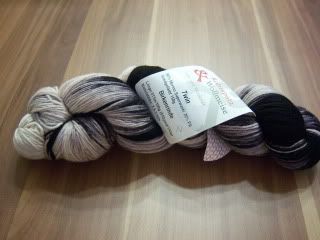
And for Sock Summit, that's doubly important - sure, it's gotta be socks, but it's gotta be cool socks. Cool yarn, and a cool project.I knew that I needed a plain and simple stocking stitch sock, for times when I'd be chatting. That choice was easy - the coolest yarn in my stash is a skein of Wollmeise in Birkenrinde (birch bark) that was purchased at the actual Wollmeise shop (oooh!) by a student of mine. (Thanks Andrea, if you're reading!)


But I also wanted an interesting sock project to show off my chops. I had a stitch pattern in mind, but wasn't sure about the yarn. So I went digging in the stash.

It's fun to rummage through one's own stash once in a while, to remind yourself of what goodies you have. And because I am going to Sock Summit, I figured it was a good idea to see what was what, so I knew what I didn't need to buy... and to see if there was anything I wanted to buy more of.

Now, I've already confessed in public that I keep a spreadsheet with a stash inventory, but I knew that the sock yarn section of inventory had got a little out of date. I therefore took the opportunity to pull it all out, admire it, and list it. And count.

And I 'fessed up on Twitter: not including WIPs and leftovers, I have 43 pairs' worth of socks in yarn.

This caused a little storm on Twitter among some of my very good knitting friends, necessitating the use of the hashtag "#flashusyourstash", naturally.

And so my friends, they also counted. Now, these ladies are all excellent knitters, and keen sock knitters, specifically, and each of them has a close and long-standing relationship with a LYS that has a rather terrific selection of sock yarn.

What I learnt from this exercise is that, apparently, I am a rank amateur when it comes to stashing sock yarn. No-one else had a number less than 100.

I have some serious catching up to do. Hey... I know just where I can get that problem taken care of.

Sock Summit 2011, here I come!

Monday, July 18, 2011

On Sock Sizing, Part I: Choosing Which Size to Knit

I've had some terrific feedback in response to my last few posts - thanks! I'm glad people are finding the training socks helpful.

I promised that I would also tackle the topic of sock sizing... I'm going to divide this up into two: sizing as it relates existing sock patterns, and how to customize.

This will not be news to people who know me well, or have had a sock knitting class with me, but it's true: I have small feet. I wear a US women's size 6 shoe. Now, these feet of mine aren't extremely small; I can still easily find shoes to fit, but they are small enough that sock sizing becomes an issue.

Also well-known about me and just as true: I get very cranky about sock patterns that come in one-size-fits-all. Because it's just not true. One size does not fit all. I've got narrow size 6 feet; a good friend of mine has wide size 11 feet. The idea that the same sock would fit us both equally well is silly: there's a good 20% different in both foot length and circumference between my feet and my friend's. Yes, that's right: 20%. Put into terms that are easy to visualize, that's like expecting the same swimsuit to fit a size 4 and a size 12 equally well. Sure, the fabric stretches, but it won't be comfortable.

So when knitters are asking me for sock pattern recommendations, I tend to point them to sock patterns that come in multiple sizes.

And how to choose which sock size to knit? The first socks I knitted were all too big for me - by the end of the day they had stretched out and would fall off.

The thing is that wool and wool-based sock yarns (which most of them are) have natural elasticity (up to 25% or even more, depending on the breed of sheep!), and with the heat and moisture of your feet, your socks stretch out during the day. To ensure they stay up and on, they need to be made with negative ease. That is, the socks should be smaller than you - about 10 to 15%. Your socks should start the day a little tight - not circulation-constrictingly tight, but snug - so that when they stretch out, they stay on. Think about your commercially-bought socks - they all stretch to fit.

So when choosing a sock pattern, if you're choosing a pattern sized by finished measurements (which I think is a very helpful idea, are you listening, designers?), choose a size that's about 10-15% smaller than your actual ankle/foot circumference. For an adult sock, that's about an inch/2.5cm smaller.

And the same thing applies to foot length, too... I always knit my socks about a quarter to half an inch (a cm) shorter than foot length.

And after a long day of wearing socks, they're still comfortable and they stay on when I take my boots off!

Tuesday, July 12, 2011

Toe-Up vs. Top-Down Socks: Why Two?, Which First?, Which is Better?

In follow up to my last two posts, the toe-up and the top-down training socks, I thought I'd tackle some questions I get asked often.

Of the two methods for knitting socks, top-down vs. toe up: Which should I do first?Which is easier? Which is better?

Which should I do first? I like to recommend new sock knitters start with a top-down sock, for the simple reason that the start is easier.

Which is easier? Hmmm... a tough one to answer. They both have their tricky bits: the toe of a toe-up sock can be fiddly, and the gusset pickup can be challenging for a top-down sock. In either case, don't believe what the muggles says - the heel is not the hardest part, in either case! As long as you have the right number of stitches, and you follow the instructions precisely, the heel is easy! Honestly, they are about equivalent in overall difficulty level.

Which is better? The easy answer to this is, simply, whichever one you like knitting best. They both have their pros and cons, and their defenders and detractors.

TOE UP
Reasons to be excited:
If you're worried about running out of yarn, working toe-up is the answer. As long as you've got enough yarn to get past the heel, you can just work the leg until you run out. Divide up the yarn evenly into two balls, and you can use up every last yard of each.

Things to be aware of:
Toe-up socks demand special cast-ons and cast offs. None of them are difficult, but make sure that you have access to your favourite resources (books or the internet) as you work. That is, don't do what I did, and attempt to knit your first toe-up sock on a 5 hour flight without any reference books.

There are two types of toe-up heels: with and without a gusset. A gusseted sock tends to fit most feet better, because it adds fabric around the arch of your foot. A non-gusseted sock fits best on a foot with a flatter arch. I use a gusset in my toe-up socks, as does the goddess mother of the toe-up sock, Wendy D. Johnson. I would recommend you look for toe-up sock patterns that do have a gusset.

TOP DOWN
Reasons to be excited:
Top-down is the "traditional" and therefore more common way to knit socks, and there are more top-down sock patterns out there. (This is changing over time, but many of the masters - Ann Budd, Nancy Bush, Cookie A., Hunter Hammersen - design top-down.)

I've published a lot of very cool top-down sock patterns... :-)

Things to be aware of:
You have to pick up stitches. This terrifies some people. Again, it's not difficult, but make sure you have reference material handy if you are uncertain about how to do it.

You do need a stretchy cast-on. Long tail works brilliantly.

ON THE QUESTION OF FITTING
This is a bigger discussion. Some sock knitters feel that it's easier to custom-fit a toe-up sock. I'll address this in a later post.

REGARDLESS....
No matter which you do first, I highly recommend you try both constructions to see which you enjoy, and to see which fits you best.

NEXT STEPS
Once you've tried the top-down training sock, consider my Basic Ribbed Sock pattern - free from Ravelry: download now. It's designed to be very accessible to newer sock knitters.

And once you've got the hang of the toe-up training sock, try Deb Barnhill's Back to Basics toe-up pattern from Knitty, here. It's terrific, well-written, and very accessible.

And re: whether to knit socks on DPNs, magic loop or two circulars: work with what you know! I don't recommend trying to learn a new type of needle setup at the same time as you're trying to learn sock knitting.

Once you're comfortable with socks, then experiment with different needle configurations to see which you like best.

And then once you've figured that out, then try two at once.

Friday, July 08, 2011

And now, the Toe-Up Training Sock


Fancy going the other way?

The Toe-Up Training Sock. An ideal way to try toe-up sock knitting.

Version for DPNs: download now

Version for Magic Loop/2 Circulars: download now

As with the top-down version, this is designed to be a one-evening knit, and takes you through the entire process of knitting a toe-up sock, without driving yourself mad with teeny-tiny needles and teeny-tiny yarn. Uses a scrap of worsted weight and 4.5mm needles of your choice.

Wednesday, July 06, 2011

New & Improved Training Sock Pattern: Top-Down, for DPNs & Magic Loop/2 Circulars


Long ago, I published an article on Knitty, designed to be an introduction to the whys and wherefores of Sock Knitting.

In the article, I included my Training Sock pattern.

I've been using this pattern for years, as a quick and easy way to learn about sock knitting. It's designed to be a one-evening knit, and takes you through the entire process of knitting a top-down sock, without driving yourself mad with teeny-tiny needles and teeny-tiny yarn.

The pattern itself hasn't changed, but I've updated the instructions recently. In particular, I'm becoming fairly insistent of late that sock patterns should be written to support whichever needle configuration the knitter prefers: dpns, magic loop or two circulars.

With that in mind, I've got two versions of the new and improved Top-Down Training Sock Pattern, one for DPNs and one for Magic Loop and 2 circulars. PDFs available for free download from Ravelry. If you want to learn how to knit a top-down sock, start there!

DPNs version: download now.

Magic Loop version: download now.

(Toe-up Training Sock Pattern to follow.)

Wednesday, June 29, 2011

Any Which Way But Loose?

Because I knit socks any which way I can...

I'm knitting a lot of socks at the moment - even more so than usual - because I'm prepping for my Sock Summit classes.

What's fun about this picture is that it shows that I'm willing to knit socks in a variety of ways: top-down and toe-up, on dpns, 2 circs, magic loop and a teeny-tiny circular needle.


In the picture, from the top:
-2 at a time, top down on two circs, in Briggs & Little Tuffy. The colours aren't sexy, and it's not the softest stuff in the sock drawer, but these will be just the ticket come February, in my boots. I'm using a bamboo and a metal circ so I can easily tell them apart. I cast them on a while ago, and am making slow progress as they're an excellent demo in my Two Socks at the Same Time (the easy way) class. They are 3.5mm needles, both very old, but I think one is a Clover and the other is likely an Aero.

Middle row, on the left:
-Colinette Jitterbug, top down, on my beloved 2.5mm 6 inch Signature needles. Of the four, this is my favourite needle configuration, and these are my favourite needles. The yarn is a tightly twisted 100% merino with lots of bounce. The stripes are very effective, I think.

Middle row, on the right:
Koigu KPPM in plain old black, top down, for Project Black Sock, on a 2.5mm 8 inch circular Addi needle. They don't see to be easy to find, but they are worth trying out, these tiny circs. No ladders at all! They take a bit of practice - I found I had to adjust my hand position to hold the needle without cramping - but they are really rather amazing for the autopilotiest of autopilot socks.

And in the bottom row:
A toe up on Knit Picks 32 inch 2.5mm metal circular for magic looping. A test of my adjusted toe-up sock template (more on that later). The yarn is some discontinued Online in the "Butterfly" series - a bargain basement find!

The amazing thing is that this isn't all of the sock projects I have on the go. There are five right there.

In addition, I have on the go two sets of my one-sock-inside-the-other, a plain black sock in Regia, and another of the black Koigu socks.

That's eleven. 11 socks on the needles right now. I mean, I do have an excuse, but this does still seem fairly extreme.

Friday, June 24, 2011

I know it's not a contest, but...

Fastest ever Knitty-publication-to-FO project for me - and for many others, I think. Knitty went live yesterday, I sewed the button on this morning.

Woo hoo!

I am loving the Pretty Twisted Cuff - a very simple and clever way to use up sock yarn bits, and to showcase a brilliant button.

The yarn is Koigu, in something tangeriney, and the button was a gift from Kara, purchased at Courage My Love in Toronto.

This makes me very happy.

Tuesday, June 21, 2011

Too Hot For Wool? Try Wire! Free Pattern!

Like many knitters, I also dabble in other crafts. I'd done some beading a few years ago, and still had tools and beads kicking around.

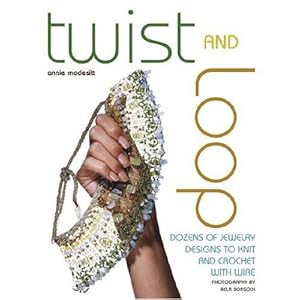
And then I tripped over the Annie Modesitt book, Twist & Loop.

How could I not? Knitting with wire is a marvellous challenge - it's knitting, alright, but it's so very different in execution and results. The pieces are small, and can be knitted in less than an hour. And it's so very sculptural, so structural.


The physical side of it is quite challenging, too. You have to change your expectations about how it feels to knit. You have to go more slowly, and more deliberately. And you definitely have to change your expectations about how the fabric looks - not only is it stiff, it's also very very untidy.

However, if you've got some beads and Artistic Wire or 24-30 gauge beading wire kicking around, and some needles you're willing to sacrifice (it tends to chew them up), then you should definitely give it a go. So much fun!

KNITTED WIRE BRACELET
Materials
• 15 yds 24 gauge wire (.51mm)
• 4mm needles - 2 dpns, wood or bamboo are best
• bracelet finding - hook & eye style, bar & loop or lobster clasp & jump ring
• pliers & wire cutters

Sizing
One size - length to fit. If left flat, approximately 1 inch wide; if curled for bangle, approximately 1/2 inch wide.

Gauge
Doesn't matter, for once!

Method
Cast on 6 stitches - the long-tail method is best. Knit until bracelet measures 6-7 inches long. Cast off loosely.

For a cuff style bracelet, leave flat. For a bangle style bracelet, roll piece lengthwise around one of your dpns.

Attach findings. Weave in ends, using pliers.

If you're interested in learning more, I definitely recommend you check out the Modesitt book.

Thursday, June 16, 2011

Continuing on the Topic of Tech Editing: What Drives You Crazy?

I make no secret of the fact that I get cranky about poorly written knitting patterns - as a designer and tech editor, it feels like an opportunity missed. A weak pattern leads to frustrated knitters, and frustrated knitters become non-knitters.

Now, none of this is to say that I expect every designer to be a great pattern writer. Designing and writing patterns are different skills - and that's ok! I would rather that the incredibly creative genius designer types focus their time and skills on that!

It's all about division of labour: leave the creativity and designing to the designers, leave the pattern writing to the pattern writers. If you're a designer, get a tech editor to help you with your pattern!

At Sock Summit, I'm teaching a class on how to write up a good sock pattern, and I want to pass along as many suggestions as possible for what to do (and what not to do).

To help me with that, a little survey for you, my dear readers: what drives you insane in patterns? What do you wish was better explained? What frustrates you?

Let me know, so I can do my bit to help educate pattern writers - and become a better tech editor, too.

Leave comments or drop me an email. Thank you!

Saturday, June 11, 2011

How I Celebrated World-Wide Knit in Public Day

Dexter is eagerly awaiting the arrival of They Might Be Giants onstage for their Luminato arts festival gig. The bag is full of treats and toys we bought him at the Woofstock dog festival.

A good day for the whole family.

Reader Mail: How to become a tech editor

A reader commented on my post about my technical editing work, asking how one becomes a tech editor.

There are two parts to this: how you get the required experience to be able to proudly describe yourself as a tech editor, and how you find the work?

How to get some experience and learn the trade:
1. Well, ok, the first one is obvious, but you should knit a lot. Knit from other people's patterns, all sorts of garments and accessories and items. Knit patterns published in different countries - UK standards can be very different than US standards; knit from European patterns - very, very different. Knit from different books and magazines and designers. And knit as many different things as you can, so that you're familiar with all sorts of garment constructions and types of patterns. A sock tech editor, for example, needs to know how to do toe-up and top-down.

2. Do some sample and test knitting. Designers are always looking for people (yes, me too!) to produce samples and to test knit patterns to review the instructions. This gets you in the position of being able to see patterns as they develop, and to provide feedback on how a pattern is written. Test knit instructions can often be rougher, less well articulated, than final patterns - and this gives you a chance to review for mistakes and missing info, and think through a pattern and how it can best be written.

3. Write some patterns of your own. You don't necessarily have to be designing complex garments, but write out a pattern for your favourite scarf or hat. Next time you make an on-the-fly modification to a pattern, write it down and then write the pattern for what you did.

3. i) When writing up a pattern, use formats/templates from different publications as a guide.

5. And last but not least, attend my "Writing Up A Awesome Sock Pattern" class at Sock Summit... You know, if you happen to be in Portland this summer.

As to finding the work, as with most things, it's about putting yourself in opportunity's way. Make contacts; get to know designers, through Ravelry, meeting them at local events, taking their classes. Talk the them! Volunteer your time - as a test knitter, as a tech editor, as a proofreader. Trust me, any designer will be thrilled with an offer of test knitting, and will be very grateful.

On that note... I've got a shawl pattern I need a sample worked up from... anyone?

Thursday, June 09, 2011

Serious Knitting Injury

A long-time student and knitting friend of mine, the lovely J., shares with us a cautionary tale.

She was on a very crowded streetcar on the way home from work, as always, with a sock project. In the shuffle to disembark, her knitting bag was pushed against her, and one of her wooden sock needles stuck her in the leg.

Although it stung, she didn't worry too much about it at the time, and upon inspection, it hadn't bled.

The next day, her leg was feeling sore, and looking bruised and swollen around the injury site. And over the next few days, it got more and more sore, and more and more swollen, necessitating a trip to the emergency room. A tetanus shot and a big box of antibiotics later, she's feeling much better, I'm pleased to report.

The doctors say that it was likely a combination of factors: the needle unluckily hit a vein, and some opportunistic bacteria took advantage.

Still, lesson learned - a needle spike shouldn't be ignored.

Saturday, June 04, 2011

New Friends

I do so love the internet. Earlier this year I had an email from a knitter in Iceland. Hrönn, a fashion designer and teacher, was coming to Toronto and she had a few questions about what to see and do here.

(You should visit her blog; even if you don't read Icelandic, you can see pictures of her work, all original designs modeled herself and by her beautiful daughter.)

We had a lovely chat by email, and I had fun sharing with her all the great things I love to do in this city.

She was here this past week, and we arranged to meet.

Hrönn is an amazing woman - she was wearing a dress she had designed herself from vintage fabric, and she fitted in so very well with the boho chic on display in Kensington market in the summer. I loved spending time with her (and her friends) and talking about knitting, beer, fashion and family life.

And she brought me a gift: a big bag of Lopi yarns! Beautiful, fine, natural coloured Lopi yarns. Laceweight Lopi! Just the sort of stuff I love. Hrönn doesn't know this about me, but I'm well-known among my knitting friends as the girl who can wear Lopi next to my skin, so she can be certain I will enjoy working with and wearing it.

I'm already considering a lace design or two for these yarns.

She also brought me a book of Lopi patterns (in English, thank goodness) I've never seen before, which has a fascinating history of Lopi knitting.

And tucked in with the yarn was some Opal licorice candy - a typical, traditional Icelandic treat. I absolutely love the box design.

Thank you, Hrönn (even though I can't pronounce your name properly!) - it was great to meet you, and it was very sweet of you to bring me such wonderful gifts.