Wednesday, October 05, 2011

Mittens for Very Cold Hands

I have a problem.  It's called Raynaud's phenomenon. When I experience cold weather, (or a rapid change in temperature), the blood vessels in my fingers contract and blood supply is decreased.  It's not dangerous, but it is unpleasant, and I therefore try very hard not to get my hands cold. (It's true for my toes, too, but the problem is generally easier to solve with 2 pairs of socks.) Combine this with naturally low blood pressure and not great circulation, and it's a recipe for needing mittens in October.

This means that I need a fairly extensive collection of warm hand-wear. It's October now, and I'm already wearing fingerless mitt to walk the dog in the morning  

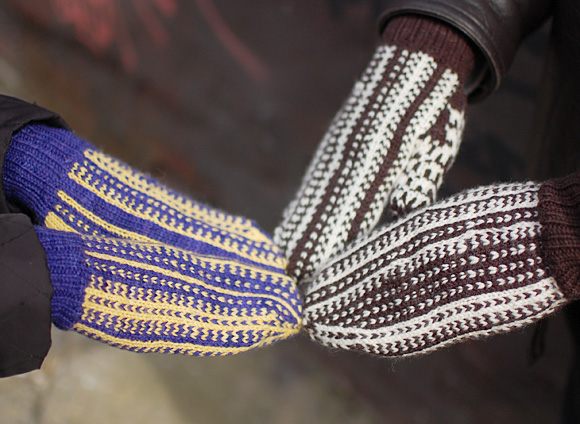
Another couple of weeks, and it will be full-on Fair Isle mittens for the morning walks.  Stranded Fair Isle makes lovely warm mittens because the strands provide a lining that keeps the wind out, and keeps the warmth in.My Morse Code mittens are my latest Fair Isle mitten design.

Come the middle of November, the Fair Isle mittens will start to fail me.

At this point, I usually give up with the hand-knit mitts entirely, and switch over to my Everest-rated Expedition mittens from Mountain Equipment Co-op.  Come January, I'm wearing those with an additional layer underneath.  

As a knitter, I also feel slightly sad when I have to break out the store-bought mittens.  Surely I should be able to make something myself. Surely I should be able to keep myself warm with wool?

This year, I'm trying something new.

I'm making stranded Fair Isle mittens to be felted! So they're wool, stranded, and they will be felted. The felting will make them thicker, denser, more windproof. With any luck, these will keep me going until December...

The design is a very very loose interpretation of the Felted Fusion Mittens from Green Elf Designs, using Briggs & Little Heritage yarn.

Unfelted, they are comically large.  Being a household with only a front-loading washing machine, 'll be hitting up my friend with the top-loader again this weekend.

And there are rather a lot of ends to weave in.  It's a good thing I'm teaching a Finishing class tonight... I always need a good demo for weaving in ends...


Friday, September 30, 2011

The Barbie Surprise Jacket, in action

Barbie helps Wilma lay out the squares for her Noro blanket....


Wednesday, September 28, 2011

KAL: The Slipper Suite

I've had a great response to my Slipper Suite pattern from the July 2011 issue of Creative Knitting magazine.

I'm very excited to announce that the lovely people at Creative Knitting have started a KAL for the patttern on Ravelry.  Join us in the group.

If you don't have the magazine, you can get a digital copy here.


I'm actually working on a pair of these slippers myself, with leftovers from Project Black Sock... I got the first one done in the spring, and have been suffering from a fairly bad case of second slipper syndrome...

(On a different note, my friend Franklin is entirely correct - it's really tough to take a good photo of your own foot, isn't it?)

And so I will be knitting along.

Wednesday, September 21, 2011

October & November Teaching Schedule

Wow!  A busy schedule.  I'm really excited about all my teaching engagements this fall.

I've got my regular teaching schedules at Lettuce Knit and The Purple Purl in Toronto.  All sorts of  fab classes - socks, both top-down and toe-up, the Baby (Barbie/Frankenstein) Surprise Jacket, Fixing Mistakes, Finishing, all sorts of things...


In addition, I'm teaching again at the Creativ Festival: Lace Knitting, my War & Peace socks, and my Expert Tips session. Details here.

I'm also teaching again at Shall We Knit at their fab new location in Waterloo. (They have a sock yarn ROOM.  A room for sock yarn. I feel faint just thinking about it.)


And I'm adding a new shop to my list: The Needle Emporium in Ancaster.  Very excited about this one - it's a great shop, and the people who run it are lovely.

Looking forward to meeting lots of new knitters!


Monday, September 19, 2011

Sock Summit Feature in Knit Magazine Issue 42


My article about Sock Summit appears in the current issue of Knit Magazine, on the newsstand in the UK and North America.


Sunday, September 18, 2011

Barbie Surprise Jacket?

In the near future, I'm teaching a couple of classes on the fun, fascinating and sometimes frustrating Elizabeth Zimmernmann "Baby Surprise Jacket". This pattern is a wonder, and remains incredibly popular. It's fun to knit, and the resulting garment is a clever little piece of knitterly origami that, once folded, becomes a sweater.
Others - including me - have blogged about the project, and there are over 15,000 projects on Ravelry for this pattern. I would be willing to bet that this is one of the most-knit projects in recent history.

 The challenge with it is that in classic EZ style, the pattern instructions as originally given in her newsletter and books were... shall we say... casual and minimal... EZ liked a knitter to think for her- (him-) self, and so wasn't much for row-by-row instructions.

 As such, the pattern can be somewhat intimidating to a newer knitter.

 As is my wont, I've developed a mini version, to allow knitters to work through the construction in a short amount of time, to help them figure it out, and to get all their mistakes out of their system.... It was dubbed by V. as the "Barbie Surprise Jacket".

 I had a few keen knitters test out the instructions for me. One intrepid knitter, the lovely Liz, tested it out for me, and sent me this picture...
So if you've got a desk toy that needs a cardigan, I have just the class for you!

Monday, September 12, 2011

Sock Math: A Photo Essay

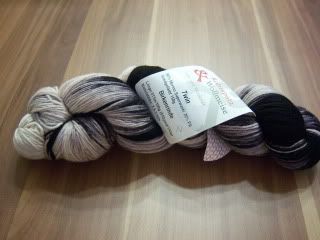
One skein of Wollmeise Twin weighs 150gm.

And I have small feet.


And one sock weighs 37 gm.


Therefore, one skein of Wollmeise Twin equals four socks.

WOOT!

Friday, September 09, 2011

Free Pattern: Worsted Weight Slouchy Hat

Worsted Weight Slouchy Hat
A simple construction to show off a gorgeous yarn.

Suitable as a first hat project, this is a quick and easy knit.

SIZES & FINISHED MEASUREMENTS
S: Fits teens and small women - 21 inch circumference and 9 inch length
M: Fits average women and small men - 22.5 inch circumference and 10 inch length
L: Fits average men - 24 inch circumference and 10.5 inch length
The hat should be a little loose - choose a size a little larger than your head size.

MATERIALS
1 (2, 2) x 50gm balls Liberty Wool (100% washable wool, 122yds/ball)
-sample uses colour 7897
-substitute 120 (150, 200) yds of any worsted weight yarn (e.g. Galway)
4mm 16 inch/40 cm circular needle
4.5 mm 16 inch/40 cm circular needle
1 set 4.5mm double-pointed needles
a stitch marker

GAUGE
20 sts and 32 rounds = 4 ins by 4 ins/10 cm by 10 cm in stocking stitch
stitch gauge is very important, round gauge less so

STITCH GLOSSARY
M1: I prefer the backwards loop make 1: simply make a backwards loop and put it on the right-hand needle.
S2kpo: Slip 2 stitches together as if to knit. Knit 1, then pass 2 slipped stitches over the stitch just knit. This is a centered double decrease that creates a nice vertical line.

METHOD
Lower Edge
With 4mm circular needle, cast on 92 (100, 108) sts. Join for working in the round and place a marker for start of round.

Ribbing round: (K1, p1) to end.
Repeat ribbing round until hat measures 2 inches from cast-on edge.
Change to 4.5mm circular needle.
Increase round, size S: (K8, m1, k8, m1, k7, m1) 4 times. 104 sts.
Increase round, size M: (K8, m1, k8, m1, k9, m1) 4 times. 112 sts.
Increase round, size L: (K9, m1) 12 times. 120 sts.

Body
Work even in stocking stitch until hat measures 7.5 (8, 8.5) inches from cast-on edge.

Close
Change to double-pointed needles when hat gets too small to work comfortably on circular needle.

Size L only:
(K6, s2kpo, k6) 8 times around. 104 sts.

Sizes S & L only:
(K5, s2kpo, k5) 8 times around. 88 sts.
(K4, s2kpo, k4) 8 times around. 72 sts.
(K3, s2kpo, k3) 8 times around. 56 sts.
(K2, s2kpo, k2) 8 times around. 40 sts.
(K1, s2kpo, k1) 8 times around. 24 sts.
S2kpo 8 times around. 8 sts.

Size M only:
(K5, s2kpo, k6) 8 times around. 96 sts.
(K4, s2kpo, k5) 8 times around. 80 sts.
(K3, s2kpo, k4) 8 times around. 64 sts.
(K2, s2kpo, k3) 8 times around. 48 sts.
(K1, s2kpo, k2) 8 times around. 32 sts.
(S2kpo, k1) 8 times around. 16 sts.
(S2kpo, k3) twice, s2kpo, k1. 10 sts.

Finishing
Weave in ends, and wash.

Thursday, September 08, 2011

Free Pattern: Nearly Instant Stripy Noro Hitsuji Hat

Just in time for cooler weather, a new hat. I don't need to tell you, my dear readers, how much I love Noro yarns.

The new Hitsuji bulky weight is an absolute hoot - all those amazing Noro colours, and it knits up absurdly quickly. It's ideal for winter accessories.

Less than two hours' knitting, I promise.

Nearly Instant Stripy Hat
Suitable as a first hat project, this is an easy & ridiculously quick knit. Excellent for last minute gift knitting!

SIZES & FINISHED MEASUREMENTS
S: Fits teens and small women - 21 inch circumference and 8.5 inch length
L: Fits average to large women's heads- 22.5 inch circumference and 9 inch length

MATERIALS
1 x 100g ball Noro Hitsuji (100% wool, 100m/ball); sample uses colour 8
6.5mm 16 inch/40 cm circular needle
8 mm 16 inch/40 cm circular needle
1 set 8mm double-pointed needles
a stitch marker

GAUGE
12 sts and 16 rounds = 4 ins by 4 ins/10 cm by 10 cm in stocking stitch using 8mm needles
stitch gauge is important, round gauge less so

STITCH GLOSSARY
Kfb: Knit into the front and back of the stitch. 1 st increased.
K2tog: Knit 2 sts together.

METHOD
Lower Edge
With 6.5mm circular needle, cast on 38 (42) sts. Join for working in the round and place a marker for start of round.

Ribbing round: (K1, p1) to end. At this point, check to make sure the round is not twisted.

Repeat ribbing round until hat measures 1.5 inch from cast-on edge.
Change to 8mm circular needle.

Increase round, size S: [(K1, kfb) 9 times, k1] twice. 56 sts.
Increase round, size L: (K1, kfb) around. 63 sts.

Body
Body round: Knit.
Work in stocking stitch as set until piece measures 4 (4.5) inches from top of ribbing.

Close
Note: As you decrease, change to double-pointed needles when hat gets too small to work comfortably on the circular needle.

Round 1: (K5, k2tog) around. 48 (54) sts.
Rounds 2, 4, 6, 8, 10: Knit.
Round 3: (K4, k2tog) around. 40 (45) sts.
Round 5: (K3, k2tog) around. 32 (36) sts.
Round 7: (K2, k2tog) around. 24 (27) sts.
Round 9: (K1, k2tog) around. 16 (18) sts.
Round 11: K2tog around. 8(9) sts.

Cut yarn, leaving a 6 inch tail. Pull through rem 8 (9) sts to close.

Finishing
Weave in ends and handwash. Hat will relax a fair bit when washed, so don't be surprised if it looks a bit small when you're knitting it.


Wednesday, August 31, 2011

Kitchener-Waterloo Knitter's Fair: Official Start of the Sweater Season

The second Saturday of September is an important day on my calendar... it's the date of the Waterloo County Knitter's Fair, hosted by my friends of the wonderful Kitchener-Waterloo Knitter's Guild.

I've always considered this weekend the official start of the sweater season - the weather is often a little cooler, and everyone is wearing their hand-knit finest. And there's so many wonderful ideas for fall and winter knitting projects on display.

I love this event - over 60 vendors, many of them very small, selling all sorts of fabulous yarn and roving and wonderful knitting goodies. Gemini Fibres and Needle Arts Book Shop are always important stops for me for their fabulous selection of crafting books. And so much great yarn - lots of local sheep and alpaca farms showing their wares. I'm getting excited just thinking about it!

Even more exciting: this year I'm speaking.

My topic is...
The first time doesn’t have to be awful: your first sweater, your first socks, your first shawl & how to make them better.
Learning to knit and learning to knit a garment are completely different things, and yet this is rarely addressed in knitting books or classes. I’ve been teaching knitting for nearly 10 years, and every week I see knitters struggle with the same problem: how to get from knitting and purling to successfully executing patterns. I’ll explain why this evolution is so challenging ,and why the current knitting literature doesn’t help.I’ll talk about how knitters of all levels can avoid the “horrible first attempt” syndrome while improving their skills and taking on new challenges. I’ll share my “training sock” philosophy (and patterns), and I’ll provide a series of tips and techniques for ensuring that your first attempt at any new technique is always fun, easy and successful.
More details in the newsletter.

I hope to see you there! Say hello!

Denise Powell is also making a presentation about using quilting designs as inspiration for knitting. She wrote an article for A Needle Pulling Thread on this topic, and if you're a quilter (or just admire them from afar, as I do), it's very cool stuff.

Sunday, August 28, 2011

Long-distance travel: all a girl needs


A travel pillow and a lace knitting project.

Of course, to add to the fun, I decided partway in that I wanted to change the lace pattern, and so I dug out my little graph paper notebook and recharted it.

But I'm not always in the mood for lace, so I've got some sock projects with me, too.

Two plain black socks (Project Black Sock is ongoing, in case you were wondering), and a cabled sock design idea in orange.


I am away for three days, after all. I would hate to run out.

So far, 32 or so hours into the trip, and I'm halfway through one of the black socks. No risk of me running out at this rate...

Friday, August 26, 2011

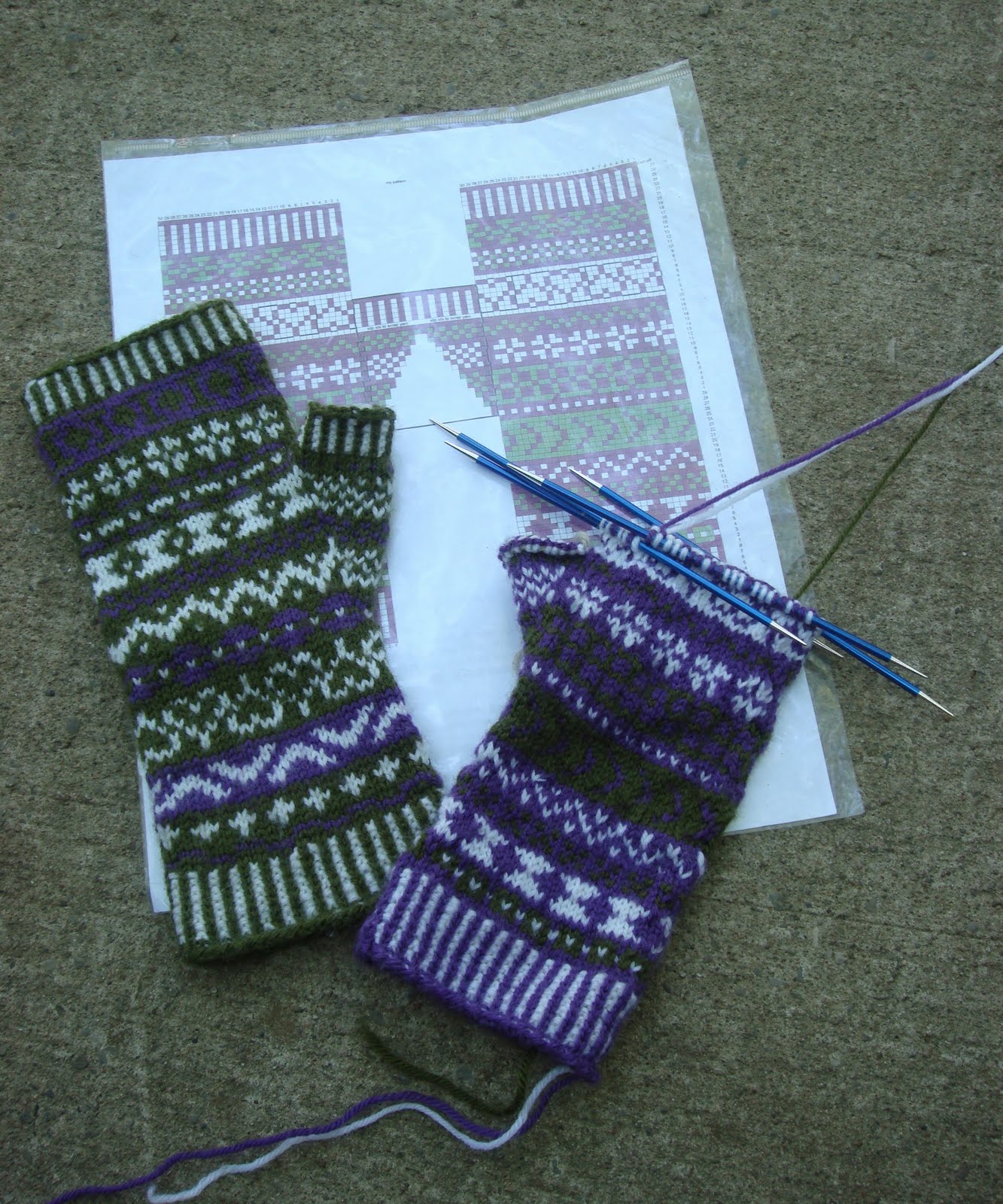
Fair Isle Fingerless Mitts, Or: Do UFOs get less finished over time?


Earlier this year (I know it was a long time ago because it was cold and snowy), I taught a workshop on designing your own Fair Isle fingerless mitts.

In preparation for the class, I worked up a design for a pair of sampler mitts, as examples. The two are deliberately different, both using a random assortment of classic Fair Isle peerie (small repeat) patterns. And I had some fun mixing up the colours, so that the ribbing is worked in different colours on the two mitts. (Yeah, yeah, I know: I love this sort of thing, even if it drives some of my... er... saner friends and students bonkers.)

I finished the first one before the class, but I never got around to completing the second. It's been sitting at the bottom of my to do list for months... I've been distracted with other work, and given that it requires a chart and three balls of yarn, it's not been a very good portable project.

So it's been gathering dust. I dug it out the other day, as I'm in need of a travel project for an upcoming flight, thinking that it would be perfect.

Well, it would be, if I had more than 20 rounds left to knit. I'd forgotten how far along I was... I'd separated off the thumb, and was already partway through the hand portion.

I never cease to amaze myself - honestly, there's less than 2 hours knitting left on this project. Why on earth did I put it down?

I know this is fairly common - knitters tell me all the time that they they're often surprised how little work remains when they dig up old UFOs. I suppose it's like the ironing - the pile gets bigger in my mind, the longer it sits. If you'd asked me to guess, I would have thought I had at least 10 hours of work left on this project. I bet this has happened to you, dear readers?

Still, I'll have a lovely new pair of fingerless mitts ready for the first cold snap.


Perhaps I should publish this pattern - that would encourage me to finish it!

Tuesday, August 23, 2011

Sock Yarn Leftovers


I've just finished a pair of Socks in Colinette Jitterbug, which I bought on a trip to the UK a few years ago. I love this yarn - thick and smooshy, with lovely vivid colours - I used it for the Vampire Boyfriend socks. I have found it's best handwashed - it seems to felt a little with machine washing.

And, once again, I'm confronted with the question of what to do with the leftovers. Having smaller-than-average feet, I always end up with a fair quantity leftover from a skein of sock yarn.

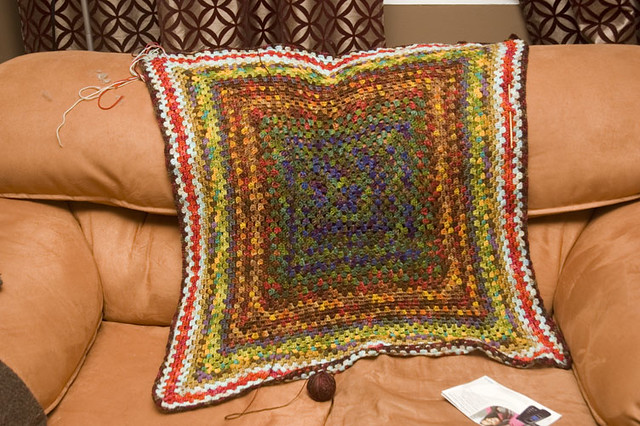
Inspired by recent conversations with my two crochet fairy godmothers, Jennifer and Tamara, and a long-ago conversation with Sarah, I have finally decided what to do with them... a giant crochet granny square blanket.

Sarah's (in the above picture) is seriously great...

This is mine so far... I've got a way to go....


But I've got the yarn all lined up and ready...


Wednesday, August 17, 2011

Free Peppermint Twist Sock Pattern: Brought to you by Soak


As I mentioned last year, I collaborated with the lovely people of Soak on a fun project. They needed some socks for the labels of their terrific Heel foot cream, and I have some socks... so they borrowed them, and took some photographs.

Heel has been a terrific success for my friends - and it never fails to make me smile to see pictures of my socks in all the yarn stores I visit!

As part of a fall promotion, Soak and Vogue Knitting have published the pattern for the sock featured on the label for my favourite scent of the Heel, the minty scented one: my Peppermint Twist socks.

Free! Download here!

Thursday, August 11, 2011

Nancy Bush & Folk Socks: My brush with greatness

It's amazing how long it takes to regain your equilibrium after something as monumental as Sock Summit. Or perhaps I shouldn't be amazed... after all, it was pretty wonderful.

(It may also have been all the coffee I drank.)

I promise I'll stop blathering on about it, but wow: I got to enjoy half an hour over a beer and some sock knitting with Ann Budd and Nancy Bush, the two women I credit for me being a sock knitter at all, let alone being a professional in the industry. I just hoped they weren't judging my technique.

Nancy Bush wrote the seminal Folk Socks. This book is the reason I knit socks.

In addition to a collection of attractive and interesting designs, the book contains a history of sock knitting, and a fairly detailed technical analysis of sock construction, including all sorts of heels and toes. It's a book I keep going back to as a reference, and as eye candy. I bought the first edition shortly after it was published in 1994. (I think people think I'm exaggerating when I say I've been knitting socks for 15 years. I'm not, honestly. I bought my first yarn for socks from a store that closed in 1996.)

I watched another instructor approach Nancy at the teachers' dinner at Sock Summit and ask her to autograph a very dog-eared copy of the book... my first thought was "why didn't I think to bring my copy", and the second was "wow, hers is as well-loved as mine". Nancy herself remarked that she's seen (and been asked to sign) many very well-used copies.

The best news is that book is being updated and reissued this fall, and I can't wait to see it.

(What I didn't want to say to Nancy is that no matter how much I love her book, she is also somewhat responsible for my obsession with sock and feet sizes. All the patterns in her book are in one size, and as I worked through the book, it became somewhat of a frustration to me, as a non-average-footed knitter. Don't let this stop you from buying the book, though. It's a masterpiece.)


Saturday, July 30, 2011

Sock Summit Day 4: Photos, photos, photos

I had the distinct pleasure today of taking Franklin Habit's famous and wonderful "Shooting Yourself in the Foot" class... oh no, wait... that's "Photographing your Fibre". But he did spend a few minutes on photographing your socks on your own feet.

Any of my friends (and readers of my blog) will know that I'm desperately in need of improvement in the area of photography.

So I spent the day playing with my camera...


Things We Learned at Sock Summit Day 2

I am a pick up artist. I did a demo on the show floor today about how and where to best pick up stitches for the gusset. Just one "aha" from the audience would have been enough, but I had a couple. Yay!

It is possible to go to the Oregon Brewer's Festival and still successfully take one of my classes. And not just any class - my War & Peace Two Socks One Inside the Other Class. You know who you are... Seriously, girl, you got chutzpah and mad skillz. I also love that the beer festival has a craft table, where you make pretzel necklaces.

And Knitgrrl scares hipsters. Dinner at Doug Fir restaurant, surrounded by pale, tattooed young men with sideburns.

It's been a busy day.

Friday, July 29, 2011

Sock Summit Day 2: Teaching & Bacon

Honoured to be here.


You know, here, in Portland, at Sock Summit.


Portland is a town that loves bacon. They have bacon donuts, bacon ice cream and bacon yarn!


So far, only one skein of yarn purchased - a jaunty orange and black stripy number from The Amy Lee Show.


How absolutely perfectly me is this? Cannot wait to knit it!

Wednesday, July 27, 2011

Tuesday, July 26, 2011

Because Size Matters: Foot Size Survey


I've been talking a lot about sock sizing of late.

When sizing socks, foot circumference is the key measurement. For the vast majority of sock designs, the length of the foot is controlled simply by working fewer or more rounds in that section- totally independent of the number of stitches you cast on.

When sizing shoes, foot length is the primary measurement. This means that all of the information out there in the world about foot size is focused on foot length.

Since foot length is remarkably unrelated to foot circumference - small feet can be wide, long feet can be narrow - telling me your shoe size tells me very little about how big your socks should be. A lot of the time, when designers are creating socks, we're guessing about how they should be sized.

With help from my friends and collaborators at Sock Summit, Knitty and Cooperative Press, I'm trying to change this. I'm launching a foot size survey, and I'm hoping you can help us out.

Send email to footsurvey@wisehildaknits.com with the following info:
  • Your shoe size: US or European size & gender (e.g. US Women’s size 8)
  • Your foot length
  • Ankle circumference around the narrowest part of your ankle
  • Foot circumference around the ball of your foot
  • Circumference around your foot at your ankle
  • Diagonal measurement around your heel, from the base of your heel up over the top of your foot
  • Circumference of your calf six inches (15cm) up from the ground

And if you can talk your friends and family into letting you measure their feet, we’d love that info too.

We'll crunch the data and come up with a set of measurements that we will publish here, through knittyblog.com and the Cooperative Press website, for all sock designers to use.

Thank you! Your reward for participation will be better sized sock patterns for everyone - and our eternal gratitude, of course!


Sunday, July 24, 2011

On Matters of Size: Flash Your Stash

I was planning and packing for the Sock Summit trip yesterday. The key consideration for any knitter when planning a trip is what knitting to take.

And for Sock Summit, that's doubly important - sure, it's gotta be socks, but it's gotta be cool socks. Cool yarn, and a cool project.I knew that I needed a plain and simple stocking stitch sock, for times when I'd be chatting. That choice was easy - the coolest yarn in my stash is a skein of Wollmeise in Birkenrinde (birch bark) that was purchased at the actual Wollmeise shop (oooh!) by a student of mine. (Thanks Andrea, if you're reading!)


But I also wanted an interesting sock project to show off my chops. I had a stitch pattern in mind, but wasn't sure about the yarn. So I went digging in the stash.

It's fun to rummage through one's own stash once in a while, to remind yourself of what goodies you have. And because I am going to Sock Summit, I figured it was a good idea to see what was what, so I knew what I didn't need to buy... and to see if there was anything I wanted to buy more of.

Now, I've already confessed in public that I keep a spreadsheet with a stash inventory, but I knew that the sock yarn section of inventory had got a little out of date. I therefore took the opportunity to pull it all out, admire it, and list it. And count.

And I 'fessed up on Twitter: not including WIPs and leftovers, I have 43 pairs' worth of socks in yarn.

This caused a little storm on Twitter among some of my very good knitting friends, necessitating the use of the hashtag "#flashusyourstash", naturally.

And so my friends, they also counted. Now, these ladies are all excellent knitters, and keen sock knitters, specifically, and each of them has a close and long-standing relationship with a LYS that has a rather terrific selection of sock yarn.

What I learnt from this exercise is that, apparently, I am a rank amateur when it comes to stashing sock yarn. No-one else had a number less than 100.

I have some serious catching up to do. Hey... I know just where I can get that problem taken care of.

Sock Summit 2011, here I come!

Monday, July 18, 2011

On Sock Sizing, Part I: Choosing Which Size to Knit

I've had some terrific feedback in response to my last few posts - thanks! I'm glad people are finding the training socks helpful.

I promised that I would also tackle the topic of sock sizing... I'm going to divide this up into two: sizing as it relates existing sock patterns, and how to customize.

This will not be news to people who know me well, or have had a sock knitting class with me, but it's true: I have small feet. I wear a US women's size 6 shoe. Now, these feet of mine aren't extremely small; I can still easily find shoes to fit, but they are small enough that sock sizing becomes an issue.

Also well-known about me and just as true: I get very cranky about sock patterns that come in one-size-fits-all. Because it's just not true. One size does not fit all. I've got narrow size 6 feet; a good friend of mine has wide size 11 feet. The idea that the same sock would fit us both equally well is silly: there's a good 20% different in both foot length and circumference between my feet and my friend's. Yes, that's right: 20%. Put into terms that are easy to visualize, that's like expecting the same swimsuit to fit a size 4 and a size 12 equally well. Sure, the fabric stretches, but it won't be comfortable.

So when knitters are asking me for sock pattern recommendations, I tend to point them to sock patterns that come in multiple sizes.

And how to choose which sock size to knit? The first socks I knitted were all too big for me - by the end of the day they had stretched out and would fall off.

The thing is that wool and wool-based sock yarns (which most of them are) have natural elasticity (up to 25% or even more, depending on the breed of sheep!), and with the heat and moisture of your feet, your socks stretch out during the day. To ensure they stay up and on, they need to be made with negative ease. That is, the socks should be smaller than you - about 10 to 15%. Your socks should start the day a little tight - not circulation-constrictingly tight, but snug - so that when they stretch out, they stay on. Think about your commercially-bought socks - they all stretch to fit.

So when choosing a sock pattern, if you're choosing a pattern sized by finished measurements (which I think is a very helpful idea, are you listening, designers?), choose a size that's about 10-15% smaller than your actual ankle/foot circumference. For an adult sock, that's about an inch/2.5cm smaller.

And the same thing applies to foot length, too... I always knit my socks about a quarter to half an inch (a cm) shorter than foot length.

And after a long day of wearing socks, they're still comfortable and they stay on when I take my boots off!

Tuesday, July 12, 2011

Toe-Up vs. Top-Down Socks: Why Two?, Which First?, Which is Better?

In follow up to my last two posts, the toe-up and the top-down training socks, I thought I'd tackle some questions I get asked often.

Of the two methods for knitting socks, top-down vs. toe up: Which should I do first?Which is easier? Which is better?

Which should I do first? I like to recommend new sock knitters start with a top-down sock, for the simple reason that the start is easier.

Which is easier? Hmmm... a tough one to answer. They both have their tricky bits: the toe of a toe-up sock can be fiddly, and the gusset pickup can be challenging for a top-down sock. In either case, don't believe what the muggles says - the heel is not the hardest part, in either case! As long as you have the right number of stitches, and you follow the instructions precisely, the heel is easy! Honestly, they are about equivalent in overall difficulty level.

Which is better? The easy answer to this is, simply, whichever one you like knitting best. They both have their pros and cons, and their defenders and detractors.

TOE UP
Reasons to be excited:
If you're worried about running out of yarn, working toe-up is the answer. As long as you've got enough yarn to get past the heel, you can just work the leg until you run out. Divide up the yarn evenly into two balls, and you can use up every last yard of each.

Things to be aware of:
Toe-up socks demand special cast-ons and cast offs. None of them are difficult, but make sure that you have access to your favourite resources (books or the internet) as you work. That is, don't do what I did, and attempt to knit your first toe-up sock on a 5 hour flight without any reference books.

There are two types of toe-up heels: with and without a gusset. A gusseted sock tends to fit most feet better, because it adds fabric around the arch of your foot. A non-gusseted sock fits best on a foot with a flatter arch. I use a gusset in my toe-up socks, as does the goddess mother of the toe-up sock, Wendy D. Johnson. I would recommend you look for toe-up sock patterns that do have a gusset.

TOP DOWN
Reasons to be excited:
Top-down is the "traditional" and therefore more common way to knit socks, and there are more top-down sock patterns out there. (This is changing over time, but many of the masters - Ann Budd, Nancy Bush, Cookie A., Hunter Hammersen - design top-down.)

I've published a lot of very cool top-down sock patterns... :-)

Things to be aware of:
You have to pick up stitches. This terrifies some people. Again, it's not difficult, but make sure you have reference material handy if you are uncertain about how to do it.

You do need a stretchy cast-on. Long tail works brilliantly.

ON THE QUESTION OF FITTING
This is a bigger discussion. Some sock knitters feel that it's easier to custom-fit a toe-up sock. I'll address this in a later post.

REGARDLESS....
No matter which you do first, I highly recommend you try both constructions to see which you enjoy, and to see which fits you best.

NEXT STEPS
Once you've tried the top-down training sock, consider my Basic Ribbed Sock pattern - free from Ravelry: download now. It's designed to be very accessible to newer sock knitters.

And once you've got the hang of the toe-up training sock, try Deb Barnhill's Back to Basics toe-up pattern from Knitty, here. It's terrific, well-written, and very accessible.

And re: whether to knit socks on DPNs, magic loop or two circulars: work with what you know! I don't recommend trying to learn a new type of needle setup at the same time as you're trying to learn sock knitting.

Once you're comfortable with socks, then experiment with different needle configurations to see which you like best.

And then once you've figured that out, then try two at once.
Friday, July 08, 2011

And now, the Toe-Up Training Sock


Fancy going the other way?

The Toe-Up Training Sock. An ideal way to try toe-up sock knitting.

Version for DPNs: download now

Version for Magic Loop/2 Circulars: download now

As with the top-down version, this is designed to be a one-evening knit, and takes you through the entire process of knitting a toe-up sock, without driving yourself mad with teeny-tiny needles and teeny-tiny yarn. Uses a scrap of worsted weight and 4.5mm needles of your choice.

Wednesday, July 06, 2011

New & Improved Training Sock Pattern: Top-Down, for DPNs & Magic Loop/2 Circulars


Long ago, I published an article on Knitty, designed to be an introduction to the whys and wherefores of Sock Knitting.

In the article, I included my Training Sock pattern.

I've been using this pattern for years, as a quick and easy way to learn about sock knitting. It's designed to be a one-evening knit, and takes you through the entire process of knitting a top-down sock, without driving yourself mad with teeny-tiny needles and teeny-tiny yarn.

The pattern itself hasn't changed, but I've updated the instructions recently. In particular, I'm becoming fairly insistent of late that sock patterns should be written to support whichever needle configuration the knitter prefers: dpns, magic loop or two circulars.

With that in mind, I've got two versions of the new and improved Top-Down Training Sock Pattern, one for DPNs and one for Magic Loop and 2 circulars. PDFs available for free download from Ravelry. If you want to learn how to knit a top-down sock, start there!

DPNs version: download now.

Magic Loop version: download now.

(Toe-up Training Sock Pattern to follow.)