Tuesday, April 27, 2010

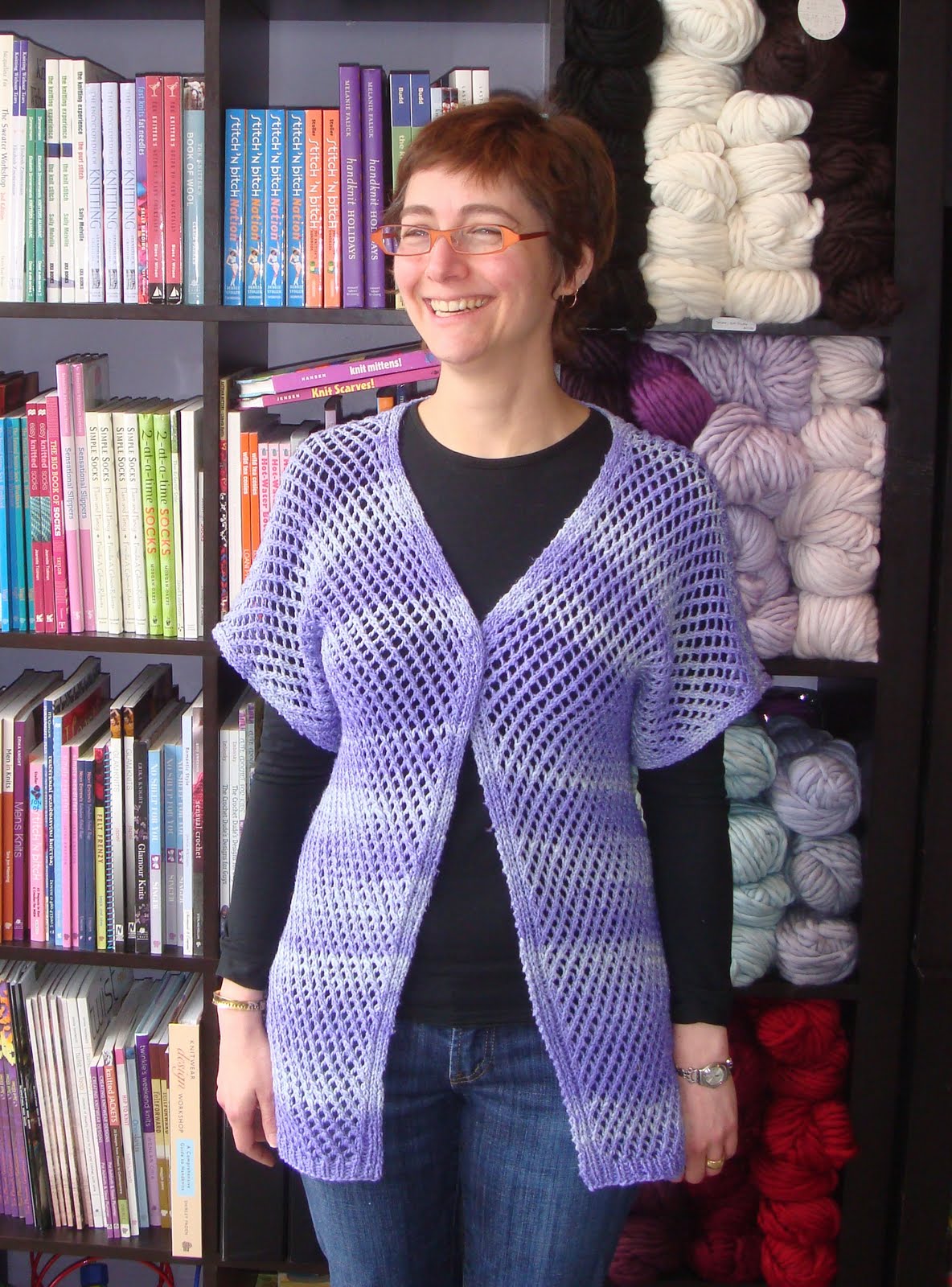
Spatchcocked: The Sweater


As promised!

This design uses Noro Shirakaba, a lovely new cotton, silk and wool blend that comes in surprisingly subtle - for Noro, anyway - colourways.

Four sizes available: Finished bust: 38 ins/97 cm, 42 ins/107 cm, 46 ins/117 cm, 50 ins/127 cm. Wear it loose and relaxed, with at least a couple of inches of ease.

The design is worked in one piece - yes! one piece! You cast on for the lower back, knit up the back, cast on for the sleeves, work the full width of the back, cast off for the neckline, and then work the fronts separately.


There is, therefore, minimal finishing!

It's a very wearable piece, going nicely over a dress or a tshirt in the summer.

Available from Ravelry, Patternfish and The Purple Purl, where the sample is on display.

Friday, April 23, 2010

Colour-Your-Own-Story Baby Blanket


As I mentioned earlier, some of our very best friends welcomed a baby this week - little Sophie.

We drove out to meet her today. She's a little sweetie, and we're honoured to be considered auntie and uncle.

Since they told us they were expecting, I had been thinking of what to make. Her Dad was Norman's best man, and they have been friends for a very very long time. I knew this baby would need something special.

So I got my designing hat on, and came up with a blankie.

The concept isn't new, but as always, I've added my own twist. It's a giant mitred square, made with seven different balls of Mission Falls 1824 Cotton. It's machine washable, and apparently exactly the right size for tucking into the car seat and moses basket.

I had much fun with the colours. If you're using multiple colours, the rule of thumb is to use an odd number. Somehow looks better that way.

So I chose 7 colours: I started with a pink in case the baby was a girl, and a blue in case the baby was a boy. And then I added purple for Heather, Sophie's mum. Green for George, her dad. George not only begins with G like green, but he is an environment scientist. The orange is for their cat, Fig; the black is for their dog, Zevon. And the last colour... well, as I mentioned above, it's a reference to an amusing situation we shared with them. In this case, it's about that time their cat peed in our car.

And so was born an idea. The colour-your-own-story baby blanket.

To start, there should be a shade of pink and a shade of blue. To cover all the bases.

And there should be a colour for each parent - colours that connects to their names, or their favourite colours.

And then colours for any siblings (human or animal). Either the colours of the pets, or favourite colours of the siblings.

And then a colour that connects the knitter to the parents. And then get knitting!

Colour-Your-Own-Story Baby Blanket


Materials
7 different balls Mission Falls 1824 Cotton (or other washable worsted/aran weight yarn; the Mission Falls 1824 wool would work just as well)
-a colour each for the two parents
-a shade of blue (bright or subtle, your choice) in case baby is a boy
-a shade of pink (bright or subtle, your choice) in case baby is a girl
-2 colours to represent the family welcoming the baby - colours of the pets, favourite colours of the siblings, the colours of the university at which the couple met
-and a colour to tell a story - are these your favourite friends to drink red wine with? use red! white wine? - use white!; do you love to camp with these friends - then how about the colour of the tent?; the colour of the logo of the company you were working at when you met? - have fun and be creative!

1 24 inch/60 cm 4.5mm circular needle

Gauge:
18 sts per 4 inches on garter stitch on 4.5mm needles; it's not critical to match size, it's more about getting a nice fabric with a bit of drape

Finished size:
approximately 66 cm/26 inches square

Method:
With the first colour, cast on 3 sts.
Row 1 (RS): K1, m1, place marker, k1, m1, k1.

I like to use Elizabeth Zimmerman's backwards loop make 1 increase here - just make a backwards loop and put it on the right needle.

Row 2 and all following WS rows: Knit all sts.
Row 3 and all following RS rows: K to marker, m1, slip marker, k1, m1, knit to end.
Repeat rows 2 & 3.

Change colours as you near the end of the ball at the start of a RS row. As the rows get longer, the stripes will get shorter - you'll get fewer rows per stripe. For the later balls, you may only get 24 or 26 rows. As you come close to the end of the ball, you can figure out if you've got enough left by measuring the yarn against the blanket. Each row needs about three times its width in yarn, so if you've got at least 12 times the width of one of the sides of the blanket, you have enough for another pair of rows. When in doubt, just change yarns.

Keep going until all 7 colours are used up. Cast off loosely on the WS.

Give it a good machine wash before you hand it over - to soften it up and get it ready for baby.

Baby Blanket Delivery

Off to meet baby Sophie, and gift her with a baby blanket I designed especially for her. The colour combo is outrageous, but for a reason. Each colour has significance:


Purple for her mum, Heather. Green for her dad, George. Orange for Fig, her cat; black for Zevon, her dog. Pink in case it was a girl; blue in case it was a boy. And the yellow? Well... the yellow is for the time Fig peed in our car. (But I probably won't mention that bit... )


Let's hope she likes it!

Pattern will be published as a freebie on this blog in the next couple of days.

Tuesday, April 20, 2010

New Pattern: Baby Booties


There seems to be a rash of babies at the moment - N's best friend George and his wife Heather recently welcomed baby Sophie to the world. N's cousin is expecting any minute. Some good friends recently had twins (welcome Connor and Liam!), and another very good friend is due in August.

This is too much for a knitter - there just isn't time for so many blankets in quick succession. Can I suggest booties?

Newborn to 3 months size. Using less than one ball of DK weight cotton, they are knitted flat and sewn up. There's a plain version with a ribbed cuff and one a little fancier. This style uses a crochet chain tie to ensure they stay on kicky little feet.

Suitable for knitters with a little experience, but not taxing. And certainly quick for emergency baby gifts!

Available online at Ravelry and Patternfish.

Thursday, April 15, 2010

Further on Lace Decreases/Good Discussion

Some good discussion on my last post - I've been enjoying the comments. Thanks to everyone.

One commenter, Laura, remarks that in general she agrees with me, but has been knitting Jared Flood's Girasole, and it calls for sk2po, and that it looks better in that context than the s2kpo she would usually use.

I've had a look at the pattern - I can't see the details in the pictures, but it definitely seems like a visible lean may well indeed work well in the diagonal lines. I will try to get a closer look.

Northmoon also suggests that in the context of the Swallowtail, the sk2po does provide a nice little 'cap' that closes up the leaf. Evelyn Clark, the designer of Swallowtail, is a smart woman, and I'm sure she chose it deliberately. I perhaps wasn't fair picking on her or her design specifically, but it happens to be a great illustration of the lean of the decrease.

I do know that I see the sk2po used significantly more often than the s2kpo. And most of the time, when I see the leaning one, I automatically replace it with a vertical decrease - and it looks the better for it. It makes me wonder if the s2kpo is, like the ssk, a reasonably new innovation/invention/discovery/unvention. Is it possible that there are patterns out there that predate it? Is it possible that if the designer had been familiar with it, they would have written the pattern differently?

All that having been said, I'm now revisiting some of my favourite lace books to with a new eye - to see which double decrease is used, and to consider in which situations the leaning version might actually work better.

This is one of the great things about the blog - the discussion. I'm loving having my world expanded by getting to know new people, hearing other opinions, and learning new things. Keep commenting, world! Thanks!

Wednesday, April 14, 2010

Lace Knitting: On the double decrease; s2kpo vs. sk2po

I had great fun last week speaking to the Kawarthas Knitting Guild, on the topic of Entrelac.

I met some lovely people (ladies and a gentleman), and we learnt some new things, and had a good discussion.

We got talking about decreases, as you do with Entrelac. Directional decreases. Entrelac uses a p2tog which leans tidily to the right, and an ssk which leans tidily to the left.

S., a knitter almost as opinionated as me (and I mean that as a compliment!), said that she'd done a workshop on decreases a few weeks before. I made my usual confession about ssk being my favourite decrease. (It's not really about which decrease it is, it's more than I have a favourite decrease...)

And then she asked me about double decreases... you know, the s2k blah blah blah decrease.

And oh boy, do I have an opinion on this!

When you need to decrease two stitches, particularly in lace, you often see the following decrease used: sk2po. It's described as being a centered double decrease.

Well, yes and no. And I hate it.

It's worked as follows: slip 1 stitch knitwise, k2tog, and then pass the slipped stitch over the k2tog. It's absolutely centered, yes. It doesn't lean, in that it doesn't cause the fabric to lean - but it certainly looks like it leans. See the decrease on the left in this swatch:


And then look at the right decrease.

The one on the right is how I think you should do a centered double decrease: s2kpo. Slip 2 sts together knitwise, knit 1, then pass the 2 slipped stitches over the knit stitch.

Very tidy. Doesn't lean, decreases two stitches, and looks centered. It has a very strong vertical line which I think looks terrific.

It surprises me how many patterns call for the sk2po decrease for a centered decrease. I think it's ugly, and it can mess up the line of the pattern stitch.

Look at my Swallowtail shawl, for example. I love this pattern, don't get me wrong. But I think the leaf motifs would be much more attractive if the top decrease was centered.


What do you think?

Tuesday, April 13, 2010

Bear with me... doing some blog upgrades

A few links might not work. Normal service will be resumed shortly, etc., etc.

Thanks for your patience!

Sunday, April 11, 2010

Noro Shirakaba cardigan thingy: spatchcocked

Read this word in a BBQ cookbook once, and it has just stuck with me...

spatchcocked.

It's usually used to mean a particular preparation of chicken - you remove the backbone, cut it in half, and then flatten it out. I've used it a couple of times to describe how a garment looks when partially sewn together and laid out.

I usually get blank looks. But I find it an oddly appropriate, even evocative word to describe how the sweater looks which is why I insist on using it.

And this is my new Noro design, spatchcocked on blocking mats, while it dries.

It's knit in one piece, and I've just got to do two seams, up the sides and under the arms.

Friday, April 09, 2010

Noro Yarns continue to surprise: Shirakaba

Not only is the new Noro Shirakaba remarkably restrained in its colouring... I mean, it's practically a solid colour... but it's also machine washable!

After the recent successful machine-washing experiments with Silk Garden, I'm feeling emboldened.

I am working on a new design - pictures to follow shortly - in Shirakaba. Today's laundry day, so I grabbed the swatch, and threw it in with the jeans on a cold wash.

Pre-wash:

Post-wash:

Post-wash:


Funny little ruler included for sense of scale.

No felting, no shrinking - it just softened up nicely.

Monday, April 05, 2010

Violent Disagreement: On Blocking & Sewing Up

I teach a Finishing class on a regular basis. It's a popular class, as finishing is one of those things that tends to make knitter nervous.

In the class, I talk about blocking. The first thing I try to do is demystify it: to help knitters understand that it's not some arcane process that requires special equipment and training, or a separate room in your house. All you need it some water - give your knitting a bath!

You need to pay attention to the washing instructions for the yarn, of course. A machine-washable yarn can be treated a bit more vigorously than a non-machine washable yarn. I tend not to steam block, or use spray bottles or any of that.

Here's my rationale: if you're making a garment, it's going to get washed at some stage. So block it the way you'll wash it. (And yes, this is how I block my swatches, too.)

If it's machine washable, send it through an appropriate wash. If it's hand wash only, dunk it in the sink, let it soak for a while, roll it in a towel to wring it out, and lay it flat to dry.

Do I pin it as it dries? Depends on what is it. If it's lace, it needs to be stretched and pinned to open up the pattern stitches.

For garments, if it's the right size and shape, I don't worry about pinning.

If you are sewing something up, blocking is a critically important part of that process. Always block your pieces before you sew up. Three reasons: one cosmetic, two practical.

The cosmetic reason: blocking something magically evens everything out and makes it look more finished. Try it with a pair of socks, or two sleeves, or two mittens - wash one and not the other, and compare how they look. I never declare a piece of knitting done until it's had a bath. Even if it's a piece that doesn't need sewing up or stretching.

Practical reason #1: blocking reduces that pesky rolling on the edges stocking stitch. It doesn't remove it entirely - nothing will - but it will make your edges a fair bit flatter. This helps enormously when you're seaming.

Practical reason #2: If the garment is going to change size or shape - to grow or shrink - you need this to happen before you sew up.

Here's the Violent Disagreement bit: someone recently pointed out that Debbie Stoller, in the first Stitch and Bitch book says that she doesn't know anyone who blocks before sewing up, and she doesn't see the point.

I was shocked.

She's so wrong on this it's not funny. If you sew something together and then wash it, and it shrinks, your seams will be all puckery. And if you sew something together, wash it, and it stretches, your seams will not stretch with it. (Especially because we don't always use the knitting yarn for the sewing up.)

Oh Debbie - your book is otherwise so very good.... I am saddened that we have come to this.

Sunday, April 04, 2010

Mad Math Skillz


Marnie MacLean has posted an enormously detailed tutorial on her blog about how to use MS Excel to assist with resizing patterns.

I laughed at first.

And then I stopped.

It's no secret that I have a degree in mathematics. And I spent 15 years working in IT.

And clearly I've been taking it all for granted.

My educational and professional background means that this stuff is so damn obvious to me. I mean, of course you create cells with the stitch and row gauges, and then you input the sizes and have the stitch numbers calculated using a formula.

It's how I do all my sizing. In fact, a spreadsheet is how I do all my designing tasks - planning, sizing, charting, taking notes as I work. I could give up word processing, but never spreadsheets.

(I used to be an an exclusive user of Microsoft Office, but have been slowing moving over to Open Office of late. It's a free, open-source Office software pack, and it's really very good.)

It's good to be reminded sometimes that you can't assume that everyone else knows what you know.

On that note, I'm not going to recreate the wheel. Go read Marnie's post.

Wednesday, March 31, 2010

On The Road: Classes at Shall We Knit in New Hamburg


Saturday April 10th I'm making a road trip.... I'm taking my ever-popular and fun Entrelac class and my life-saving Fixing Mistakes class to Shall We Knit in New Hamburg.

Info here.

I met the SWK team at the K/W Guild in January, and I'm thrilled to be teaching there - and not just because of their legendary Koigu selection. They're a great group of knitters and people!

Hope to see some of my slightly-westerly readers there, too.

Monday, March 29, 2010

Finished Moose Sweater

Way to go, J.!


J's Moose sweater is phenomenal. And I'm not just saying that because I designed it, and because she choose the colours I would have used... ;-)

It's phenomenal because she did an absolutely amazing job of knitting it - holy even colourwork, Batman! - and she looks great in it.

She did made a couple of modifications: no front pockets, and she cut the lower part of the collar short so that she can put a zipper in. If you're working on the sweater and need the details on these changes, email me and let me know.

Thanks J. - I'm honoured you chose my pattern.

Saturday, March 27, 2010

Knitting my Own Pattern: Modest Lace Shawl v2.0


The Modest Lace Shawl was one of my earliest published designs, and certainly my first lace design.

It's the project we work in my Lace Knitting classes. As anyone who has taken one of my classes knows, we begin by swatching up a few of the most basic lace stitches, to get comfortable with handling the patterning. And the swatches build in complexity, until we get to this pattern stitch. And then I show how to handle it when you're working increases, too.

The original sample shown in the photo above is not in possession anymore. So I've been reworking it in Manos' Serena, a blend of cotton and baby alpaca. The colourway is a lovely slightly variegated pink that reminds me of strawberry ice cream. It's very nice to work with, and I'm getting a great lacy fabric on 4.5mm needles. I'm still having a few issues with the alpaca, a possible allergic reaction. I have to be careful to wash my hands after I've worked with it, and not touch my face or eyes if I've been handling the yarn. I'm not happy about it, but it's not so bad I've had to put the project down.

As someone else commented recently, it's interesting and instructive to knit your own patterns. It wasn't completely lost to me, as I do often refer to it in my class, but it's different to actually follow the instructions all the way through.

I'm pleased to report that I still like the design very much - a great choice of pattern stitch, if I do say some myself. Once again, thanks go to Ms. Barbara Walker for the original stitch.

It's a fun knit, and a good place to get started with lace. It's worked tip up, so it's easier to track and manage the increases, and the pattern stitch is a nice easy 7-stitch repeat, with nothing too fancy going on.

The design itself needs no updates, but I think the writeup could, at the very least, use a few more commas...

Available at Patternfish and Ravelry

Monday, March 22, 2010

On Sock Sizing; Worsted Weight Toe-Up Sock Pattern

I had an email last week from someone looking for sock patterns for small feet.

I say this often: every designer gives something away about her/himself in their designs. For me, it's that I'm petite. And that extends to my size 6ish (US; size 4 UK) feet. They are just on the smaller size of average.
This means that I can often do well at shoe sales - and that I have benefited from optimistic shoe shoppers who have bought a size smaller hoping it would fit (again, many thanks to N's Mum who bought the wrong size, and has gifted me with a lovely pair of shiny red shoes).

A very good, very tall friend of mine has a size 10 1/2 foot. The idea of one-size-fits all socks seems pretty silly to me - especially when you're going to the trouble of knitting them, they may as well fit you properly.

I am, therefore, very careful to ensure that any sock pattern I publish comes in multiple sizes. (And I work very hard to enforce this at Knitty, too. I've only let one one-size-fits-all sock pattern get by me... Skew. Both the designer and I are mathematicians, and neither of us could figure out the numbers. Be prepared if you submit a sock pattern to Knitty, I will demand multiple sizes!)

Which brings me to my latest design: a worsted-weight toe-up sock that comes, naturally, in three sizes.

Available at Patternfish, Ravelry, and The Naked Sheep.

I designed this to be an intro to toe-up sock knitting - so top-down knitters could see what all the fuss is about! I use the wonderous Judy's Magic Cast-on, and its soulmate, Jeny's Surprisingly Stretchy Bind-Off. A single skein of Cascade 220 (or equivalent worsted weight yarn) very quickly makes a nice pair of socks.

Tuesday, March 16, 2010

Knitter's Frolic: Classes (but no shopping)

I'm teaching again this year at the DKC Knitter's Frolic. I love this event - a great chance to meet and mingle with knitters from all over Canada and the northeastern US.

I'm teaching the following: Pattern Reading, Fixing Mistakes, and Designing Custom-Fit Socks, on the Saturday.

More info here.

The bad news (for me, anyway) is that I'm teaching all day Saturday, and will have very limited time to shop. I will need to be very focused.

Do say hi if you see me!

Thursday, March 11, 2010

Just in Time For Spring: The Puffy Vest Pattern

Because where I live, Spring is all about layers. The sun is shining, and we're all keen to ditch the heavy winter gear, but it's not very warm yet. These sorts of things are perfect - I can feel springy and lightly dressed, without freezing to death.

And if you're anything like me, you get tired of your winter clothes long before it's warm enough to dust off the summer gear. So a new, warm-but-not-too-wintery vest may be just the thing you're seeking to change your look and enliven your wardrobe.

And trust me, this is an incredibly fast knit. I created my first one in less than 48 hours, and I knitted a second one in a handful of days.

As I've commented before, I have a soft spot for chunky-weight mohair. But it is a difficult fibre to design with. It knits up big and puffy, and the resulting garments can be suffocatingly warm.

This reinterpretation of the hoodie vest harnesses these challenging properties of the mohair and uses them to great effect. The puffiness is what makes this a fun and attractive style. It's sleeveless so it knits up quickly and uses little yarn; this feature also ensures that you don't overheat.

It designed it to be worn fairly fitted and cropped, to keep it flattering.

Pattern available on Patternfish and Ravelry .


Monday, March 08, 2010

More On Raglans/Unpopular Opinion Alert/"Easy to Alter"/Solving the Wrong Problem?

I let my frustration show in a tweet last week... I said something along the lines of "Dear Top-Down-One-Piece Raglan people: Please stop."

I was teaching a class last week, and I had a long discussion with a woman about the sweater she was working on.

It was a top-down one-piece raglan, and she was partway through the yoke. It was a fairly plain garment, and a relaxed style. She had a million questions. She was looking to alter it.

We wanted to change the length of the garment. Easily done - and indeed, one of the excellent benefits of a top-down sweater. She was considering altering the sleeve length - also easily done.

But then she explained to me that she wanted it to fit differently in the top, and to make it more fitted.

At that point, I lost my patience.

Not with the knitter - but with us.

With the community.

This woman was a reasonably skilled knitter, with a clear idea of what she was looking to create.

She'd gone into a shop, looking for a pattern to create a particular garment - and she'd been directed to a top-down one-piece raglan. "They are easy to alter."

I really wish we'd stop presenting the top-down one-piece raglans like they are the solution to every knitting problem.

Elements like body and sleeve length are very easy to alter - sure. But not necessarily the whole thing.

And no matter how skilled you are at knitting and altering, there are limits to what a raglan can do and how they can fit. And they simply don't work on every body type.

Here's the unpopular bit: go look at the hundreds of February Lady Sweater projects on Ravelry. It's a design that looks terrific on some people, but looks truly awful on others. (In particular, check out the armholes.) And despite this particular sweater being a favourite of the Harlot, it's got issues in the armhole area, too.

And one-piece construction is great if the yarn isn't too heavy - but a yarn like alpaca or cotton can get very heavy, and really benefits from seams to retain some structure.

I feel like we're really misleading knitters if we keep pushing them towards only one style of garment. I cannot get a raglan to fit me, it's true, but I'd have the same rant if they did fit me well. I like set-in sleeves, but I don't push everyone to that style, either. Everyone is shaped differently, and everyone needs to know what works for them.

And how do you know what works for you? Experiment! Go spend an hour in the Gap and try on every sweater they have. Try raglans, try set-in sleeves, try circular yokes, try drop shoulders. Try garments with waist shaping. Try garments that hang straight. Try different lengths. Take a good honest look at yourself. And take notes!

I know, I know. I've grumbled about this before.

I just feel that far too often something is missing from the decision process when you choose a pattern to knit: the understanding that this is a garment you are going to wear, and that you should like the look and fit of.

Now, I do understand why both designers and knitters like the top-down. Amy presents a nicely articulated discussion of why she likes to design raglans here. And I agree with everything she says.

And I know one of the big reasons why knitters like them: people don't like seaming.

But I think we're solving that particular problem the wrong way. I know that people don't like seaming because they don't know how. The patterns glibly throw out instructions like "set in sleeves" in the finishing, but never explain precisely what they mean.

And if you don't have a reference book like my beloved Vogue Knitting, you're going to be at sea.

(The people who struggle the most sewing up knitting are those who are most familiar with sewing fabric. It's entirely different. A proper seam is really not hard, and the result is truly amazing. I love teaching my finishing class, because of the amazed reactions I get.)

So people don't like seaming, so they like a one-piece sweater. Makes sense to me. But you're going to be limited on styles and fits if that's all you have in your knitting toolkit. I'm on a one-woman crusade to banish fear of finishing.

And of course, top-down sweaters are worked in the round - also great. I'm a big fan of this - but in many cases, that can actually be done with all sorts of different styles. There's no reason why a set-in sleeve can't be worked in the round to the armholes, whether bottom up or top-down - assuming it's an appropriate yarn and style.

So yeah - people think I'm a raglan hater. I'm not, really. I'm a hater of narrow thinking and of limiting possibilities.

Wednesday, March 03, 2010

Two Socks in One: A Class!

I've had a few questions about the whole two-socks-in-one thingy....

it's not a double-thickness sock - it's two ENTIRELY SEPARATE socks knitted at the same time, on the same needles.


Yes, it's absurd.


Yes, it's likely a bit slower than knitting them separately.


Yes, you lose the magical no-purl benefits of working normally in the round.


Why? Because it's there.

It's the knitter's equivalent of Mount Everest.

And I'm teaching a class on it. Sunday April 18th, 1-3pm at The Purple Purl. Click here for more details.

For experienced and adventurous sock knitters only - ideally those with a well-developed sense of the absurd.

Tuesday, March 02, 2010

First Moose Sighting in the Wild!


Miko did hers in purple, naturally.

I've said this before, but this will never grow old for me, seeing people knitting my designs.