See my post over at the KnittyBlog.
You guys probably know that I'm part of the Knitty team - I am the grasshopper to sensei Mandy for technical editing. Love the work - it is precisely the combination of math and knitting that makes me happy. I've said this for a long time - I use my math significantly more in this world than I ever did in the tech industry, and technical editing really exercises that side of my brain. In addition, I find a strange pleasure in charting - it fires exactly the same neurons as doing Sudoku, and gives me precisely the same satisfaction.
Okay, okay, it's weird, I know - but the knitting world is benefiting from my weirdness in having well-written and accurate sock patterns. I use my powers for good!
Monday, May 31, 2010

Tuesday, May 25, 2010
Textile Museum Yardage Sale this weekend in Toronto
A highlight of the crafter's year in Toronto is the Textile Museum's "More than Just a Yardage Sale".
It's a fundraiser for the museum, held in the parking lot beside the building. The Museum collects donations of new and previously loved crafty materials, tools, patterns, equipment, books and so forth. There is a huge variety of crafts represented - knitting, quilting, sewing, embroidery, cross stitch, rug hooking - there have even been macrame sightings in previous years. Knitting stuff was in short supply last year, but there's always a few goodies, and the prices are amazing.
I've found some real treasures there over the years: a partially complete sewing project of a 1960s vintage mohair suit, complete with pattern - for $10. I took it to a dressmaker and I have a one-of-a-kind custom fit outfit. I also got a skirt length of lime green Harris Tweed, complete with matching lining. There's always lots of books and patterns - I've found some great sock patterns dating back to the 1970s for 50 cents, and a copy of The Knitter's Guide to Sweater Design, for the princely sum of $2. It sells online for much more, I was very pleased with this find.
And last but not least, for 75 cents I bought a half-complete cross stitch project - an antique car, if memory serves. I ditched the actual cross-stitch, but kept the two needles and the frame - a bargain!
You'll find a lot of UFOs (unfinished objects) in various states of abandonment - some almost complete, some barely started. They are priced to sell, and definitely worth looking at, not necessarily for the project, but as with my cross-stitch purchase, for the book or tools or materials contained within.
Bring cash and a shopping bag or two.
I'd like to tell you that it starts at 1pm on Friday to give me time to shop, but the website gives my game away - the hours are Friday 11am to 6pm, and Saturday 10am to 1pm.
It's a fundraiser for the museum, held in the parking lot beside the building. The Museum collects donations of new and previously loved crafty materials, tools, patterns, equipment, books and so forth. There is a huge variety of crafts represented - knitting, quilting, sewing, embroidery, cross stitch, rug hooking - there have even been macrame sightings in previous years. Knitting stuff was in short supply last year, but there's always a few goodies, and the prices are amazing.
I've found some real treasures there over the years: a partially complete sewing project of a 1960s vintage mohair suit, complete with pattern - for $10. I took it to a dressmaker and I have a one-of-a-kind custom fit outfit. I also got a skirt length of lime green Harris Tweed, complete with matching lining. There's always lots of books and patterns - I've found some great sock patterns dating back to the 1970s for 50 cents, and a copy of The Knitter's Guide to Sweater Design, for the princely sum of $2. It sells online for much more, I was very pleased with this find.
And last but not least, for 75 cents I bought a half-complete cross stitch project - an antique car, if memory serves. I ditched the actual cross-stitch, but kept the two needles and the frame - a bargain!
You'll find a lot of UFOs (unfinished objects) in various states of abandonment - some almost complete, some barely started. They are priced to sell, and definitely worth looking at, not necessarily for the project, but as with my cross-stitch purchase, for the book or tools or materials contained within.
Bring cash and a shopping bag or two.
I'd like to tell you that it starts at 1pm on Friday to give me time to shop, but the website gives my game away - the hours are Friday 11am to 6pm, and Saturday 10am to 1pm.
Monday, May 24, 2010
Air Travel: Newflash

I hadn't done any flying since the latest round of changes to airport security, so I wasn't sure what the situation was.
We had a quick trip to Boston this weekend to visit the newest member of Norman's family, a special little baby born of challenging circumstances called Jacob Nathaniel.
It took me ages to decide what to take with me to work on: I couldn't take my current design project, as it's colourwork and 4 balls of yarn would have taken up too much room in my bag.
And I couldn't take the design project that's up next on my to-do list, as it's lace, and I haven't settled on the stitch patterns.
So I dug in the pile of UFOs and came up with the Noro Sekku laceweight scarf design I'd been playing with in the winter. Of course, nothing is ever simple: the needles were an issue. I'd been working it on 2mm metal needles (!), and I suspected that choice wasn't going to fly for two reasons. 1) No one would ever want to knit a scarf knitted on 2mm needles, and 2) 2mm metal needles look more like a weapon than anything I've ever knitted with. I was quite convinced they would be taken away.
So I dig up the smallest non-metal 16 inch circ I own - 3.5mm - and swatched. Ick - too loose.
Alison found a 3mm bamboo for me, and so I took that home and started working with that. Ack. Awful. First of all, it was too loose still, and it was just so damn slow with the Noro.
So I decided, in the spirit of science, to gamble. I restarted the scarf on a 2.5mm 16 inch metal circular needle, and stuffed an emergency ball of sock yarn and a set of bamboo sock needles in the corner of my bag just in case I had to surrender the circular needle. I also packed my little Stitch Saver mini crochet hook.
And I'm very pleased to report I didn't have any problems - well, other than getting distracted and making mistakes.
So, yes, short metal circulars - still plane-friendly.
And the baby? Adorable!
Tuesday, May 18, 2010
New Design: Shetland Skies Circular Shawl
 My first circular shawl, created with the 'Pi' method popularized by Elizabeth Zimmerman. I've used traditional Shetland patterns - Cat's Paw, Fern, Tree, and of course Feather and Fan - but a very non-traditional colour. And I love it!
 A single skein of Malabrigo sock yarn (or equivalent 400m) gives a shawl about 32 inches/80 cm in diameter. A second skein adds about 10 inches/25 cm to the diameter, with a larger and more dramatic Feather & Fan border. You could work in any yarn - a DK would make for a bigger shawl, or go with an aran or even chunky for a great blanket!

Pattern available at Patternfish and Ravelry. The sample is available for viewing at Lettuce Knit.
Saturday, May 15, 2010
Pragmatism or Paranoia? Or Just Clever Risk Management?
I am contrary in so many ways, as a knitter. (Well, ok, in the rest of my life, too.)
And one of the biggest points of contrariness in my knitting life is on the issue of how to pull the yarn from the ball.
You know: do you pull from the centre or the outside?

Many, many knitters pull from the centre. They've been told - by books, by wise grandmothers, by other knitters - that pulling from the inside is the One True Way. Naturally, I do it differently. I pull from the outside. (Gasp of horror.)
Oh yes, if the ball is perfectly wound, and the yarn is nice and smooth and not too sticky, pulling from the inside is great. The ball doesn't roll around in your bag. It stays compact, and clean and convenient.
All lovely. I can definitely appreciate all of those benefits.
And yet. I pull from the outside.
I like to claim it's pragmatism. I'm beginning to wonder if it's paranoia.
There are things I like doing, and things I don't like doing. Knitting - love it, of course. Writing patterns - yup, love it. Charting, even. Love it.
In the "not so much love" category, however, falls the task of untangling knotted yarns. I would rather undergo dental surgery than untangle a huge hopeless mess of a tangle. One badly tangled ball is too many for me.
Just this week I watched a customer at one of my LYSs spend nearly two hours untangling a mis-wound ball of sticky laceweight yarn that she had tried to pull from the centre.

Sometimes it tangles right at the start. I've watched knitters spend 15 minutes of a 2 hour class fighting with the yarn barf before they can start knitting. (Come on, doesn't the fact that it's called Yarn Barf tell you something?)
Sometimes it tangles partway through, or as you approach the end of the ball.
And most times, it doesn't tangle at all.
But I really really really don't like untangling. So it's all about risk management for me. I am willing to compromise those wonderful benefits so that I don't have to waste a single moment untangling.
And one of the biggest points of contrariness in my knitting life is on the issue of how to pull the yarn from the ball.
You know: do you pull from the centre or the outside?

Many, many knitters pull from the centre. They've been told - by books, by wise grandmothers, by other knitters - that pulling from the inside is the One True Way. Naturally, I do it differently. I pull from the outside. (Gasp of horror.)
Oh yes, if the ball is perfectly wound, and the yarn is nice and smooth and not too sticky, pulling from the inside is great. The ball doesn't roll around in your bag. It stays compact, and clean and convenient.
All lovely. I can definitely appreciate all of those benefits.
And yet. I pull from the outside.
I like to claim it's pragmatism. I'm beginning to wonder if it's paranoia.
There are things I like doing, and things I don't like doing. Knitting - love it, of course. Writing patterns - yup, love it. Charting, even. Love it.
In the "not so much love" category, however, falls the task of untangling knotted yarns. I would rather undergo dental surgery than untangle a huge hopeless mess of a tangle. One badly tangled ball is too many for me.
Just this week I watched a customer at one of my LYSs spend nearly two hours untangling a mis-wound ball of sticky laceweight yarn that she had tried to pull from the centre.
Sometimes it tangles right at the start. I've watched knitters spend 15 minutes of a 2 hour class fighting with the yarn barf before they can start knitting. (Come on, doesn't the fact that it's called Yarn Barf tell you something?)
Sometimes it tangles partway through, or as you approach the end of the ball.
And most times, it doesn't tangle at all.
But I really really really don't like untangling. So it's all about risk management for me. I am willing to compromise those wonderful benefits so that I don't have to waste a single moment untangling.
Tuesday, May 11, 2010
Frolic 2010: Is it Possible to be Hungover from Yarn Fumes?
What a great time!
I taught three classes - Pattern Reading, Fixing Mistakes, and Designing Your Own Custom-Fit Socks. Met some great knitters, and had some great discussions.
My Custom-Fit Socks class shows you how to take your gauge and your foot measurements and design a sock (top-down or toe-up, as is your wont). But of course we talked about the challenge of designing socks as a gift for someone whose foot you cannot measure - either due to geographic distance, or because you don't want to ruin the surprise.
One of my students said that the Sears catalogue, apparently, has a table of shoe size correlated to foot length, so as long as you can get a shoe size, you're well on your way. Brilliant!
As to what I did in my brief breaks between classes - a little tiny bit of shopping. I resisted the yarn, but did manage to get myself two marvellous and obscure lace books

and the niftiest little toys in the world: mini bamboo crochet hook and knitting needles. The crochet hook is 3mm, and the knitting needles are 2.5mm - and each is 2.5 inches/7 cm long. Just the thing to add to my little box of mini knitting tools.

I taught three classes - Pattern Reading, Fixing Mistakes, and Designing Your Own Custom-Fit Socks. Met some great knitters, and had some great discussions.
My Custom-Fit Socks class shows you how to take your gauge and your foot measurements and design a sock (top-down or toe-up, as is your wont). But of course we talked about the challenge of designing socks as a gift for someone whose foot you cannot measure - either due to geographic distance, or because you don't want to ruin the surprise.
One of my students said that the Sears catalogue, apparently, has a table of shoe size correlated to foot length, so as long as you can get a shoe size, you're well on your way. Brilliant!
As to what I did in my brief breaks between classes - a little tiny bit of shopping. I resisted the yarn, but did manage to get myself two marvellous and obscure lace books

and the niftiest little toys in the world: mini bamboo crochet hook and knitting needles. The crochet hook is 3mm, and the knitting needles are 2.5mm - and each is 2.5 inches/7 cm long. Just the thing to add to my little box of mini knitting tools.

Friday, May 07, 2010
Material Girl Socks
I'm thrilled to announce the first sock pattern in a series of rockin' sock designs for Van Der Rock yarns.
Meet the Material Girl.

This pattern will make you want to draw on a fake mole, wear your bra as outerwear and constantly re-invent yourself.

And matching wristlets, naturally.

Three-page full-colour PDF includes pattern for socks and wristlets in three women’s sizes, with tips for personalizing the fit. Calls for 2 x 50g skeins of Van Der Rock Super Sock or Merino Sock and shown here in Neon.
More details on Ravelry and at Van Der Rock Yarns' site.
Material Girl is the first in a series of rockin’ sock designs... check back during Summer 2010 for more patterns inspired by women who rock.
She'll be on display at the Frolic, and patterns and the seriously wonderful Van Der Rock sock yarn will be available. And even if you're not livin' in a material world, I bet they have a colour that you'll love.
Meet the Material Girl.

This pattern will make you want to draw on a fake mole, wear your bra as outerwear and constantly re-invent yourself.

And matching wristlets, naturally.

Three-page full-colour PDF includes pattern for socks and wristlets in three women’s sizes, with tips for personalizing the fit. Calls for 2 x 50g skeins of Van Der Rock Super Sock or Merino Sock and shown here in Neon.
More details on Ravelry and at Van Der Rock Yarns' site.
Material Girl is the first in a series of rockin’ sock designs... check back during Summer 2010 for more patterns inspired by women who rock.
She'll be on display at the Frolic, and patterns and the seriously wonderful Van Der Rock sock yarn will be available. And even if you're not livin' in a material world, I bet they have a colour that you'll love.
Thursday, May 06, 2010
A classic from the back catalogue; The Stone Roses Effect?
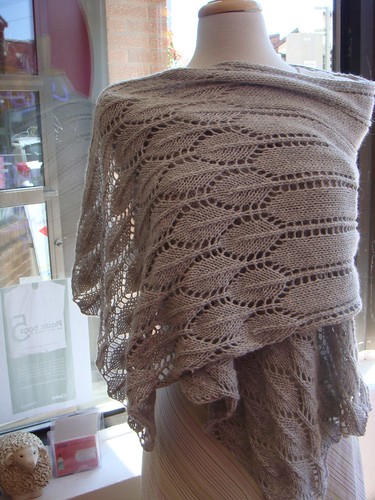
I designed this lace shawl, the Long Leaf Lace, about 5 years ago.
Since then, it's sold many, many copies, and I encounter people on a regular basis who have knitted it.
And I still love it. It's a modern piece, not too fussy - to knit and to wear - and work with as both a casual or dressy piece.
I worry sometimes, though. I've designed a number of other lace pieces since then - and none of them have had the same response. Am I like the The Stone Roses - never to duplicate the success of my first release?
It won't stop me from trying!
Pattern available on Ravelry and Patternfish.
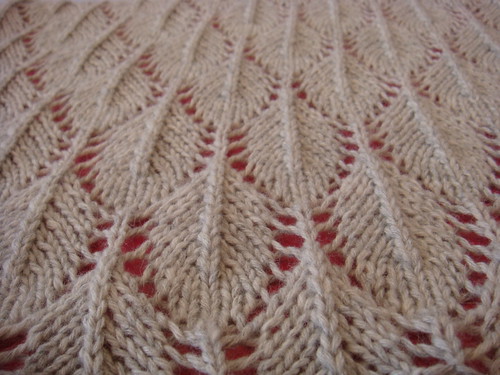
See more of Emily's version on The Naked Sheep blog.
There are versions in sock yarn, in a worsted weight yarn, and everything in between. It works well in pretty much anything. It's a manageable project for a newer lace knitter, with a nice big lace motif.
Sunday, May 02, 2010
DKC Frolic Saturday May 8th: Classes & Shopping
Much buzzing and excitement in the southern Ontario knitterly world, as we get ready for the DKC Frolic this coming weekend.
I'm teaching three classes: Pattern Reading, Fixing Mistakes, and Design Your Own Custom-Fit Socks.
Pattern Reading is for knitters who are confident with their needles (or getting there!) and are ready to tackle a pattern. Patterns are written in a language all their own, and I teach you how to read, understand and follow a pattern, whether using US/Canadian standards and language, or UK, or even Japanese. I also explain gauge and how to check it (and when you don't need to!), and how to read sizing and schematic info so you know you're knitting a garment that will actually fit. Bring any patterns you want to work, or are having problems with.
Fixing Mistakes is for knitters who are getting good, but are still stymied when something goes wrong. I'll show you how to safely undo stitches and correct them - as I say in the class, taking the stitches entirely off the needles really should be the last resort. I'll show you what to do about dropped stitches, incorrect stitches and strange holes. I'll also talk about fixing the sorts of mistakes that happen in following the pattern - forgetting an increase, or doing an extra one. And most important of all, I'll teach you when a mistake doesn't need to be fixed! Bring your mistakes - I promise I won't embarrass or make fun of you for them...
And Design Your Own Custom Fit Socks is for knitters who have worked a few socks, and are ready to start creating their own. I cover top-down and toe-up, and talk about how to not only properly fit a sock, but how to apply pattern stitches and one-of-a-kind design elements. Optional: bring a swatch of the yarn you'd like to work it.
Info and sign up details here.
As for shopping, I won't have much time, but it's just going to force me to be focused.
On this year's wish list:
 Some kind of mini-ruler and scissor solution.
I am trying to put together a mini version of my toolkit for carrying in my purse. So far I have a mini crochet hook, safety pins, markers, a cable needle and a darning needle all handy in an Altoids gum tin. For cutting I've been carrying a small Swiss Army knife, but it takes up too much room and has too many other non-relevant tools to really be appropriate. There's also a USB stick, because yes, I've found it's good to have my patterns and teaching notes with me. What I need is a smaller cutting solution, and some kind of a ruler. I've seen some nifty "got gauge" rulers, but they are only in US/imperial measurements. I'm not adverse to changing the container, if I can find something reasonably small.
Update: a couple of good suggestions in the comments - thanks! I have half been considering getting an unobtrustive tattoo of a ruler of my hand, but popular opinion is that it might sag over time and give inaccurate measurements... ;-)
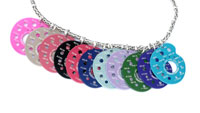 a needle gauge pendant, in the smaller sock/lace sizes, for both function and style!
And of course, some fun, interesting and obscure books. I am sure Marsha of the Needle Arts Book Shop will be able to tempt me.
I'm teaching three classes: Pattern Reading, Fixing Mistakes, and Design Your Own Custom-Fit Socks.
Pattern Reading is for knitters who are confident with their needles (or getting there!) and are ready to tackle a pattern. Patterns are written in a language all their own, and I teach you how to read, understand and follow a pattern, whether using US/Canadian standards and language, or UK, or even Japanese. I also explain gauge and how to check it (and when you don't need to!), and how to read sizing and schematic info so you know you're knitting a garment that will actually fit. Bring any patterns you want to work, or are having problems with.
Fixing Mistakes is for knitters who are getting good, but are still stymied when something goes wrong. I'll show you how to safely undo stitches and correct them - as I say in the class, taking the stitches entirely off the needles really should be the last resort. I'll show you what to do about dropped stitches, incorrect stitches and strange holes. I'll also talk about fixing the sorts of mistakes that happen in following the pattern - forgetting an increase, or doing an extra one. And most important of all, I'll teach you when a mistake doesn't need to be fixed! Bring your mistakes - I promise I won't embarrass or make fun of you for them...
And Design Your Own Custom Fit Socks is for knitters who have worked a few socks, and are ready to start creating their own. I cover top-down and toe-up, and talk about how to not only properly fit a sock, but how to apply pattern stitches and one-of-a-kind design elements. Optional: bring a swatch of the yarn you'd like to work it.
Info and sign up details here.
As for shopping, I won't have much time, but it's just going to force me to be focused.
On this year's wish list:
 Some kind of mini-ruler and scissor solution.
 I am trying to put together a mini version of my toolkit for carrying in my purse. So far I have a mini crochet hook, safety pins, markers, a cable needle and a darning needle all handy in an Altoids gum tin. For cutting I've been carrying a small Swiss Army knife, but it takes up too much room and has too many other non-relevant tools to really be appropriate. There's also a USB stick, because yes, I've found it's good to have my patterns and teaching notes with me. What I need is a smaller cutting solution, and some kind of a ruler. I've seen some nifty "got gauge" rulers, but they are only in US/imperial measurements. I'm not adverse to changing the container, if I can find something reasonably small.
Update: a couple of good suggestions in the comments - thanks! I have half been considering getting an unobtrustive tattoo of a ruler of my hand, but popular opinion is that it might sag over time and give inaccurate measurements... ;-)
a needle gauge pendant, in the smaller sock/lace sizes, for both function and style!And of course, some fun, interesting and obscure books. I am sure Marsha of the Needle Arts Book Shop will be able to tempt me.
Saturday, May 01, 2010
Summer Sock Wardrobe
(And oldie but goodie from my pattern catalogue, which I find fabulous relevant in our current unpredictable weather.)

I love going barefoot in the summer, and will cheerfully ditch my socks at the first sign of spring - but just because it's sunny doesn't mean it's actually warm enough to expose my toes.
These socks fill a gap in my sock wardrobe - for those days when I want to go sockless, but can't really do it.
Ankle socks for wearing in your sneakers - pom-pom mandatory.
Pedicure socks - expose your toes but keep the rest of your feet warm.
And flip-flop socks - just because.
Summer Sock Wardrobe - Patternfish link; Ravelry link
The pedicure socks represent an improvement on other published version in that they have a thong that goes between your big and next-to-big toes, so that they stay on.
I love going barefoot in the summer, and will cheerfully ditch my socks at the first sign of spring - but just because it's sunny doesn't mean it's actually warm enough to expose my toes.
These socks fill a gap in my sock wardrobe - for those days when I want to go sockless, but can't really do it.
Ankle socks for wearing in your sneakers - pom-pom mandatory.
Pedicure socks - expose your toes but keep the rest of your feet warm.
And flip-flop socks - just because.
Summer Sock Wardrobe - Patternfish link; Ravelry link
The pedicure socks represent an improvement on other published version in that they have a thong that goes between your big and next-to-big toes, so that they stay on.
Thursday, April 29, 2010
Two-Socks-in-One: The Pattern/Go on, you know you want to try it...

 Not only is it possible to knit two socks at the same time, one inside the other, but we also have proven conclusively that it can be fun.
And now, so you can play along at home, I have a full pattern and how-to guide.
Start the way I always do, with a training version...
And then move on to the full-size version.
My pattern provides all the instructions and guidance you need.
It also provides several additional features that improve upon previously published versions of this technique: I've engineered it so that it exactly duplicates my standard top-down sock, with carefully chosen directional decreases, and it comes in multiple sizes - women's S, M & L, men's S & L.


Although I used DPNs, as is my wont, the pattern is written for any needle type - DPNs, two circulars, or magic loop.

Pattern available on Ravelry and Patternfish, and it provides very detailed notes to help you out.
Go on, I dare you!
Tuesday, April 27, 2010
Spatchcocked: The Sweater
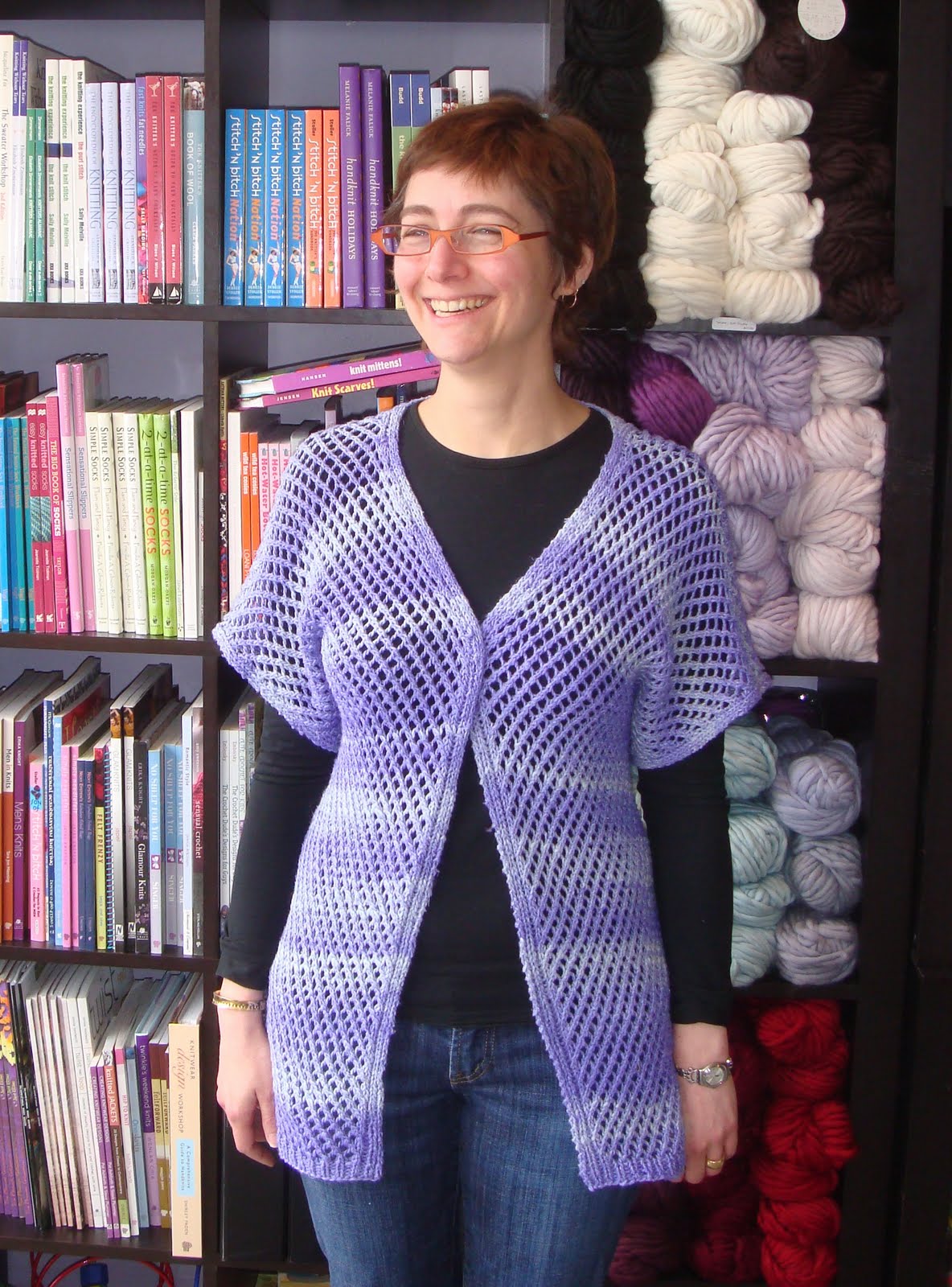

As promised!
This design uses Noro Shirakaba, a lovely new cotton, silk and wool blend that comes in surprisingly subtle - for Noro, anyway - colourways.
Four sizes available: Finished bust: 38 ins/97 cm, 42 ins/107 cm, 46 ins/117 cm, 50 ins/127 cm. Wear it loose and relaxed, with at least a couple of inches of ease.
The design is worked in one piece - yes! one piece! You cast on for the lower back, knit up the back, cast on for the sleeves, work the full width of the back, cast off for the neckline, and then work the fronts separately.

There is, therefore, minimal finishing!
It's a very wearable piece, going nicely over a dress or a tshirt in the summer.
Available from Ravelry, Patternfish and The Purple Purl, where the sample is on display.
Friday, April 23, 2010
Colour-Your-Own-Story Baby Blanket
 |  |
We drove out to meet her today. She's a little sweetie, and we're honoured to be considered auntie and uncle.
Since they told us they were expecting, I had been thinking of what to make. Her Dad was Norman's best man, and they have been friends for a very very long time. I knew this baby would need something special.
So I got my designing hat on, and came up with a blankie.
The concept isn't new, but as always, I've added my own twist. It's a giant mitred square, made with seven different balls of Mission Falls 1824 Cotton. It's machine washable, and apparently exactly the right size for tucking into the car seat and moses basket.
I had much fun with the colours. If you're using multiple colours, the rule of thumb is to use an odd number. Somehow looks better that way.
So I chose 7 colours: I started with a pink in case the baby was a girl, and a blue in case the baby was a boy. And then I added purple for Heather, Sophie's mum. Green for George, her dad. George not only begins with G like green, but he is an environment scientist. The orange is for their cat, Fig; the black is for their dog, Zevon. And the last colour... well, as I mentioned above, it's a reference to an amusing situation we shared with them. In this case, it's about that time their cat peed in our car.
And so was born an idea. The colour-your-own-story baby blanket.
To start, there should be a shade of pink and a shade of blue. To cover all the bases.
And there should be a colour for each parent - colours that connects to their names, or their favourite colours.
And then colours for any siblings (human or animal). Either the colours of the pets, or favourite colours of the siblings.
And then a colour that connects the knitter to the parents. And then get knitting!
Colour-Your-Own-Story Baby Blanket

Materials
7 different balls Mission Falls 1824 Cotton (or other washable worsted/aran weight yarn; the Mission Falls 1824 wool would work just as well)
-a colour each for the two parents
-a shade of blue (bright or subtle, your choice) in case baby is a boy
-a shade of pink (bright or subtle, your choice) in case baby is a girl
-2 colours to represent the family welcoming the baby - colours of the pets, favourite colours of the siblings, the colours of the university at which the couple met
-and a colour to tell a story - are these your favourite friends to drink red wine with? use red! white wine? - use white!; do you love to camp with these friends - then how about the colour of the tent?; the colour of the logo of the company you were working at when you met? - have fun and be creative!
1 24 inch/60 cm 4.5mm circular needle
Gauge:
18 sts per 4 inches on garter stitch on 4.5mm needles; it's not critical to match size, it's more about getting a nice fabric with a bit of drape
Finished size:
approximately 66 cm/26 inches square
Method:
With the first colour, cast on 3 sts.
Row 1 (RS): K1, m1, place marker, k1, m1, k1.
I like to use Elizabeth Zimmerman's backwards loop make 1 increase here - just make a backwards loop and put it on the right needle.
Row 2 and all following WS rows: Knit all sts.
Row 3 and all following RS rows: K to marker, m1, slip marker, k1, m1, knit to end.
Repeat rows 2 & 3.
Change colours as you near the end of the ball at the start of a RS row. As the rows get longer, the stripes will get shorter - you'll get fewer rows per stripe. For the later balls, you may only get 24 or 26 rows. As you come close to the end of the ball, you can figure out if you've got enough left by measuring the yarn against the blanket. Each row needs about three times its width in yarn, so if you've got at least 12 times the width of one of the sides of the blanket, you have enough for another pair of rows. When in doubt, just change yarns.
Keep going until all 7 colours are used up. Cast off loosely on the WS.
Give it a good machine wash before you hand it over - to soften it up and get it ready for baby.

Baby Blanket Delivery
 Off to meet baby Sophie, and gift her with a baby blanket I designed especially for her. The colour combo is outrageous, but for a reason. Each colour has significance:
Purple for her mum, Heather. Green for her dad, George. Orange for Fig, her cat; black for Zevon, her dog. Pink in case it was a girl; blue in case it was a boy. And the yellow? Well... the yellow is for the time Fig peed in our car. (But I probably won't mention that bit... )

Let's hope she likes it!
Pattern will be published as a freebie on this blog in the next couple of days.
Tuesday, April 20, 2010
New Pattern: Baby Booties

There seems to be a rash of babies at the moment - N's best friend George and his wife Heather recently welcomed baby Sophie to the world. N's cousin is expecting any minute. Some good friends recently had twins (welcome Connor and Liam!), and another very good friend is due in August.
This is too much for a knitter - there just isn't time for so many blankets in quick succession. Can I suggest booties?
 Newborn to 3 months size. Using less than one ball of DK weight cotton, they are knitted flat and sewn up. There's a plain version with a ribbed cuff and one a little fancier. This style uses a crochet chain tie to ensure they stay on kicky little feet.
Suitable for knitters with a little experience, but not taxing. And certainly quick for emergency baby gifts!
Available online at Ravelry and Patternfish.

Thursday, April 15, 2010
Further on Lace Decreases/Good Discussion
Some good discussion on my last post - I've been enjoying the comments. Thanks to everyone.
One commenter, Laura, remarks that in general she agrees with me, but has been knitting Jared Flood's Girasole, and it calls for sk2po, and that it looks better in that context than the s2kpo she would usually use.
I've had a look at the pattern - I can't see the details in the pictures, but it definitely seems like a visible lean may well indeed work well in the diagonal lines. I will try to get a closer look.
Northmoon also suggests that in the context of the Swallowtail, the sk2po does provide a nice little 'cap' that closes up the leaf. Evelyn Clark, the designer of Swallowtail, is a smart woman, and I'm sure she chose it deliberately. I perhaps wasn't fair picking on her or her design specifically, but it happens to be a great illustration of the lean of the decrease.
I do know that I see the sk2po used significantly more often than the s2kpo. And most of the time, when I see the leaning one, I automatically replace it with a vertical decrease - and it looks the better for it. It makes me wonder if the s2kpo is, like the ssk, a reasonably new innovation/invention/discovery/unvention. Is it possible that there are patterns out there that predate it? Is it possible that if the designer had been familiar with it, they would have written the pattern differently?
All that having been said, I'm now revisiting some of my favourite lace books to with a new eye - to see which double decrease is used, and to consider in which situations the leaning version might actually work better.
This is one of the great things about the blog - the discussion. I'm loving having my world expanded by getting to know new people, hearing other opinions, and learning new things. Keep commenting, world! Thanks!
One commenter, Laura, remarks that in general she agrees with me, but has been knitting Jared Flood's Girasole, and it calls for sk2po, and that it looks better in that context than the s2kpo she would usually use.
I've had a look at the pattern - I can't see the details in the pictures, but it definitely seems like a visible lean may well indeed work well in the diagonal lines. I will try to get a closer look.
Northmoon also suggests that in the context of the Swallowtail, the sk2po does provide a nice little 'cap' that closes up the leaf. Evelyn Clark, the designer of Swallowtail, is a smart woman, and I'm sure she chose it deliberately. I perhaps wasn't fair picking on her or her design specifically, but it happens to be a great illustration of the lean of the decrease.
I do know that I see the sk2po used significantly more often than the s2kpo. And most of the time, when I see the leaning one, I automatically replace it with a vertical decrease - and it looks the better for it. It makes me wonder if the s2kpo is, like the ssk, a reasonably new innovation/invention/discovery/unvention. Is it possible that there are patterns out there that predate it? Is it possible that if the designer had been familiar with it, they would have written the pattern differently?
All that having been said, I'm now revisiting some of my favourite lace books to with a new eye - to see which double decrease is used, and to consider in which situations the leaning version might actually work better.
This is one of the great things about the blog - the discussion. I'm loving having my world expanded by getting to know new people, hearing other opinions, and learning new things. Keep commenting, world! Thanks!
Wednesday, April 14, 2010
Lace Knitting: On the double decrease; s2kpo vs. sk2po
I had great fun last week speaking to the Kawarthas Knitting Guild, on the topic of Entrelac.
I met some lovely people (ladies and a gentleman), and we learnt some new things, and had a good discussion.
We got talking about decreases, as you do with Entrelac. Directional decreases. Entrelac uses a p2tog which leans tidily to the right, and an ssk which leans tidily to the left.
S., a knitter almost as opinionated as me (and I mean that as a compliment!), said that she'd done a workshop on decreases a few weeks before. I made my usual confession about ssk being my favourite decrease. (It's not really about which decrease it is, it's more than I have a favourite decrease...)
And then she asked me about double decreases... you know, the s2k blah blah blah decrease.
And oh boy, do I have an opinion on this!
When you need to decrease two stitches, particularly in lace, you often see the following decrease used: sk2po. It's described as being a centered double decrease.
Well, yes and no. And I hate it.
It's worked as follows: slip 1 stitch knitwise, k2tog, and then pass the slipped stitch over the k2tog. It's absolutely centered, yes. It doesn't lean, in that it doesn't cause the fabric to lean - but it certainly looks like it leans. See the decrease on the left in this swatch:

And then look at the right decrease.
The one on the right is how I think you should do a centered double decrease: s2kpo. Slip 2 sts together knitwise, knit 1, then pass the 2 slipped stitches over the knit stitch.
Very tidy. Doesn't lean, decreases two stitches, and looks centered. It has a very strong vertical line which I think looks terrific.
It surprises me how many patterns call for the sk2po decrease for a centered decrease. I think it's ugly, and it can mess up the line of the pattern stitch.
Look at my Swallowtail shawl, for example. I love this pattern, don't get me wrong. But I think the leaf motifs would be much more attractive if the top decrease was centered.

What do you think?
I met some lovely people (ladies and a gentleman), and we learnt some new things, and had a good discussion.
We got talking about decreases, as you do with Entrelac. Directional decreases. Entrelac uses a p2tog which leans tidily to the right, and an ssk which leans tidily to the left.
S., a knitter almost as opinionated as me (and I mean that as a compliment!), said that she'd done a workshop on decreases a few weeks before. I made my usual confession about ssk being my favourite decrease. (It's not really about which decrease it is, it's more than I have a favourite decrease...)
And then she asked me about double decreases... you know, the s2k blah blah blah decrease.
And oh boy, do I have an opinion on this!
When you need to decrease two stitches, particularly in lace, you often see the following decrease used: sk2po. It's described as being a centered double decrease.
Well, yes and no. And I hate it.
It's worked as follows: slip 1 stitch knitwise, k2tog, and then pass the slipped stitch over the k2tog. It's absolutely centered, yes. It doesn't lean, in that it doesn't cause the fabric to lean - but it certainly looks like it leans. See the decrease on the left in this swatch:

And then look at the right decrease.
The one on the right is how I think you should do a centered double decrease: s2kpo. Slip 2 sts together knitwise, knit 1, then pass the 2 slipped stitches over the knit stitch.
Very tidy. Doesn't lean, decreases two stitches, and looks centered. It has a very strong vertical line which I think looks terrific.
It surprises me how many patterns call for the sk2po decrease for a centered decrease. I think it's ugly, and it can mess up the line of the pattern stitch.
Look at my Swallowtail shawl, for example. I love this pattern, don't get me wrong. But I think the leaf motifs would be much more attractive if the top decrease was centered.

What do you think?
Tuesday, April 13, 2010
Bear with me... doing some blog upgrades
A few links might not work. Normal service will be resumed shortly, etc., etc.
Thanks for your patience!
Thanks for your patience!
Sunday, April 11, 2010
Noro Shirakaba cardigan thingy: spatchcocked
Read this word in a BBQ cookbook once, and it has just stuck with me...
spatchcocked.
It's usually used to mean a particular preparation of chicken - you remove the backbone, cut it in half, and then flatten it out. I've used it a couple of times to describe how a garment looks when partially sewn together and laid out.
I usually get blank looks. But I find it an oddly appropriate, even evocative word to describe how the sweater looks which is why I insist on using it.
And this is my new Noro design, spatchcocked on blocking mats, while it dries.
 It's knit in one piece, and I've just got to do two seams, up the sides and under the arms.
spatchcocked.
It's usually used to mean a particular preparation of chicken - you remove the backbone, cut it in half, and then flatten it out. I've used it a couple of times to describe how a garment looks when partially sewn together and laid out.
I usually get blank looks. But I find it an oddly appropriate, even evocative word to describe how the sweater looks which is why I insist on using it.
And this is my new Noro design, spatchcocked on blocking mats, while it dries.
 It's knit in one piece, and I've just got to do two seams, up the sides and under the arms.
Friday, April 09, 2010
Noro Yarns continue to surprise: Shirakaba
Not only is the new Noro Shirakaba remarkably restrained in its colouring... I mean, it's practically a solid colour... but it's also machine washable!
After the recent successful machine-washing experiments with Silk Garden, I'm feeling emboldened.
I am working on a new design - pictures to follow shortly - in Shirakaba. Today's laundry day, so I grabbed the swatch, and threw it in with the jeans on a cold wash.
Pre-wash:
 Post-wash:
Post-wash:

Funny little ruler included for sense of scale.
No felting, no shrinking - it just softened up nicely.
After the recent successful machine-washing experiments with Silk Garden, I'm feeling emboldened.
I am working on a new design - pictures to follow shortly - in Shirakaba. Today's laundry day, so I grabbed the swatch, and threw it in with the jeans on a cold wash.
Pre-wash:
 Post-wash:
Post-wash:

Funny little ruler included for sense of scale.
No felting, no shrinking - it just softened up nicely.
Subscribe to:
Posts (Atom)