This is one of those times when a knitter's yarn choice is better than my original....
This is the Turtle Purl self-striping sock yarn in the Burberry colorway, used for my Herringbone scarf.
Seriously, how good is this?
Very proud of Brenda, and I can't wait to see her finished project.
Friday, July 27, 2012
Wednesday, July 25, 2012
Project Bags: Little Things I Love
I carry my knitting around. A lot. I'm a public transport user, and I never go anywhere without at least one knitting project.
I've used any number of little project bags to nestle into the corner of my purse: everything from purpose made knitting bags, to ziplock bags, to repurposed camera bags, you name it.
I met the lovely people of Della Q at TNNA, and they introduced me to a line of theirs I hadn't seen before: the Edict Project bags.
Naturally, the Sock Project bag was the most appropriate. It makes me happy.
In addition to being adorable, it's very practical. Large enough to hold the yarn, the sock-in-progress, any pattern notes, and the sock's mate (so I can count and make sure I've worked the same number of ribbing rounds on both), it's still small enough to tuck into my purse.
Della Q hass a whole range of these 'Edict' project bags.... some identify what you're working on: "Hat Project", "Sock Project", "Scarf Project", "Random Project".
Some clarify the state of your knitting: "Tangled String", "Handknit for you", "Knit with Love".
And some declare the state of your mind: "Shh.. I'm counting", "Naughty Knitter", and "Paws off My Knitting".
But best of all may be this one: "Cheaper than Therapy".
Thursday, July 19, 2012
Reader Mail: On Stopping, or Not
I recently met a knitter, D., in a class.
We've been having an email discussion, and she made a passing comment at the bottom of her email...
I'm often knitting to a deadline, working on design commissions and samples. For those projects, there's sometimes late nights. Right now, I'm working on a pair of mittens that need to be completed for photography, and I'm knitting on them every spare moment I get. Which includes knitting late at night. I can't stop, because there's a deadline.
But it's not the same. What D. is talking about is that compulsion to keep going on something for the sake of it. Because you're enjoying it. Because you don't want to stop.
This happens to me less often with knitting - because I am most often working on things I need to knit - but I suffer from it terribly when it comes to crochet.
I don't do much crochet professionally; indeed, I don't do much crochet at all. I rarely create crochet designs, and I don't often have the time to work on projects that aren't specifically design projects or commissioned work. (This isn't a 'poor me' thing, I promise, it's just the state of my to do list.)
Because I don't really design crochet, when I do get to crochet, it's most often working someone else's project - those Noro crochet slippers, for example. And because I don't have a lot of spare crafting time, so if it's project from someone else's design, I need to really really want to work the project to push off work projects... and when I really really want to work the project, I really really want to keep working the project... and I don't want to let go and stop... There's a "just one more" element to crochet, too - just one more round, just one more motif, just one more slipper....
And so no, D., I'm sorry - I don't have any suggestions. Just suffer along with the rest of us :-).
We've been having an email discussion, and she made a passing comment at the bottom of her email...
"BTW, for when we knit late at night and we don't want to let go and stop... any suggestions?"It made me laugh, because I knew exactly what she meant... I bet every knitter does. That compulsion to keep going, that need to work one more row, to get to the next step, to knit on, late into the night, when you know you should be asleep.
I'm often knitting to a deadline, working on design commissions and samples. For those projects, there's sometimes late nights. Right now, I'm working on a pair of mittens that need to be completed for photography, and I'm knitting on them every spare moment I get. Which includes knitting late at night. I can't stop, because there's a deadline.
But it's not the same. What D. is talking about is that compulsion to keep going on something for the sake of it. Because you're enjoying it. Because you don't want to stop.
This happens to me less often with knitting - because I am most often working on things I need to knit - but I suffer from it terribly when it comes to crochet.
I don't do much crochet professionally; indeed, I don't do much crochet at all. I rarely create crochet designs, and I don't often have the time to work on projects that aren't specifically design projects or commissioned work. (This isn't a 'poor me' thing, I promise, it's just the state of my to do list.)
Because I don't really design crochet, when I do get to crochet, it's most often working someone else's project - those Noro crochet slippers, for example. And because I don't have a lot of spare crafting time, so if it's project from someone else's design, I need to really really want to work the project to push off work projects... and when I really really want to work the project, I really really want to keep working the project... and I don't want to let go and stop... There's a "just one more" element to crochet, too - just one more round, just one more motif, just one more slipper....
And so no, D., I'm sorry - I don't have any suggestions. Just suffer along with the rest of us :-).
Monday, July 16, 2012
Foot Sizing Survey Results
It's been a long time coming - for which, apologies - but the results of the foot size osurvey are now available, Over at the Knittyblog. Not only the data, but I've done some analysis on what the results mean for sock knitters and sock designers.
Let me know if the info is helpful!
Friday, July 13, 2012
Photo of the Day Has Been Dormant: Back At It!
Make this the last but most important lesson in my quest to become a better photographer: you can't get better if you don't actually take any photographs.
I got back at it this morning.
There's epic construction along my usual commute to Friday morning class at the Purple Purl. I've been trying a new route, the College/Carlton/Gerrard streetcar, and there's a 10 minute walk done Jones Avenue towards the shop.
It was a hot, bright morning, and I was looking around the unfamiliar neighbourhood as I walked. I loved the little peeks into the backyards through the alleys between the house.
This one seems particularly inviting: sunshine leading me down the alley, to an open gate, through which you can pass into a lush green garden. Urban oasis indeed.
I'm pretty pleased with this one: no edits made at all. I sort of wish the recycling bins weren't there, but they do add to the "urban-ness" of it all.
Sunday, July 08, 2012
Hoist with my own petard
The problem with being opinionated about things is that they come back to bite you sometimes. And I've been bitten.
It's not uncommon to see an instruction like:
Now, the important thing to know is that ultimately, if the designer isn't specific how about to decrease, or where, then it doesn't really matter. You just need to get to the right number of stitches.
I'm working on some new patterns, with multiple sizes and multiple gauges, and I've found myself in need of the following instruction:
The problem is that this particular pattern is aimed at newer knitters, and I realized that there was no way I was going to let myself get away with this. So I had to write them all out - 10 different rounds! It took a surprising amount of thinking.
It's not uncommon to see an instruction like:
Knit, decreasing 12 sts evenly across the row.I don't like these sorts of things, particularly for patterns aimed at less experienced knitters, because they can seem awfully intimidating - and they require either math or a high degree of confidence to power through. I understand why designers use them, absolutely - mostly to save space in the pattern - but they're scary for less confident pattern readers.
Now, the important thing to know is that ultimately, if the designer isn't specific how about to decrease, or where, then it doesn't really matter. You just need to get to the right number of stitches.
I'm working on some new patterns, with multiple sizes and multiple gauges, and I've found myself in need of the following instruction:
Knit, decreasing 6 (6, 6, 6, 8)/6 (8, 10, 10, 10) sts evenly around. 34 (36, 38, 42, 44)/26 (28, 30, 32, 34) sts.
The problem is that this particular pattern is aimed at newer knitters, and I realized that there was no way I was going to let myself get away with this. So I had to write them all out - 10 different rounds! It took a surprising amount of thinking.
The final decrease round.I haven't proofread them yet, but I think I got them right. I hope. But most of all I hope this makes my pattern easier to work.
Fingering weight version
1st size: (K5, k2tog, k4, k2tog, k5, k2tog) twice. 34 sts.
2nd size: (K4, k2tog, k3, k2tog) 4 times. 36 sts.
3rd size: (K4, k2tog) 10 times, k4. 38 sts.
4th size: (K3, k2tog) 10 times. 40 sts.
5th size: (K3, k2tog, k4, k2tog) 4 times, (k3, k2tog) twice.
Worsted version
1st size: (K3, k2tog, k4, k2tog, k3, k2tog) twice. 26 sts.
2nd size: (K4, k2tog, k3, k2tog, k4, k2tog) twice. 28 sts.
3rd size: (K4, k2tog) 6 times around. 30 sts.
4th size: (K4, k2tog, k5, k2tog, k4, k2tog) twice. 32 sts.
5th size: ([K3, k3tog] 3 times, k4, k2tog) twice. 34 sts.
Thursday, July 05, 2012
Interweave Knitting Lab California
I'm over the moon that I've been asked to teach at Interweave's fabulous Knitting Lab event in San Mateo, California this coming November.
I'm teaching two of the classes for which I am best known:
Two Socks In One: The War & Peace Method
and a new one:
Fair Isle Bootcamp: Design Your Own Fair Isle Wristwarmers
More info about the event here.
I'm teaching two of the classes for which I am best known:
Two Socks In One: The War & Peace Method
The Sock Knitter’s Mount Everest? This class teaches the legendary technique for knitting two socks at the same time on the same needles, one inside the other, as mentioned by Tolstoy in War and Peace. In the class, we’ll work a pair of mini socks using this amazing technique. The design we work is top-down, but the techniques I demonstrate are easily applied to toe-up knitting.
Designing Custom-Fit Socks
Liberate yourself from pattern books, and ensure your socks really fit properly! Learn how to create a top-down or toe-up sock pattern for any yarn, and for any foot. We’ll cover knee socks, and discuss special fit requirements like high arches, flat feet, skinny and not-so-skinny ankles. I’ll show you how to apply pattern stitches like lace, cables and colorwork, and how to manage differences in gauge and fabric stretch. You’ll leave the class with a set of templates and guidelines for all your sock fitting needs.
and a new one:
Fair Isle Bootcamp: Design Your Own Fair Isle Wristwarmers
This class will teach you everything you need to know to be a confident Fair Isle knitter. We’ll review the history of Fair Isle knitting, and discuss the types of patterns and how they evolved. Through practice swatches, you’ll master reading the patterns and charts, and working with multiple colors - both one-handed and two-handed methods, both in-the-round and flat. In the second half of the class, you’ll be provided with the motifs, templates and yarns to design and create your own pair of unique fingerless mitts.
More info about the event here.
Tuesday, July 03, 2012
What I'm Knitting: Godzilla Ridge
Have you read my post over at Knittyblog?
This project is making me very happy, and it's coming along brilliantly.
I don't know why I always end up knitting heavy blankets or similar in the summer. Over the weekend, in temperatures in the mid-30s (Celsius), I was working on a bulky-weight cowl...
This project is making me very happy, and it's coming along brilliantly.
I don't know why I always end up knitting heavy blankets or similar in the summer. Over the weekend, in temperatures in the mid-30s (Celsius), I was working on a bulky-weight cowl...
Wednesday, June 27, 2012
Chicago, Chicago!
With apologies to Frank Sinatra...
"Chicago, Chicago I'll show you around - I love it
Bet your bottom dollar you lose the knittin' blues in Chicago, Chicago".
Yes, I'm off to Chicago this October, to teach at Vogue Knitting Live. I'm teaching several classes: Pattern Writing Skills, Design Your Own Custom-Fit Socks, Socks for Absolute Beginners (really! I can get beginners knitting socks! I promise!), Top Down Socks 101 and Toe-Up Socks 101.
I'm very excited - the class list is astounding and I'm honoured to be included with such luminaries as Nancy Bush, Sally Melville and June Hemmons Hiatt. More info here.
Tuesday, June 26, 2012
The Anti-Mentor
Totally off-topic:This story isn't about me, but it begins with me.
I used to have another career. In an industry I didn't really fit into. I liked a lot of the work, but I never felt passionate about what I did, and never really felt like I fit in.
About 15 years ago, my paths crossed with Michael O'Connor Clarke. He hired me to do a job for which I had neither the experience nor the qualifications. I'm still not sure how it turned out for him, but it was terrific for me: I got some amazing experience, learned a whole load of new things, and found myself a mentor.
Michael was my mentor for a few years, helping me out as I muddled my way through, trying to figure out what I wanted to be when I grew up. And he listened to me and supported me when I went through a difficult time in my personal life.
And then at lunch a few years ago, he delivered his final and best act of mentorship: he told me to go away. We both knew that I was unhappy and hadn't really found my place in the tech world, but I didn't have the courage to get out.
He didn't want to be my mentor anymore because he didn't want me to be in the position of needing his help. He didn't want me to be in his industry anymore.
I'm not, and I'm happier and more fulfilled professionally than I ever was in my previous career. And Michael gets credit for helping me make that jump. I'll forever be grateful to him for that.
It was with shock and sadness that I learned yesterday of his illness. Michael has been diagnosed with esophageal cancer, a very aggressive and difficult to treat cancer. I'm still processing this, I'll be honest. There is a call for support that has been organized by his friends and colleagues.
And old and very dear friend lost his father to brain cancer recently, too. I just don't know what to say.
Actually, I take that back. I do know what to say: Fuck cancer.
Wednesday, June 20, 2012
On the Road
This week I'm off to Columbus, Ohio, for the TNNA industry conference.
Other than TNNA, Columbus is notable as being the home of the much-loved Jeni's Ice Cream... I've heard so much about it. Apparently it's a highlight of the event, and people love this ice cream so much that they have it shipped across the country. (Image shamelessly borrowed from their site.)
I've stocked up on Lactaid and I'm very much looking forward to trying it!
Of course, there are other, more sensible reasons to visit Columbus during the humidity season: so many knitters to meet up with, so many new yarns to fondle and drool over, so many new products to see... and so many opportunities to talk up my first book, and the coming second book... yes, that's right, I'm working on a new book. More details to come!
Did you know that this week marks Knitty's 10th anniversary? My first contribution - "Socks 101" was the Spring of 2005 issue, and I've been honoured to have been a member of the team since 2008.
Monday, June 18, 2012
Kate Learns to Use Her New Camera
Have you been following the series I wrote for Knittyblog on learning to use my new camera?
Part 1
Part 2
Part 3.
Some helpful tips in the comments, too - make sure you read those!
You can see of the results of these efforts on my Photo A Day page, too. It's listed in the Nav Bar on the left.
Part 1
Part 2
Part 3.
Some helpful tips in the comments, too - make sure you read those!
You can see of the results of these efforts on my Photo A Day page, too. It's listed in the Nav Bar on the left.
Tuesday, June 12, 2012
"You're doing it wrong"
As a knitting teacher, these are words I work very hard not to say.
And yet I hear stories every week about non-teachers who are more than happy to say them. They are most often meant to be kind and helpful, and are delivered with the best of intentions. But in many cases they are less than helpful.
Even if the speaker is correct that the knitter is indeed wrong, it's a pretty discouraging message to hear. But sometimes, wrong turns out to be very, very right.

While I playing Knit Guru at Shall We Knit this past weekend, I met a knitter. She approached me nervously, saying that she "knitted funny", and needed help getting sorted out.
She told me her story: she learned to knit when a girl, and happily knitted along, on and off over the years. And then a neighbour, a woman from the former Yugoslavia, ripped her knitting out of her hands and said those terrible words... "You're doing it wrong."
So our knitter learned to knit again from her neighbour.
She put her knitting down again for a number of years, and has recently restarted. She's been knitting with a group of friends who once again told our now very confused friend that she was doing it wrong.
She came to me anticipating that I would help her "get it right".
It gave me great pleasure to tell her that she was doing it right, and she needn't change a thing.
You see, there's more than one way to knit.
Most of us in North America and the UK knit - regardless of whether yarn is in left or right hand - knit a specific way: our stitches are oriented so that the right leg is at the front of the needle, and we work into the front loop. Easy.
But there's another way to do it - and it's generally accepted as being a faster and ergonomically more efficient way of doing things: Combination Knitting. It's also known as Eastern Uncrossed, and it's common in the far east of Europe (the former Soviet Territories) and the "near east" of the Middle East. I know a lovely Iranian knitter who works this way. And everyone who works this way is blindingly fast.
In essence, you wrap your purls the "other" way, and therefore your knit stitches are seated the other way - right leg at the back of the needle. The angle to work the knit stitch is more convenient, and it goes without saying that the purl stitch is easier to do.
So my new friend left happy - and perhaps even a little smug - upon learning that she wasn't just doing it right, she was doing it better!
If you're interested in this, or suspect you might indeed be a 'combinationer', please visit the website I've linked to above - the author, Annie Modesitt, is the master of Combination Knitting.
And yet I hear stories every week about non-teachers who are more than happy to say them. They are most often meant to be kind and helpful, and are delivered with the best of intentions. But in many cases they are less than helpful.
Even if the speaker is correct that the knitter is indeed wrong, it's a pretty discouraging message to hear. But sometimes, wrong turns out to be very, very right.
While I playing Knit Guru at Shall We Knit this past weekend, I met a knitter. She approached me nervously, saying that she "knitted funny", and needed help getting sorted out.
She told me her story: she learned to knit when a girl, and happily knitted along, on and off over the years. And then a neighbour, a woman from the former Yugoslavia, ripped her knitting out of her hands and said those terrible words... "You're doing it wrong."
So our knitter learned to knit again from her neighbour.
She put her knitting down again for a number of years, and has recently restarted. She's been knitting with a group of friends who once again told our now very confused friend that she was doing it wrong.
She came to me anticipating that I would help her "get it right".
It gave me great pleasure to tell her that she was doing it right, and she needn't change a thing.
You see, there's more than one way to knit.
Most of us in North America and the UK knit - regardless of whether yarn is in left or right hand - knit a specific way: our stitches are oriented so that the right leg is at the front of the needle, and we work into the front loop. Easy.
But there's another way to do it - and it's generally accepted as being a faster and ergonomically more efficient way of doing things: Combination Knitting. It's also known as Eastern Uncrossed, and it's common in the far east of Europe (the former Soviet Territories) and the "near east" of the Middle East. I know a lovely Iranian knitter who works this way. And everyone who works this way is blindingly fast.
| (image from Annie Modesitt's website - she created it, she owns it) |
So my new friend left happy - and perhaps even a little smug - upon learning that she wasn't just doing it right, she was doing it better!
If you're interested in this, or suspect you might indeed be a 'combinationer', please visit the website I've linked to above - the author, Annie Modesitt, is the master of Combination Knitting.
Wednesday, June 06, 2012
What Are You Doing for WWKIP Day?
It's World Wide Knit In Public Day starting on Saturday, running for a full week. We knitters clearly have the ability to bend time...

I will be at Shall We Knit in Waterloo, participating in their activities. There will be a bake sale, manicures (using Soak’s fab new kit), an Indigodragonfly trunk show and dyeing demonstration, sales and other shenanigans. I’m going to be playing Knit Guru Kate, offering assistance to any and all knitting problems for $3 for 5 minutes. (If I can’t answer the question, it’s free!) All proceeds are going to Canadian Breast Cancer research.
Did I mention there was a bake sale?
And if that's not enough, on Sunday, I'm teaching two classes:
There's Continental Knitting in the morning, and my Herringbone Lace Shawl in the afternoon.
My Herringbone Lace Shawl is an ideal first lace project, it introduces you to safe, easy and fun lace knitting. I teach you about the magical top-down shawl works. And it's great way to use up those single skeins of sock yarn....
Register for either class here.
I will be at Shall We Knit in Waterloo, participating in their activities. There will be a bake sale, manicures (using Soak’s fab new kit), an Indigodragonfly trunk show and dyeing demonstration, sales and other shenanigans. I’m going to be playing Knit Guru Kate, offering assistance to any and all knitting problems for $3 for 5 minutes. (If I can’t answer the question, it’s free!) All proceeds are going to Canadian Breast Cancer research.
Did I mention there was a bake sale?
And if that's not enough, on Sunday, I'm teaching two classes:
There's Continental Knitting in the morning, and my Herringbone Lace Shawl in the afternoon.
Register for either class here.
Friday, June 01, 2012
Swatching for Gauge: Everything You Wanted to Know But Were Hoping You Could Just Ignore...
Ok, I've gone on at length about why you have to check (and match gauge). And now to answer the first question: How? And what do you do about it?
At its most basic, you swatch to make sure you're using the size of needles that's right for you. That's all.
Step 1. Knit a swatch.
How many sts and rows are you supposed to get? Take that number and multiply it by 1.5 to 2. E.g. for 18 sts/24 rows, cast on about 30 sts and knit until the piece is about 6 inches long. Use the needles recommended in the pattern to start. 'Recommended' is the key word here - these are the needles that the designer used to get gauge, but you might knit looser or tighter. Work in the pattern stitch specified; most often stockinette stitch.
Step 2. Wash the swatch.
Oh yes. Are you going to ever wash the garment? If so, you need to wash your swatch. Many fabrics can change quite radically with washing: superwash wool stretches out a fair bit, cottons can shrink up and change shape; linens and hemps relax. If your garment fits you before you wash it, it's quite likely it won't fit after you've washed it.
(This means that the garment that comes off your needles might not fit until you wash it the first time. Cool by me, since you should wash the pieces before you sew them together anyway.)
Oh yeah, and let it dry before you measure it. Like, overnight.
Step 3. Measure the swatch.
Using a ruler - not a tape measure, they can stretch - measure out 4 inches and count all the sts in the four inches. Including fractions of stitches. Fractions matter very much.
And then measure rows. Same deal, including fractions.
Step 4. Consider your plan of action
Have you matched gauge? Raise a glass! Eat a cupcake! Give yourself a round of applause! You're ready to start knitting.
And by "matching gauge" here I mean PRECISELY the right number of sts in 4 inches, and pretty much the right number of rows in 4 inches. Dirty secret: there's a bit of room for fudge in rows - if you're within about 10% of the required number (e.g. 28 instead of 26), you'll be fine for most purposes.
Are you off? By how much? If you're within about 10-15%, then a needle change should get you where you need to be. If you're off by more than about 10-15%, chances are you're going to need to change yarn. Changing the gauge of a fabric that much is likely to affect the fabric too much.
Too many stitches?
You're knitting too tight. (You're fitting more sts into four inches than you should have, therefore they are too small.) Move up a needle size and start again.
Too few stitches?
You're knitting too loose. (You're fitting fewer sts into four inches than you should have, therefore they are too big.) Move down a needle size and start again.
Frequently asked questions:
OMG. Are you telling me I have to do this all over again? Are you out of your mind?
Frankly, your gauge should never be a surprise. That is, I start measuring once I've got an inch or two of my swatch worked to get a sense of whether I'm even in the vicinity. If I'm not; I'll stop right there and restart. I've even been known to wash a half-knitted swatch on the needles.
Will I run out of yarn?
Likely not, but hang on to your swatches and if you need the yarn as you get near the end of the project, undo them.
Isn't this a lot of work?
Well, it might take up an evening, but it's significantly less work than knitting a sweater that doesn't fit. (See my post about me being unsympathetic on this point... )
Wednesday, May 30, 2012
More on gauge & knitting another size: a very good question for a commenter
Following up on my last post about gauge and the perils of knitting another size...
In response to my points about the danger of having to add more increases to the sleeve, that it might make the sleeve too long, a commenter asks a reasonable question:
But my point was this: knitters often believe (hope?) that they can just work another size and have it magically work out, with no math at all. And as my example illustrates, and your question supports, this just isn't true.
Another reader has asked for some more basic guidance on checking gauge and counting - I'll post on this in the next day or two. Any other questions I can answer?
In response to my points about the danger of having to add more increases to the sleeve, that it might make the sleeve too long, a commenter asks a reasonable question:
'With a few calculations, though, surely you could just knit the number of rows that would give you the correct length for the size you actually want?'Absolutely, of course you can adjust the length of the sleeve. It's not that hard, relatively speaking, and knitters who are comfortable with the math do this all the time!
But my point was this: knitters often believe (hope?) that they can just work another size and have it magically work out, with no math at all. And as my example illustrates, and your question supports, this just isn't true.
Another reader has asked for some more basic guidance on checking gauge and counting - I'll post on this in the next day or two. Any other questions I can answer?
Tuesday, May 29, 2012
"So just knit a larger size"
When a knitter can't match gauge for a garment pattern, it's often suggested that they compensate by simply knitting a smaller or larger size of the garment.
I hate to burst your bubble, but I do NOT advise this strategy.
Here's why: your garment will be the wrong length and your sleeves won't fit into your armholes.
Let's use an example: Cheesy Puffs from an early issue of Knitty. There are four sizes - M, L, XL, XXL.
Let's say I want to make the L size, with a finished chest of 48 inches. And I can't get the called-for gauge of 13 sts in 4 inches, I'm getting 14 sts instead. This means that my fabric is smaller than it should be.
So, I think to myself: I'll just knit the larger size.... that will work out ok, won't it? It's only one stitch and one size, how much trouble could it be?
You'd be surprised.
Problem #1) If you knit the XL you'll get the XL length. The vast majority of garment patterns are written by distance... (not numbers of rows); that is, it's totally independent of gauge. So for this specific pattern, if I'm following the XL instructions, I'll work the back until it measures 18 inches before the armholes because that's what it tells me to do. But if it's the size L that I was aiming for, I'm an inch over - that size needs only 17 inches before the armhole.
This one is pretty easy to fix, but it does require some thinking and planning ahead. It requires you to read through your pattern and check all the various lengths, compare them for the two sizes, and adjust the XL sizes to use the L lengths.
Problem #2) Your sleeves won't fit into the armholes.
Again, the armholes are given by distance: for the size L, you have to work 11 inches after the armhole shaping. And the top of the sleeve is calculated carefully to be 22 inches across - twice the depth of the armhole. For size L, the sleeve is 73 sts at the top, at 13 sts/4 inches. (And 13 sts/4 inches = 3.25 sts/inch.) Since the sleeve is worked flat, take off the 2 sts you'll lose in your seam, so that gives you 71 sts. And 71 sts/3.25 sts per inch = 21.9 inches.
But if I work the size larger, I've got 75 sts at the top of the sleeve, at my gauge of 14 sts/4 inches. (And 14 sts/4 inches = 3.5 sts/inch.) Take off 2 for the seam, which gives me 73 sts. And 73 sts/3.5 sts per inch = 21.4 inches.
But if I've been following the instructions for XL, then I've been told to work 12 inches before the armhole shaping, so now I'm trying to fit a 21.4 inch sleeve into a 24 inch armhole.
Can you fix it? Sure, but at that point you're basically redesigning the garment. You'd need to adjust the depth you work for the armhole (11 inches instead of 12, that's not too hard), but then you'd still need recalculate the number of sts you need for the top of the sleeve so that it fits that depth, since the 75 I'd been working with is still too small for the 22 inches. I'd want 22 inches * 3.5 sts/inch = 77 sts. Which means that I'd need to recalculate the increases for the sleeve - since working an extra repeat of the 4-row increase pattern on the sleeve may well make the sleeve too long... and so it goes.
And this is for a straight armhole. The situation only gets messier for a shaped armhole and a set-in sleeve.
Surely just knitting another swatch is easier?
I hate to burst your bubble, but I do NOT advise this strategy.
Here's why: your garment will be the wrong length and your sleeves won't fit into your armholes.
Let's use an example: Cheesy Puffs from an early issue of Knitty. There are four sizes - M, L, XL, XXL.
Let's say I want to make the L size, with a finished chest of 48 inches. And I can't get the called-for gauge of 13 sts in 4 inches, I'm getting 14 sts instead. This means that my fabric is smaller than it should be.
So, I think to myself: I'll just knit the larger size.... that will work out ok, won't it? It's only one stitch and one size, how much trouble could it be?
You'd be surprised.
Problem #1) If you knit the XL you'll get the XL length. The vast majority of garment patterns are written by distance... (not numbers of rows); that is, it's totally independent of gauge. So for this specific pattern, if I'm following the XL instructions, I'll work the back until it measures 18 inches before the armholes because that's what it tells me to do. But if it's the size L that I was aiming for, I'm an inch over - that size needs only 17 inches before the armhole.This one is pretty easy to fix, but it does require some thinking and planning ahead. It requires you to read through your pattern and check all the various lengths, compare them for the two sizes, and adjust the XL sizes to use the L lengths.
Problem #2) Your sleeves won't fit into the armholes.
Again, the armholes are given by distance: for the size L, you have to work 11 inches after the armhole shaping. And the top of the sleeve is calculated carefully to be 22 inches across - twice the depth of the armhole. For size L, the sleeve is 73 sts at the top, at 13 sts/4 inches. (And 13 sts/4 inches = 3.25 sts/inch.) Since the sleeve is worked flat, take off the 2 sts you'll lose in your seam, so that gives you 71 sts. And 71 sts/3.25 sts per inch = 21.9 inches.
But if I work the size larger, I've got 75 sts at the top of the sleeve, at my gauge of 14 sts/4 inches. (And 14 sts/4 inches = 3.5 sts/inch.) Take off 2 for the seam, which gives me 73 sts. And 73 sts/3.5 sts per inch = 21.4 inches. But if I've been following the instructions for XL, then I've been told to work 12 inches before the armhole shaping, so now I'm trying to fit a 21.4 inch sleeve into a 24 inch armhole.
Can you fix it? Sure, but at that point you're basically redesigning the garment. You'd need to adjust the depth you work for the armhole (11 inches instead of 12, that's not too hard), but then you'd still need recalculate the number of sts you need for the top of the sleeve so that it fits that depth, since the 75 I'd been working with is still too small for the 22 inches. I'd want 22 inches * 3.5 sts/inch = 77 sts. Which means that I'd need to recalculate the increases for the sleeve - since working an extra repeat of the 4-row increase pattern on the sleeve may well make the sleeve too long... and so it goes.
And this is for a straight armhole. The situation only gets messier for a shaped armhole and a set-in sleeve.
Surely just knitting another swatch is easier?
Sunday, May 27, 2012
Sometimes I may seem unsympathetic and unforgiving...
I've had a couple of conversations about gauge in classes in the last few days, and it seemed pretty clear from the reactions of my students that they felt that I was being strict and unsympathetic.
The truth?
I am. On the topic of gauge, I am unyielding.
I'm entirely sympathetic to those who don't understand what it's all about. I'm very sympathetic to those to who don't understand why it's important. And I'm happy to spend as much as needed addressing questions on how to do it.
I took me years to wrap my head around the issue of gauge and how it related to why my hats were too small. And then a bit longer than that to figure out how to use that knowledge to ensure that my hats were no longer too small.
But I am entirely unsympathetic to those who do know what's what - and then tell me that they find it too much work to swatch. I have to tell you, I don't find it particularly cute or funny when a knitter tells me that they don't bother swatching. (More often than not, this 'confession' is delivered with a giggle, like it's a cheeky and harmless transgression.) Why? Because I know that next year I'm going to hear a story about a garment that took months to knit but didn't fit, and how unhappy it made the knitter. Often I have these two conversations in the same class - (different knitters, obviously).
The longer I teach knitting, the sharper my reply: "Do you care how it fits?".
Because it's as simple as that. If you don't swatch for a garment you simply cannot know if it's going to be the right size.
Now: the corollary to this is that if it's not a garment - or not an item where a particular size matters, for example a scarf or a shawl - gauge doesn't matter. I don't mind if my scarf is an inch wider than the pattern says it should be. (It doesn't mean I don't still knit a test piece to assess the fabric, to make sure I like how it looks; and sometimes that test piece is just the first few inches of the scarf. But I don't swatch for gauge. But that's a topic for another day.)
I had a related conversation this weekend with knitters about working a project from a kit. The kit is for a certain size baby garment. One of the two knitters, S., had already made this garment from the same brand of kit, and remarked that she had a fair bit of yarn left over. Indeed, according to threads on Rav, this particular kit in this particular size had enough left over to make one size larger. Excellent news! B. and I joked a little about her needing to swatch - of course, I said. We were in a group, and there were several conversations going on. A few minutes later, S. and B. were chatting and S. told B. she really didn't need to swatch - it's only a baby sweater, after all, and it doesn't matter if it's the wrong size... if it's too big then all the better, and if it's too small it would be ok because she was making the larger size anyway. (I general, I would agree - there's a bit of room for fudge with sizing a baby sweater.)
I think they were both a bit shocked when I stopped my conversation, interrupted theirs and very firmly said no. B. had to swatch. No question.
Here's the other thing about not knitting to gauge: knitting looser uses up more yarn. Since B. was already pushing the limits of her kit by working the larger size, if she wasn't on gauge (or smaller), she was risking running out of yarn. To me, the equation is simple: spend less than an hour swatching to make sure you're on gauge, or spend 10 or 15 hours (or more) knitting a sweater you can't finish because you've run out of yarn.
So yes, if my delivery was sharp or harsh, I apologize. If I came across as unyielding - I'm not sorry one bit.
Saturday, May 26, 2012
Intrepid Knitter is Intrepid
Sallie took my "War & Peace" socks class at The Needle Emporium in the spring. She came back today for my Continental class so she could speed up her production.
Unsurprisingly, Sallie took to Combination knitting like a duck to water. And she bought Principles of Knitting at my insistence.
I do love an Intrepid Knitter.
Thursday, May 24, 2012
California Revival Knits
One of the great things about being a Cooperative Press Author is the opportunity to meet and collaborate with my peers - other wonderful knitters with fabulous visions for changing the knitting world.
One of those wonderful knitters is Stephannie Tallent, also known as StephCat.
We met for the first time at Rhinebeck last year, and we immediately bonded over a mutual love of animals. Like many of us in this business, StephCat has another life: her other identify is as a vet. She nodded her head sagely when I told her about the escapades of our hound-dog Dexter - the look in her eyes said "well, he is a hound, what did you expect?" but she was too polite to say it out loud.
Steph and her husband have an English Cocker Spaniel, Rigel, who has also been known to indulge in a little mischief once in a while. And they have three beautiful Tonkinese cats, one of whom is featured in her book, California Revival Knits.
Yes, Stephannie just published her first book, California Revival Knits.
The book contains 14 designs, all inspired by California Revival style of architecture and design.
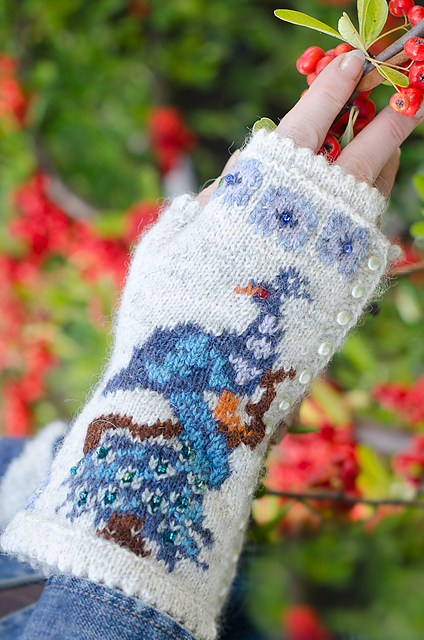
The designs are stunning.... these Peacock fingerless mitts are haunting my dreams....
but I think the best part of the book is Steph's discussion of the California Revival style and the inspirations for her designs. You can see all 14 designs on Ravelry.
Another thing we have in common is that we both work as tech editors for other designers - and we have the same trepidation of being tech edited ourselves.. After all, says the little voice in the back of your head, we should know better. In Steph's words: "...mostly I feel really stupid when someone else finds my mistakes. Invariably some are found. But then, I catch mistakes in other tech editor's patterns (I often swap tech editing with other designer/tech editors). I'm really leery of the quality of a pattern when someone blithely announces they don't bother using tech editors.m It just can be so hard to see your own mistakes, especially when you've totally immersed yourself in your pattern." I couldn't have said it better myself.
Also, this makes me feel better since Steph edited my own book, and I know she found mistakes.
I asked Steph about what she learned while writing the book, and I found something else we have in common: when we want to learn a new technique, we challenge ourselves to design with it... in particular, she mentioned that her intarsia skills are much better than the used to be. And with those Peacock Mitts, I can see why!
Did I mention how much I love the Peacock Mitts?
It's not all colourwork (phew!), there's some beaded knits, some fabulous twisted stitches and some really great lace. And you know that being a tech editor, Steph's patterns are well written and easy to follow.
Buy a digital or physical copy here.
Subscribe to:
Posts (Atom)