(Ok, so the alliteration ran out there...)
Loving the comments on my Knittyblog post about Mattress stitch. Some very helpful suggestions!
Monday, November 29, 2010

Thursday, November 25, 2010
The Precious: Snowflower Shawl
For several weeks this summer I was working on a secret project... That's the (only) problem with knitting designs for publications - I can't blog about them.
This was a big project. By yardage, it's one of the biggest things I've knit, calling for about 1500m of lace weight cashmere. And being 1500m of lace weight cashmere, it's also one of the most precious things I've knitted.
It's finally been published, and I'm thrilled to be able to show it off...
The Snowflower Shawl, for Yarn Forward Magazine Issue 31.
 (All images courtesy Yarn Forward Magazine, copyright St Range photography/Darren Strange.)
It's the last part in a three-part series on how to expand your lace knitting skills.
The first was the Double Diamond stole, in issue 29.
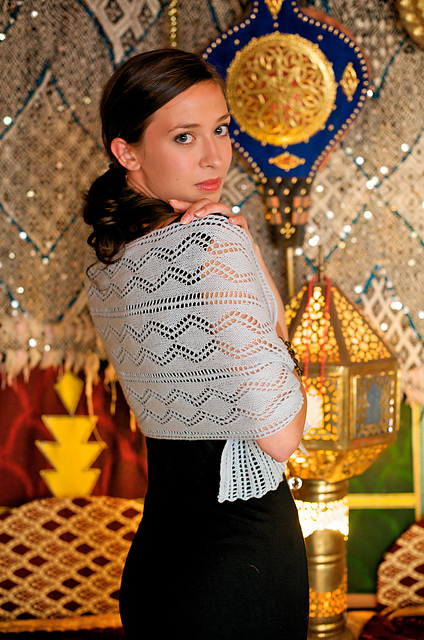 The second part was the Falling Leaves triangle shawl, in issue 30.

And the finale is this circular shawl, based on Elizabeth Zimmerman's Pi shawl shaping.
One of the reasons I love designing for Yarn Forward - other than the fact they send me such gorgeous yarns to work with - is that the publications are available digitally. The publication is based in the UK, but anyone can buy a copy, and the issues remain for sale long after the print copies have sold out.
This was a big project. By yardage, it's one of the biggest things I've knit, calling for about 1500m of lace weight cashmere. And being 1500m of lace weight cashmere, it's also one of the most precious things I've knitted.
It's finally been published, and I'm thrilled to be able to show it off...
The Snowflower Shawl, for Yarn Forward Magazine Issue 31.
(All images courtesy Yarn Forward Magazine, copyright St Range photography/Darren Strange.)It's the last part in a three-part series on how to expand your lace knitting skills.
The first was the Double Diamond stole, in issue 29.
The second part was the Falling Leaves triangle shawl, in issue 30.And the finale is this circular shawl, based on Elizabeth Zimmerman's Pi shawl shaping.
One of the reasons I love designing for Yarn Forward - other than the fact they send me such gorgeous yarns to work with - is that the publications are available digitally. The publication is based in the UK, but anyone can buy a copy, and the issues remain for sale long after the print copies have sold out.
Tuesday, November 23, 2010
Harumph, I say; harumph!
Minor guilty confession of the week: I read the Dear Prudence advice column on Slate.
Or at least I used to.
In a live chat column she wrote this week, a reader enquires:
It's the answer that made my hair stand on end:
On behalf of all the sock knitters in the world, I am truly offended that Ms. Prudence thinks that the socks we make are "lumpy, itchy and droopy". Perhaps we should launch a campaign to send her some socks so she can see the quality of what we make - and understand how very very wrong she is.
What do you think?
Or at least I used to.
In a live chat column she wrote this week, a reader enquires:
- Q. Help! Advice on Gift-Giving: I am a knitter who is knitting socks for my son's preschool class. I intend to give these socks as Christmas gifts this year. I am keeping them a secret as I would like them to be surprises. The only one who knows is the teacher as I needed her help getting the kids' feet sizes. My question revolves around the note I am going to include with the socks. Of course it will include washing and drying instructions (cold water and low heat); however, I am stumped about how to ask for the socks back if the kids don't like them, so they can be redistributed. Now, I don't really want the socks back for my own son; I would like the socks to go to someone who'd actually wear them. What would you do in this instance?
It's the answer that made my hair stand on end:
- A: In this instance, I would stop with the socks and knit a sweater for my own child. While many people enjoy handmade scarves, there's a reason people stopped wearing lumpy, itchy, droopy handmade socks as soon as industrial looms were invented. It's sweet of you to want to make gifts for the entire class, but you're investing way too much time in a gift that won't be appreciated. If you want to do something handmade, maybe you should bake some treats. Or you could offer to come in and do a knitting lesson for the kids. Unless you're making socks they can hang by the fireplace for Christmas, no one wants handmade socks in their Christmas stocking.
On behalf of all the sock knitters in the world, I am truly offended that Ms. Prudence thinks that the socks we make are "lumpy, itchy and droopy". Perhaps we should launch a campaign to send her some socks so she can see the quality of what we make - and understand how very very wrong she is.
What do you think?
Monday, November 22, 2010
Someone Else's FO: Kureyon Basic Triangle Shawl

Another lovely example of my Basic Triangle Shawl, in Noro Kureyon. Gorgeous - and thanks to Kathleen for the picture. I do so love this yarn - look at those stripes!
Wednesday, November 17, 2010
Heel: For Feet Worthy of Hand-Knit Socks
Earlier this fall, I handed a giant bag of my hand-knit socks over to a friend... my sock drawer sat practically empty for a couple of weeks, as the temperature dropped. It was a bit scary, I have to admit. I had to resort to wearing store-bought socks for a while.
And why on earth would I do something so silly?
My socks went off to modelling school to become famous.

The lovely people at Soak have just launched a new product - Heel - a wonderful foot cream - "for feet worthy of hand-knit socks". (I've been using it for a few weeks, and it's great.)
They needed some socks for the packaging art, and I'm honoured to say that they chose mine!
There's a great post on the Soak blog about the photo shoot, and some really gorgeous shots.

And why on earth would I do something so silly?
My socks went off to modelling school to become famous.
The lovely people at Soak have just launched a new product - Heel - a wonderful foot cream - "for feet worthy of hand-knit socks". (I've been using it for a few weeks, and it's great.)
They needed some socks for the packaging art, and I'm honoured to say that they chose mine!
There's a great post on the Soak blog about the photo shoot, and some really gorgeous shots.
Tuesday, November 16, 2010
Off Topic: Christmas Cake
Updates: No nuts, no! The original recipe doesn't call for them, and although I love them, hubby has some allergies. Re: loaf pans & sizes. I've used a variety of pans and it works great. 8 by 8 square plans, big loaf pans, small loaf pans.... I don't worry about the size of pan, I just start checking for doneness at the 2 hour mark.
I've been tweeting about this often enough and had enough questions that I figured I should just blog about it...
Like many Canadians, I'm an immigrant in a culturally mixed marriage, and Norman and I try to honour the holidays and traditions of both our cultures. One cultural tradition I've brought to the relationship is fruitcake. I absolutely adore fruitcake. I know it's not to everyone's taste, but I also insist that many haven't tasted it the way it's supposed to be made.
And in my opinion, that's boozy. (Apologies to the non-drinkers in the crowd. I know and respect that there are some who don't drink or use alcohol. You can actually get a very similar effect by using a mixture of strong coffee and fruit juice for soaking the fruit, and then soaking the cakes in fruit cordials and syrups.)
My Mum makes the "proper" cake every year, the one we eat during the actual festive meals. I make what I've come to refer to as the "standby" cake. The one we can eat in the run up to Christmas, the one we can offer to guests, the one I can cut up and take to parties and get-togethers during the season. Although Mum's is more traditional, the way I love it, I've found that many fruitcake skeptics enjoy my slightly unorthodox (pun intended?) version. My cake is very dark, sticky and fudgy in texture - and fairly moist with dark rum.
As I tweeted, the recipe I use is, oddly, Canadian. When we first arrived in Canada, my Mum bought of a copy of the now-out-of-print Madame Jehane Benoit's Encyclopedia of Canadian Cooking.
Shortly after I finished university, I decided I wanted to try making fruitcake, but being an inexperienced baker with a minimal kitchen and budget, I wasn't sure I was up for trying the full thing. Mum found me a recipe in Madame Benoit's book - called, amusingly enough, My Mother's Fruitcake.
I've been making it for years now, and I think it's pretty good.
The book seems to be long out of print, and so, with full credit, here's the recipe:
“My Mother’s Fruit Cake” from Madame Jehane Benoit’s Encyclopedia of Canadian Cooking
2 cup currants
2 cups seedless raisins
1 cup mixed peel
1/4 cup rum or orange juice
2 cups butter
2 cups fine granulated sugar
6 eggs, well beaten
2 cups molasses
7 cups all purpose flour
1 tsp baking powder
1 tsp ground nutmeg
1 tablespoon cinnamon
1 tablespoon ground cloves
Put fruit and juice/rum in a bowl and soak for 12 hours, covered, stirring a a few times.
Preheat oven to 240 deg F. (Yes, very low.) Line cake tins with greaseproof paper.
Cream butter with sugar until very light. Add eggs one by one, stirring hard each time. Add molasses.
Sift together dry ingredients.
Add half of flour to creamed butter, mix well.
Add rest of flour alternately with fruit.
Stir until thoroughly blended.
Bake for 3 hours or until cake tester comes out clean.
My notes:
1. I play fast and loose with the fruit. I usually cut back on the raisins and currants and make up the amount with dried cranberries (or glace cherries, but the cranberries are better). I put some finely chopped candied ginger in one year, that was nice. If you don 't like the mixed peel, ditch that and use more cranberries and even dried cherries and blueberries.
2. 1/4 cup juice or rum for 12 hours.... I use about 1/2 to 3/4 cup of booze – whatever is in the bar: rum, gold tequila, rye, bourbon, Southern Comfort, cheap scotch, brandy – and soak for about a week.
3. I use strong dark molasses – the blackstrap variety – because I love the dark and slightly bitter taste it brings. If you’re less about molasses, use the lighter kind.
4. I bake it at least three or four weeks early then store it in the fridge in containers and pour dark rum on it every few days. It will seem fairly soggy, that's ok. Stop watering it about a week before you want to start serving it so the top dries out a bit. This is really the key to making it more interesting and fun than "normal" fruitcake.
5. The batter gets very hard to stir once you’re adding the flour & fruit in. Use serious wooden spoons. I usually lose at least one spatula or wooden spoon to it every year.
6. I bake in loaf pans and it takes 2 to 2 and a bit hours. It’s hard to tell if it’s done – I do the tap the underside trick, like loaves of bread.
I've been tweeting about this often enough and had enough questions that I figured I should just blog about it...
Like many Canadians, I'm an immigrant in a culturally mixed marriage, and Norman and I try to honour the holidays and traditions of both our cultures. One cultural tradition I've brought to the relationship is fruitcake. I absolutely adore fruitcake. I know it's not to everyone's taste, but I also insist that many haven't tasted it the way it's supposed to be made.
And in my opinion, that's boozy. (Apologies to the non-drinkers in the crowd. I know and respect that there are some who don't drink or use alcohol. You can actually get a very similar effect by using a mixture of strong coffee and fruit juice for soaking the fruit, and then soaking the cakes in fruit cordials and syrups.)
My Mum makes the "proper" cake every year, the one we eat during the actual festive meals. I make what I've come to refer to as the "standby" cake. The one we can eat in the run up to Christmas, the one we can offer to guests, the one I can cut up and take to parties and get-togethers during the season. Although Mum's is more traditional, the way I love it, I've found that many fruitcake skeptics enjoy my slightly unorthodox (pun intended?) version. My cake is very dark, sticky and fudgy in texture - and fairly moist with dark rum.
As I tweeted, the recipe I use is, oddly, Canadian. When we first arrived in Canada, my Mum bought of a copy of the now-out-of-print Madame Jehane Benoit's Encyclopedia of Canadian Cooking.
Shortly after I finished university, I decided I wanted to try making fruitcake, but being an inexperienced baker with a minimal kitchen and budget, I wasn't sure I was up for trying the full thing. Mum found me a recipe in Madame Benoit's book - called, amusingly enough, My Mother's Fruitcake.
I've been making it for years now, and I think it's pretty good.
The book seems to be long out of print, and so, with full credit, here's the recipe:
“My Mother’s Fruit Cake” from Madame Jehane Benoit’s Encyclopedia of Canadian Cooking
2 cup currants
2 cups seedless raisins
1 cup mixed peel
1/4 cup rum or orange juice
2 cups butter
2 cups fine granulated sugar
6 eggs, well beaten
2 cups molasses
7 cups all purpose flour
1 tsp baking powder
1 tsp ground nutmeg
1 tablespoon cinnamon
1 tablespoon ground cloves
Put fruit and juice/rum in a bowl and soak for 12 hours, covered, stirring a a few times.
Preheat oven to 240 deg F. (Yes, very low.) Line cake tins with greaseproof paper.
Cream butter with sugar until very light. Add eggs one by one, stirring hard each time. Add molasses.
Sift together dry ingredients.
Add half of flour to creamed butter, mix well.
Add rest of flour alternately with fruit.
Stir until thoroughly blended.
Bake for 3 hours or until cake tester comes out clean.
My notes:
1. I play fast and loose with the fruit. I usually cut back on the raisins and currants and make up the amount with dried cranberries (or glace cherries, but the cranberries are better). I put some finely chopped candied ginger in one year, that was nice. If you don 't like the mixed peel, ditch that and use more cranberries and even dried cherries and blueberries.
2. 1/4 cup juice or rum for 12 hours....
3. I use strong dark molasses – the blackstrap variety – because I love the dark and slightly bitter taste it brings. If you’re less about molasses, use the lighter kind.
4. I bake it at least three or four weeks early then store it in the fridge in containers and pour dark rum on it every few days. It will seem fairly soggy, that's ok. Stop watering it about a week before you want to start serving it so the top dries out a bit. This is really the key to making it more interesting and fun than "normal" fruitcake.
5. The batter gets very hard to stir once you’re adding the flour & fruit in. Use serious wooden spoons. I usually lose at least one spatula or wooden spoon to it every year.
6. I bake in loaf pans and it takes 2 to 2 and a bit hours. It’s hard to tell if it’s done – I do the tap the underside trick, like loaves of bread.
Wednesday, November 10, 2010
On The Road Again: Shall We Knit

This weekend I'm back to teach some classes at Shall We Knit in New Hamburg, just outside of Kitchener.
I had a marvelous time when I was there in April, and I'm thrilled to have been invited back.
I'm teaching my ever-popular Fearless Finishing class, and my Yarn Knowledge class. Yarn Knowledge is a newer class on my list, and I developed in response to the questions I hear regularly from knitters - newer and established alike...
- Mystified by all these terms - double knitting, worsted, aran? Unsure whether fingering is a potato or a yarn? Wondering why you should care about whether a yarn is superwash or not? How do you go about finding a substitute yarn for a pattern? This class will explain yarn terminology, help you understand yarn substitution and gauge, and make you a more confident yarn shopper and knitter.
Info on both classes here.
Some spaces are still available.
And I'll be back there in January for Continental Knitting, and my wild and crazy Two Socks In One Class.
Monday, November 08, 2010
Qiviut Sock Yarn
Go look at today's Knitty Blog post - Qiviut sock yarn! And if you don't know why that's exciting, that's extra reason to read it.
The Naked Sheep: So Long and Thanks for All the Fish
Yesterday I taught my last class at The Naked Sheep in Toronto. I've been teaching there since it opened, in mid 2004.
This wonderful little yarn shop in Toronto's Beaches district is closing this month, and I'm sad to see it go.
I am so very grateful to both Lorena, the original owner,
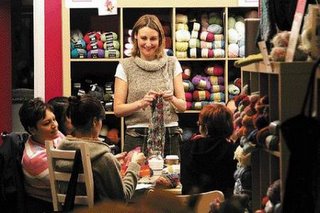
and Lisa,

the current owner, for the opportunity to teach there all these years.
The Naked Sheep gave me my big break - it was the first shop I taught at. The Naked Sheep introduced me to Noro. The Naked Sheep allowed me to mingle with so many wonderful people. I will miss my classes there, and my Sunday morning gang, and the excellent team who worked there.
It's thanks to the Sheep that I am the knitter and teacher and designer I am. Without the Sheep, I'd still be stuck in a cubicle somewhere in IT-land, wishing I could knit during conference calls.
The Sheep was one of the first of the current generation of knitting shops in Toronto - shops that appeal to newer knitters, to a younger crowd. In the 1990s in Toronto many of the knitting shops closed down, and only a few hardy stores remained. When she opened in 2004, Lorena had a store that appealed not only to established knitters, but also created an environment that lured in younger non-knitters. The Sheep's beginner classes and Wednesday knit nights remained amazingly popular all throughout the life of the store. When Lisa purchased the store, her enthusiasm and energy took the store to a new level and she did an amazing job of running it while holding down a full-time job and being a mother to two very active kids.
Many, many knitters in Toronto are knitters because of the Sheep.
All I can say is thank you.
This wonderful little yarn shop in Toronto's Beaches district is closing this month, and I'm sad to see it go.
I am so very grateful to both Lorena, the original owner,
and Lisa,
the current owner, for the opportunity to teach there all these years.
The Naked Sheep gave me my big break - it was the first shop I taught at. The Naked Sheep introduced me to Noro. The Naked Sheep allowed me to mingle with so many wonderful people. I will miss my classes there, and my Sunday morning gang, and the excellent team who worked there.
It's thanks to the Sheep that I am the knitter and teacher and designer I am. Without the Sheep, I'd still be stuck in a cubicle somewhere in IT-land, wishing I could knit during conference calls.
The Sheep was one of the first of the current generation of knitting shops in Toronto - shops that appeal to newer knitters, to a younger crowd. In the 1990s in Toronto many of the knitting shops closed down, and only a few hardy stores remained. When she opened in 2004, Lorena had a store that appealed not only to established knitters, but also created an environment that lured in younger non-knitters. The Sheep's beginner classes and Wednesday knit nights remained amazingly popular all throughout the life of the store. When Lisa purchased the store, her enthusiasm and energy took the store to a new level and she did an amazing job of running it while holding down a full-time job and being a mother to two very active kids.
Many, many knitters in Toronto are knitters because of the Sheep.
All I can say is thank you.
Friday, November 05, 2010
My Old Nemesis, We Meet Again
In the fall of 2005, I knitted a scarf with KidSilk Haze.

The idea was that since I had a winter coat that was fairly... err... bold in its patterning, I needed black accessories to go with it.
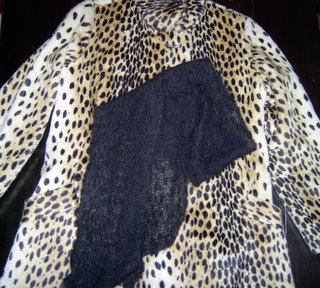
It may well have been the single most miserable knitting experience of my life.
Awful.
The post I wrote back then seriously undersells the pain I suffered. I refrained from grumbling about how many times I changed needles to find ones that worked well with the yarn. I never did find a needle that made it an enjoyable experience.
It was so awful I remember it well. Bitterly. I shudder at the thought.
And I was desperately unhappy with the finished result - it wasn't wide enough, I'd stopped short of the intended length, and the cast off was too tight. I put it away, and swore never to use the yarn again.
I had such a miserable time that I regularly warn people away from the yarn.
I nearly staged an intervention once when I saw a mother teaching her daughter to knit with this yarn.
But then, oh then... I found the scarf again this fall. And I wore it for the first time since the fall of 2005.
Oh dear god, it's gorgeous. It's light, and ethereal and warm and actually very nice. It's still too narrow to wear as I had intended, but it looks really rather great as a little cravat sort of thing.
So... as I'm noodling on a project I need to demonstrate the use of biasing to a newer knitter, I ponder again my garter stitch scarf. Am I crazy to think I should recommend this (with firm notes on appropriate needle choice and pointers on how not to lose your mind) to new-ish knitters?
The idea was that since I had a winter coat that was fairly... err... bold in its patterning, I needed black accessories to go with it.
It may well have been the single most miserable knitting experience of my life.
Awful.
The post I wrote back then seriously undersells the pain I suffered. I refrained from grumbling about how many times I changed needles to find ones that worked well with the yarn. I never did find a needle that made it an enjoyable experience.
It was so awful I remember it well. Bitterly. I shudder at the thought.
And I was desperately unhappy with the finished result - it wasn't wide enough, I'd stopped short of the intended length, and the cast off was too tight. I put it away, and swore never to use the yarn again.
I had such a miserable time that I regularly warn people away from the yarn.
I nearly staged an intervention once when I saw a mother teaching her daughter to knit with this yarn.
But then, oh then... I found the scarf again this fall. And I wore it for the first time since the fall of 2005.
Oh dear god, it's gorgeous. It's light, and ethereal and warm and actually very nice. It's still too narrow to wear as I had intended, but it looks really rather great as a little cravat sort of thing.
So... as I'm noodling on a project I need to demonstrate the use of biasing to a newer knitter, I ponder again my garter stitch scarf. Am I crazy to think I should recommend this (with firm notes on appropriate needle choice and pointers on how not to lose your mind) to new-ish knitters?
Saturday, October 30, 2010
Friday, October 29, 2010
Catnip-stuffed Cat Toy: Free Pattern
I've developed a knitted cat toy pattern recently, and being currently without a cat, I would love a few knitters and their kitties to test it for me.
Sarah and her adorable Gabby have already given it a go and it found it reasonably suitable.
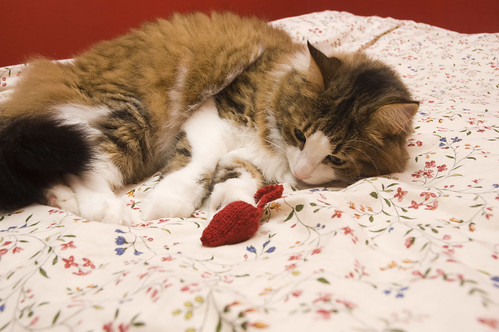
In particular, I'd like it to be tested with a superwash wool and a non-superwash wool - I want to know if the felting works for or against it in terms of longevity of play.
Please leave any and all feedback as comments - thanks much! Easy to read? Makes sense? Fun to knit? Fun to play with? The pattern is designed to be a reasonably easy intro to working on DPNs - do you think that's the case?
And even if you don't have comments - knit away, and may both you and the feline members of your family have fun!
Mouse for Kittie
Materials, Finished Size & Gauge:
I used Sirdar Eco Wool DK and 3.75mm dpns, but any pure wool would work nicely; use needles a size smaller than the ball band calls for.
This yarn and needle combo gave me a finished size of mouse about 3 inches long, with a gauge of about 23 sts per 4 inches. Ultimately, as long as it's a reasonably tight fabric - to keep the stuffing in - you're good.
Method:
Cast on 12 sts using your favourite method, leaving an 8 inch tail. Distribute across 3 dpns - 4 on each. Join for working in the round, being careful not to twist.
(Bonus expert tip: even if it is twisted, you can fix this after the first round. Make sure you check after knitting the first round, and if you need to, untwist!)
Knit 1 round even, pulling the first stitch nice and snug. Place a safety pin in the fabric to mark the start of round.
Round 2: (K1, m1, k2, m1, k1) 3 times. 18 sts.
Round 3: Knit.
Round 4: (K1, m1, k4, m1, k1) 3 times. 24 sts.
Rounds 5-9: Knit.
Round 10: (K2tog, k6) 3 times. 21 sts.
Round 11: Knit.
Round 12: (K2tog, k5) 3 times. 18 sts.
Round 13: Knit.
Round 14: (K2tog, k4) 3 times. 15 sts.
Round 15: Knit.
Round 16: (K2tog, k3) 3 times. 12 sts.
Round 17: Knit.
Round 18: (K2tog, k2) 3 times. 9 sts.
Round 19: Knit.
Round 20: (K2tog, k1) 3 times. 6 sts.
Cut yarn, leaving a 4-inch tail. Thread yarn onto darning needle and pull through rem stitches. Cinch to close.
Stuff mouse firmly with a combination of wool roving or snipped wool yarn ends, with a little bundle of catnip wrapped in a tissue in the middle. (Cats don't like the smell of plastic, so they may not like a polyester-stuffed mouse as much.)
Thread tail from cast-on onto darning needle and use it to gather the cast-on edge. It doesn't need to be pretty. Pull it tight to close and weave in both ends.
To make a tail, cut three 16 inch lengths of your yarn. Thread them through the gathered cast-on end, ensuring they are hanging evenly - you want 6 threads of about the same length. Tie an overhand knot in all six as close to the top as possible, and then braid the tail together, doubling each strand. When tail is about 3 or 4 inches long, finish with another overhand knot, and trim, leaving a 1-inch tassel.
Hand to cat, and see what happens.

Sarah and her adorable Gabby have already given it a go and it found it reasonably suitable.
In particular, I'd like it to be tested with a superwash wool and a non-superwash wool - I want to know if the felting works for or against it in terms of longevity of play.
Please leave any and all feedback as comments - thanks much! Easy to read? Makes sense? Fun to knit? Fun to play with? The pattern is designed to be a reasonably easy intro to working on DPNs - do you think that's the case?
And even if you don't have comments - knit away, and may both you and the feline members of your family have fun!
Mouse for Kittie
Materials, Finished Size & Gauge:
I used Sirdar Eco Wool DK and 3.75mm dpns, but any pure wool would work nicely; use needles a size smaller than the ball band calls for.
This yarn and needle combo gave me a finished size of mouse about 3 inches long, with a gauge of about 23 sts per 4 inches. Ultimately, as long as it's a reasonably tight fabric - to keep the stuffing in - you're good.
Method:
Cast on 12 sts using your favourite method, leaving an 8 inch tail. Distribute across 3 dpns - 4 on each. Join for working in the round, being careful not to twist.
(Bonus expert tip: even if it is twisted, you can fix this after the first round. Make sure you check after knitting the first round, and if you need to, untwist!)
Knit 1 round even, pulling the first stitch nice and snug. Place a safety pin in the fabric to mark the start of round.
Round 2: (K1, m1, k2, m1, k1) 3 times. 18 sts.
Round 3: Knit.
Round 4: (K1, m1, k4, m1, k1) 3 times. 24 sts.
Rounds 5-9: Knit.
Round 10: (K2tog, k6) 3 times. 21 sts.
Round 11: Knit.
Round 12: (K2tog, k5) 3 times. 18 sts.
Round 13: Knit.
Round 14: (K2tog, k4) 3 times. 15 sts.
Round 15: Knit.
Round 16: (K2tog, k3) 3 times. 12 sts.
Round 17: Knit.
Round 18: (K2tog, k2) 3 times. 9 sts.
Round 19: Knit.
Round 20: (K2tog, k1) 3 times. 6 sts.
Cut yarn, leaving a 4-inch tail. Thread yarn onto darning needle and pull through rem stitches. Cinch to close.
Stuff mouse firmly with a combination of wool roving or snipped wool yarn ends, with a little bundle of catnip wrapped in a tissue in the middle. (Cats don't like the smell of plastic, so they may not like a polyester-stuffed mouse as much.)
Thread tail from cast-on onto darning needle and use it to gather the cast-on edge. It doesn't need to be pretty. Pull it tight to close and weave in both ends.
To make a tail, cut three 16 inch lengths of your yarn. Thread them through the gathered cast-on end, ensuring they are hanging evenly - you want 6 threads of about the same length. Tie an overhand knot in all six as close to the top as possible, and then braid the tail together, doubling each strand. When tail is about 3 or 4 inches long, finish with another overhand knot, and trim, leaving a 1-inch tassel.
Hand to cat, and see what happens.
Monday, October 25, 2010
One lousy stitch
The Harlot has experienced this issue recently, too.
I have been working two socks at the same time - no, not that way - just two socks on two different sets of needles. One is on dpns, the other on magic loop. I often do this, to take as a prop to my sock knitting classes.
I've been working on the two, on and off, and as it often the way with projects I take to classes as demos, I'm not always paying full attention to them. Stuff goes wrong.
Take a look at the current pair - both almost finished.

See something odd?
The one sock (the upper one in the photo) has a nice organic stripey pattern all throughout the sock. The second (the lower one in the photo) has a rather nifty and much more regular stripe pattern on the foot. The red is pooling on one side of the foot.
All well and good, but they don't look the same anymore.
I did some thinking and some counting and came to a rather embarrassing realization: I'd missed a gusset decrease somewhere, and one sock has one stitch more than the other. One single lousy stitch can make this much of a difference. Wild, eh?
(Yes, that's Dexter helping me with the photoshoot. He is sad that the socks seem to be too big for him.)

Saturday, October 23, 2010
3 Months
 Three months ago today Dexter moved in with us. In the first days after he was found, we shared fostering him with a neighbour, the lovely Florence. Dexter spent the days with us, and nights snuggled with Florence, as we didn't want to leave him alone in his injured and confused state.
In those first days, he mostly slept, as he was recovering from his injuries. He had a nasty cut on his tail, and wobbly back legs - likely due to a run-in with a bike or a scooter.
He moved in with us full-time on July 23rd, exactly a week after he mysteriously appeared in another neighbour's front yard. We got him a new collar and leash, and a tag with our phone number and his (new!) name inscribed on it. At that point, we were still searching for his family - online, through various animal services, and with posters distributed to vets all around the city and around the neighbourhood. At about the three week mark it became pretty clear that he'd settled in, he was feeling much better (thanks to Dr. Larry and team, our excellent vets) and no-one was looking for him. And over those weeks, he became our dog.
Based on how he looks, and his personality and behaviours, we're absolutely confident he's a beagle mix of some kind. We are also fairly sure that the other half of the mix is coonhound, as he looks remarkably like one - just half the size - and displays a lot of their known behavioural and personality traits, including a passion for treeing and barking at squirrels.
Whatever he is, he's definitely a scent-hound. He's also a quick study, a little stubborn, and mouthy.
Things we've learned in three months of living with a hound:
- His favourite walk of the week is Tuesday morning - garbage day! Much to sniff.
- He can run with great speed, although his right back leg is a bit flappy, the only lingering effect of his injuries.
- He can open our front door if we forget to lock it.
- He has a bedtime. Whether we've walked or not, no matter what we're all doing, at 10:45pm Dexter gets up on the bed and snuggles down for the night.
- And balls of yarn are precisely that.... balls, to be chased around the house and played with.
Friday, October 22, 2010
If they don't provide a lanyard for the pass, you can always make one

Look! A crochet FO!
This is about as sophisticated as I get with a crochet hook, but I thought it was pretty clever....
Sunday, October 17, 2010
Creativ Festival Classes
 Just a reminder that I`m teaching a few classes at the Creativ Festival in Toronto this coming weekend...
Some of them are sold out (!), but a few spaces remain in the following classes:
-Cables 101, Friday at 6pm
-Fixing Mistakes, Saturday at 11am
and
-Designing Custom-Fit Socks, Saturday at 1pm.
More info on the classes and registration details here...
I like teaching at this show - it`s a great way to meet knitters from outside of the Toronto area.
And of course, there`s always some shopping to do.
I`ll also be making some appearances in the booth of A Needle Pulling Thread magazine - drop by to say hello.
Tuesday, October 12, 2010
The Lizard Ridge Leftovers/Insanity Vest Continues Apace


This will certainly be a discussion piece. You're not seeing the full impact of the colours since it's a self portrait taken in our green bathroom in poor light.
I will wear it as you see it here - with a black t-shirt and jeans.
Since the photo was taken, I had a good evening of knitting and I'm into the final stretch of the body. The only decisions left will be how to edge it, and what I'll need to give Denny to thank her for weaving in all those ends...
I think for edging I'll just do a simple rolled edge - picking up stitches all the way around, knit a round or two, and then cast off.
Saturday, October 09, 2010
In Which I Show My Dirty Laundry, Metaphorically
A post on the Knittyblog about why I love spreadsheets, and how I use them to help me in my knitting.
Showing the world that snippet of my stash inventory feels like showing my dirty laundry in public, it really does.
Denny confessed to me today that she really couldn't understand how I could be good at math and bad at arithmetic. Ask anyone who's tried to split a restaurant bill with me - I always have to get my writer hubby to work out the tip.
On a different note: Happy Birthday, John. The world misses you. I miss you. You have been more of an influence on me than many know - and not just because of my undying love for Chelsea boots and caps.
Monday, October 04, 2010
At Last! A Solution for My Lizard Ridge Leftovers
I finished Lizard Ridge 3 years, 3 months and 10 days ago.
Since then, there has been a little plastic bag of leftovers in my stash.

When I cleaned out my stash a few weeks ago, I was reminded that it was there.
And I started thinking.
I'd always meant to use them up, these leftovers. I'd weighed it - there was about 400gm in the bag. (If truth be told, it's not entirely Lizard Ridge leftovers. There are a few bits and pieces from other projects in there, too.) But net net: I had 400m of Kureyon, mostly in little tiny 5g balls.
I had tried some crochet, but since there wasn't enough to make an actual blanket - and given that I already had a Kureyon blanket - it didn't seem like the right application.
I've been teaching a class recently on my Top-Down Vest pattern, and I've been working with the pattern, trying a few modifications and variations. The original pattern calls for worsted weight gauge - 20 sts/4 inches. But there was no reason I couldn't do it with an aran weight (18 sts/4 inches) - and 400m is just about exactly what I need to make a vest.
And the die was cast.
So I have began a top-down vest with my Lizard Ridge Leftovers.
There is a fine line between a knitting project that marks you as eccentric, and one that marks you as truly insane.


I'll let you judge whether I have crossed the line...
Sunday, October 03, 2010
Hats Hats Hats!
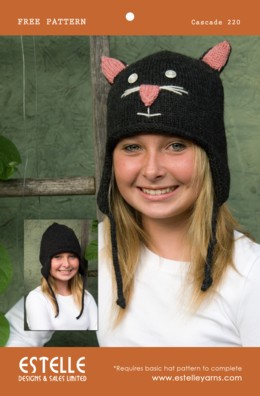
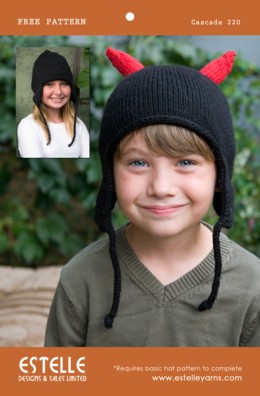
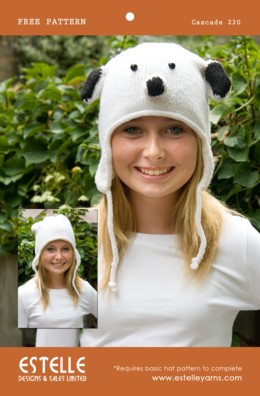
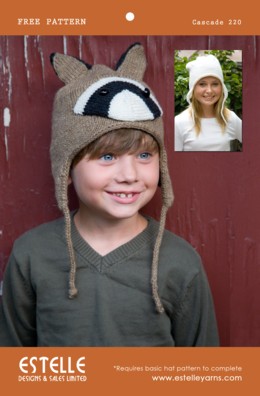
A few months ago I worked on a series of hat designs for Estelle yarns. Much fun was had...
There's the basic hat... Nice and simple, using Cascade 220 - with earflaps for warmth.
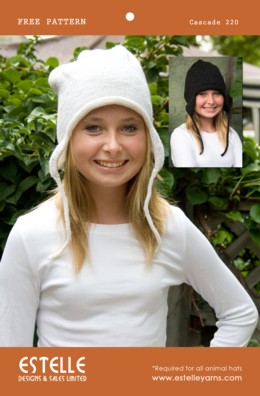
There's a kitten...
A devil...
A polar bear...
And naturally, a raccoon...
Free patterns available for download here. Something for every taste and personality!
There's the basic hat... Nice and simple, using Cascade 220 - with earflaps for warmth.
There's a kitten...
A devil...
A polar bear...
And naturally, a raccoon...
Free patterns available for download here. Something for every taste and personality!
Subscribe to:
Posts (Atom)