Tuesday, August 17, 2010

Wheatsheaf Shawl and Double Diamond Stole; Making Lace Accessible

Bit behind on this one... I've had two lace designs published in recent issues of Yarn Forward Magazine.

The Wheatsheaf Shawl was featured in Issue 28, and it's specifically written to be accessible even for a non-lace knitter. I spent a lot of time considering the elements that make lace challenging, and figuring out how to address them in the design and the pattern. It's only a two-row pattern repeat for the basic last stitch, and one of them is a plain purl row! Easy-peasy! And I wrote out how to incorporate the increases into the lace stitch in detail.

And last but not least, I did something a little different in the centre spine... Most top-down lace shawls have an innocent-looking central spine of yo, k1, yo... Seems simple enough, but it's actually very difficult to work for a knitter who's not confident with yarnover increases. You can't reliably place a marker, as the yarnovers can get wrapped around them, and the marker can end up in the wrong place. And if the yarnover travels, the central spine goes horribly awry. I see this a lot in my classes. The knitter can be doing everything right, but a slipped marker can make things go horribly wrong! So I changed up the central spine to be 2 stitches: yo, k2, yo. It looks just as good, but allows you to safely and confidently place a marker. And I think it looks good too - it harmonizes very well with the edgings. I'm not sure why it's not more common, to be honest. It seems like a simple and elegant solution to a vexing problem.

ElectroGirl has posted a finished Wheatsheaf shawl on Ravelry and I love it. Great choice of yarn, and she did a terrific job of both knitting and photographing it.


The writeup has lots of hints and tips to make lace knitting easy and fun - and ideally get knitters hooked so that they will consider other projects - like the Double Diamond Stole, for example!

The Double Diamond Stole in Issue 29 is a great next step. See a picture at this preview.

It's an easy-to-manage but very rewarding and beautiful project. It's worked in cashmere from ColourMart - my god, I loved working with this yarn. It adds a small level of challenge in that there are a few different patterns rows and a decrease that might be new to some knitters, but it's still entirely approachable for all skill levels. Yarn Forward was generous enough to provide me enough space to be able to include a really detailed pattern writeup to guide knitters through the project. There are both written instructions and charts, so that knitters who prefer one over the other are accommodated.

Can't wait to see the projects on Ravelry!

Thursday, August 12, 2010

Ready for Sweater Weather

Even when I was a teenager, long before I was the avid knitter I am now, the middle of August would find me longing for "sweater weather".

This year the craving is stronger than it's ever been. Between the insanely hot summer we've had, and my proximity to all these stunning fall yarns, I'm absolutely ready for summer to be over.

Now, I'm not crazy. I'm not yet ready for full-on jackets and sleeves and mitts and boots and all that nonsense, but I'm definitely starting to feel vest-y. I've got some really great (sadly also discontinued) Harris Chunky Rowan yarn in my stash...


and it's screaming out to be made into something for those first few crisp days of fall.

I bought the yarn from the bargain bin at the Sheep a while ago with a specific project in mind; it's just been waiting for a slot to open up in my schedule so I could actually knit with it.

As to what I'm going to do with it... I have a pretty firm idea.

Back when The Naked Sheep first opened, I designed a vest for the shop in the newly released Rowan Plaid. The yarn is now discontinued, and it's a shame. It was a good one: a not too weighty chunky yarn, with nice colour combos, and a great hand. It was a blend of wool, alpaca and acrylic, so it was warm but light.

The vest itself was very simple - worked in reverse stocking stitch, with a single cable running up one side, and with a cowl neck.


The sample is long gone, too... I believe it may have moved to B.C. with the old shop owner, Lorena. I know she used to wear it. (That's the ultimate compliment that can be paid to a sample you've knitted for a shop - finding the owner wearing it!)

In fact, she's wearing it in this picture...


I want to recreate the vest so I get to wear it this time!

Of course, I can't leave well enough alone... this 2010 version will be worked from the top-down so that I can make it a bit longer. I don't have tons of yardage, and this way I'll be able to use up every last bit. The new yarn is a bit more textured than the original, so I think it requires a slightly larger scale cable, too.

I'm desperate to get going, but there is the small matter of the sock project I need to finish first...

Thursday, August 05, 2010

Dexter Update


Over on the KnittyBlog... there's a lesson for every pet owner in Dexter's story.

Monday, August 02, 2010

Finishing: Very Helpful Links

It's no secret that I have strong opinions to share on finishing.

Good finishing makes all the difference in a project. Good finishing techniques make a project look,... well... finished.

I know it's not necessarily the most fun part of a knitting project. It's sort of like ironing your cotton clothes, however - a necessary step to make something look its best.

And I know that a lot of knitters don't feel confident about finishing. I can't say I blame them - it's not well explained in the patterns or books in general. The average pattern will say something helpful like "sew up", or "assemble", or - my favourite - "set in sleeves". And it's not necessarily covered in sufficient detail in the books, either.

But as I prove every time I teaching a finishing class, taking time to use proper seaming techniques is absolutely 100% worth it.

A proper seam is smooth, tidy and invisible.

Here, let me show you...

Seamed using the techniques you would normally use to seam fabric:


Seamed using Mattress stitch:


What do you think?

Proper seaming techniques aren't difficult - but I do find they simply aren't well known. Even very skilled and experienced knitters don't necessarily know how to seam a good seam.

I learned many of my techniques from my bible, Vogue Knitting. And I recently discovered that their Knit Simple publication's website has a lot of helpful info - including a page of info about some of the key seaming techniques.

And as usual, Theresa provides an incredibly helpful how-to on Knitty.

Go! Check them out! Key information! Seriously! These won't necessarily make Finishing more fun, but they will certainly help you make it easier and better.

Tuesday, July 27, 2010

Basic Triangle Shawl FOs; Creativ Festival Classes


A couple of weeks ago I published my Basic Triangle Shawl pattern.

SheepLady75 on Ravelry has created an absolutely stunning one in her rainbow-coloured handspun. I am blown away by how the colours progress and work so well with the shape. And Mom2Bassets has worked one in a very sophisticated and chic colourway of Mushishi.

Wow - they're both great! This is precisely the sort of thing I imagined when I created it - a great use for a coloured or textured yarn, and a great TV or travel knitting project.

On a different note, the schedule for Creativ Festival has just been released, and I'm teaching a number of classes. The event takes place October 23, 24 & 25th at the Metro Convention Centre in Toronto.

Sunday, July 25, 2010

Update: No-one Looking for the Little Guy


So he's staying here, and he seems to like it.

And we like it very much.

We're calling him Dexter. If a family calls, and can prove he belongs with them, he can go. Failing that, we're his family now.

Wednesday, July 21, 2010

Two Non-Knitting Things Keeping Me Busy This Week

Am taking a sewing class at The Workroom in Toronto. It's a day camp for grownups for the week - complete with candy and treats.

It's a Amy Butler shirtdress project - if you've seen me around this summer, you know how much I love wearing shirtdresses - and as soon as I saw it advertised I had to sign up.

It's a fun group, and it's great to stretch my sewing skills - I don't do it nearly often enough.

The other thing that's keeping us busy is this little guy:


He was found by a neighbour in her yard on Friday, and we've been busy working with our neighbours taking care of him, and trying to find his family. He's a sweetheart, he really is, and we're sure that somewhere there is a family missing him very much. He has no chip, and no tags on his collar, so there was absolutley no info about who he is or where he came from. We've posted at the Humane Society and with City Animal Services; we've been using Twitter and Facebook and Craigslist. We've searched classified ads in all the local papers. We've emailed all the vets in the area, and we're postering.

We're also making sure he feels safe and taken care of - making sure he's not alone, and he's fed and healthy.

No news, so far. It's a heartbreaker, the idea that there is a family somewhere without their little guy. And if there isn't someone looking for him, it's a heartbreaker in a different way. We will keep looking - we're carrying posters further afield today.

If you know who he might be, or you're willing to put a poster in your neighbourhood in Toronto, please email founddog@wilnervision.com.

Friday, July 16, 2010

Secret Knitting: Not Very Exciting

I've just finished a big Secret Knitting Project. Secret Knitting Projects are those that are meant for publication...

Secret Knitting Projects make for terrible blog fodder. We can't show them off, you see. They are Secret!

You've seen hints of it, in various photos of late.

Secret Knitting has spent hours on the bench in our yard, enjoying the sunshine.


Secret Knitting went to Coney Island.


Secret Knitting has enjoyed with me an iced coffee or twelve.


Secret Knitting has ridden the streetcar, back and forth across Toronto, many times. Secret Knitting got caught in a G20-related TTC stoppage.

Secret Knitting has been around, it's true. It's a big project. By yardage, it's one of the largest projects I've ever worked. It's a fine yarn, so it wasn't too big to carry around until the final stages. But it is a warm yarn - cashmere - so there were days when it was a challenging project to work in public in this hottest of hot summers.

And now, Secret Knitting is in a puffy envelope, making its way to a Secret Location for photography.

I'm proud of this one, and can't wait to show it off when the time comes.

Fly safe, Secret Knitting - I look forward to your eventual return home!

Wednesday, July 14, 2010

Free Pattern: Basic Triangle Shawl - Non-Lacy, Very Easy


I love a top-down triangle shawl, but I don't always want to knit lace. A plainer shawl is much more suited to wearing with a parka in the depths of winter, and is much easier to knit.

This is an ideal first shawl project for a newer knitter, or a relaxing knit for an experienced knitter. Shaped from the top down, it uses the "kfb" increase and markers to help you on your way, and it's a great introduction to the top-down triangle construction.

If you're not sure about yarnovers - or just not wanting lace - this is the shawl for you!

A PDF version is available on Ravelry.

FINISHED MEASUREMENTS
Approximately 136 cm/54 inches wide x 21 inches/54 cm long after blocking.

MATERIALS
2 x 50gm balls Rowan Felted Tweed (50% Merino, 25% Alpaca, 25% Viscose, 175m/ball) -sample uses colour 150
-substitute 350m of any worsted weight yarn - e.g. Cascade 220 or Noro Kureyon
4.5mm needles - a 24 inch/60 cm circular is easiest, butyou can use straight needles if you prefer
a single 6mm needle for casting off
a stitch marker

GAUGE
approximately 16 sts and 26 rows = 4 ins by 4 ins/10 cm by 10 cm in stocking stitch
it's not critical for this project - what's most important is that you like how the fabric looks & feels

METHOD
Top Edge
The top edge is established in garter stitch.

With 4.5mm needle, cast on 9 sts. Use the long tail or the cable cast on. (These are links to videos on knittinghelp.com for these cast-on methods.)

Row 1 (RS): Kfb, k2, kfb twice, k2, kfb, k1. 13 sts.
Row 2 (WS): Knit.
Row 3 (RS): Kfb, k4, kfb twice, k4, kfb, k1. 17 sts.
Row 4 (WS): Knit.
Row 5 (RS): Kfb, k6, kfb twice, k6, kfb, k1. 21 sts.
Row 6 (WS): K11, place marker on the right-hand needle, k10.

To work the kfb increase: Knit into the front of the stitch as normal, pulling the yarn through, but leave the stitch on the left-hand needle. Put the point of the right-hand needle into the back loop of the stitch, and knit that. Pull the yarn through and slip the stitch off the left needle. 2 sts where there used to be one.
Knittinghelp.com has a great video here.

Body
The body is worked in a 8-row pattern. On each RS row, 4 increases are worked - one at each end, and two in the middle. The placement of the increases is what makes the shape - the increases in the middle push the rows out sideways, on an angle. The marker helps you keep track of where to do those increases.

Row 1 (RS): K3, kfb, k to 1 st before centre marker, kfb, slip marker, kfb, k until 5 sts rem, kfb, k4.
Row 2 (WS): K4, p to last 4 sts, k4.
Repeat rows 1 & 2 twice more.
Row 7 (RS): K3, kfb, k to 1 st before centre marker, kfb, slip marker, kfb, k until 5 sts rem, kfb, k4.
Row 8 (WS): K all sts.

Repeat the above 8 rows until you're almost out of yarn, ending after a Row 8.

Lower Edge
You'll work a few rows of garter stitch and then cast off.
Ensure RS is facing. Knit 5 rows. WS will be facing. Using the 6mm needle in your right hand, cast off knitways.
Tip: Using the larger needle for the cast-on ensures your stiches are loose and even. It's actually very hard to get a loose cast-on using the same size needles you knit with. This is actually a good idea for all your knitting.

Finishing
Soak the finished shawl in lukewarm water for 10 or 15 minutes. Roll in a towel or if the yarn is machine washable, run through the spin cycle of your washing machine to wring it out. Stretch it out and pin the three corners to your laundry rack, or a mattress, or blocking mats, or towels on the floor and leave to air dry. This step is important to make your shawl look its best!

Monday, July 12, 2010

Figuring Out What Does Work

I've talked here about particular styles and fits that do and don't work for my particular body type.

I'm often asked by knitters how to figure this out for themselves - every body is different, and everyone looks good in different things.

I highly recommend three general steps, and one very specific...

1) Measure yourself, and figure out what shape your body actually is. You probably instinctively know some key facts already - collect your dressing rooms experiences. Me, I knew for a long time that I could never find a blouse that fitted me well in the shoulders yet actually buttoned up. What this means is that my bust is larger than is typical for someone of my frame size. Do you find that you often need a different size bottom than top in suits, for example? Do you find that things fit you well in the hips but the waist is too tight or loose? No judgments from me or anyone else on these matters - it's not about numbers or fashion magazine sizing - it's about knowing yourself and knowing how to take advantage of your shape to look your best.

2) Get your hands on a copy of Maggie Righetti's book "Sweater Design in Plain English". The author spends a lot of time describing and categorizing different body shapes, and discussing shapes and styles that work for those shapes. It's a terrific book, whether you wish to actually design a sweater or not. Many of the books of the "what not to wear" ilk would help with this, too. Maggie's book is best as it focuses specifically on knitwear, but you can learn a lot from a book like Clinton Kelly & Stacey London's "Dress Your Best", or Trinny & Susannah's "What Not to Wear: The Rules"

3) Go shopping! (And Sherri suggests you do this on a hot day so you can enjoy the air conditioning in the mall...) Go try things on. Be respectful of the garments and the shops, of course, but try on as many things as you can. Try on things you like, and try on things you don't like, or wouldn't normally wear. This isn't about colour, it's about style and shape. Be honest with yourself: can you move in the style? Do all the key elements lie flat and aren't straining? Is everything even, or are certain areas too loose while others are too tight? Take an honest friend with you, if you can, to provide feedback. Or take pictures of yourself. Focus on necklines and armhole/sleeve/shoulder shapes - those are the key factors. Try on different necklines. Try on different shoulder & sleeve constructions. Set in sleeves work for me, for example, because I'm petite and narrow in the shoulders... if I wear something that's a too loose in the shoulders, the overall effect is that I'm a little kid wearing my big brother's clothes. A broader shouldered friend looks better in a raglan because there is typically more space in both the shoulders and underarms. Once you've identified neckline/shoulder/sleeve shapings, then look at lengths and overall shapes - straight, shaped, a-lines, and see how you like them and what works best for you.

4) And when you're considering a specific pattern, go look at Ravelry. Ravelry is an amazing resource for knitters, as you can see the completed projects on other knitters of all shapes and sizes. Find someone who is roughly your shape and see how it looks on them.

Saturday, July 10, 2010

Another New Sock Design: Hollaback Sock

The second in my Rocker Chick series for van der rock yarns, I present the Gwen Stefani- inspired Hollaback sock....


Rock on, sock knitters...

More details and the pattern available here.

Friday, July 09, 2010

Pamela Wynne is a mensch; I am not

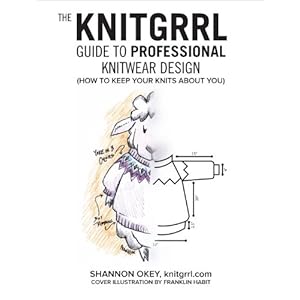
As I mentioned yesterday, I'm interviewed in Shannon Okey's wonderful new book, The Knitgrrl Guide to Professional Knitwear Design.

Shannon interviewed me by email... we've worked together a few times, and it was a long and fun email conversation, and I was my usual candid, opinionated self. Shannon printed many of my comments verbatim.

Rereading it now, I realize that my intended tone doesn't come through in print at all... it reads to me like I'm cranky and bitchy.

In the interview I criticize another designer's work, and name names. And that's not fair or professional.

The design in question is a top-down raglan, and my personal struggles with those are well known. I cannot wear a top-down raglan - seriously wrong shoulder/bust ratio to make it work. To make it fit around my bust, it gets (much) too big in the shoulders and armholes.

When talking about challenges with finding a garment that fits your own body well, I cited this sweater as an example of a sweater that had fit challenges. What comes through in print is that I think the sweater is bad. Not at all true - it's just bad for me.

As soon as I realized how it read in the book, I contacted the designer in question, Pamela Wynne, to apologize. She was gracious and kind in return, and I'm very grateful for that.

One more lesson learned from Shannon's book - to remember that tone doesn't come across in print, and that anything may be reproduced out of context.

Mad for Plaid

Introducing Mad for Plaid, my latest sock design published in the new Knitty - the First Fall issue.


I had fun playing with colours for this design...


It's an easy and approachable sock construction, top-down, band heel, nothing fancy going on. Very knittable as a first sock project. What makes it special is some not-too-challenging colourwork that creates a clever tartan sort of effect... it's mostly easy horizontal stripes, with four 1-stitch wide vertical stripes.

And of course, I did a left and a right sock - and I mixed up the colours. These four socks were knitted with 4 50gm skeins of sock yarn - all the same colours, just positioned differently. You can work a pair exactly the same, but I'm not that sort of girl...

Thursday, July 08, 2010

The Knitgrrl Guide to Professional Knitwear Design: Book Review


Shannon, the world of knitting thanks you.

Good lord, this book is a marvel. I agree wholeheartedly with all the glowing reviews out there.

For me, it's worth every penny just for Appendix B, the Book Proposal Template. The interviews with other knit design professionals are utterly inspiring and illuminating - while being brutally honest about the challenges of working in knitting. The book is full of well-articulated, clear and reasonable advice for anyone in the knitwear industry. She covers everything - not just the knitterly stuff like writing patterns and including schematics, but detailed advice on marketing, sales and legal topics.

Her style is friendly and accessible, while being realistic and balanced. Lots of concrete and relevant examples underline her messages and guide the reader's thinking and learning.

Last but not least, Shannon covers a topic very close to my heart: she provides a very clear argument for using technical editors.

This book is the best mentor I've ever had - and I didn't even need to take it out for lunch.

If you want to publish a pattern, read this book. If you want to write a book, read this book. If you want to work in the knitwear industry - as a designer, yarn shop employee, editor, writer, knitter - read this book.

Just read the book! Even someone who considers themselves to be "just a knitter" will find much to enjoy in the interviews with designers... Shannon talks to all the names we know and love - my friends Amy and Jillian are there, as is one of my personal heroes, Annie Modesitt, and the wonderful designer Louisa Harding, and so many others... I won't reproduce the full list, but every single one of them is worth reading. Shannon gathered designers and professionals of all levels, styles, backgrounds and opinions.

(I promise you, I'm not saying all this because I'm quoted in the book. In fact, it was day three of reading and loving it before I realized I was... ) Perhaps the best recommendation of all is that as soon as it arrived, I turned to the section that provides information on something I'm working on right now, and starting using Shannon's suggestions right away.

Speaking of opinionated, I am one of the interviewees... and as usual, I'm frank and opinionated. I've expressed a couple of ideas that I'm sure some will disagree with - and I look forward to the discussion that results from that!

Wednesday, July 07, 2010

Lots to Read, But Elsewhere...

The last few weeks I've been writing the KnittyBlog WWW Wednesday round-up post... lots of fun and interesting stuff for you reading pleasure! Check it out on Wednesdays!

In addition, Robin Hunter has posted an interview she did with me about the business of being (and becoming) a professional knitwear designer. I enjoyed the conversation very much - I hope you enjoy the result.

Monday, July 05, 2010

Summer Knitting


Central Park, Sunday July 4th, 90 degrees or so. And yet still knitting with wool.

I may be slightly mad...

Saturday, July 03, 2010

Probably a very bad idea...


but a delicious one, on a hot summer day.

Happy July 4th to my US friends!

Friday, July 02, 2010

On Holiday

I've been quiet of late, but for two good reasons: I've been blogging over at KnittyBlog - which you should read, if you don't already. Even if I'm not writing it, you should read it regularly.

But also I've been on holiday.

With my knitting, naturally.


I took my knitting by subway to Coney Island and Brighton Beach.

Both my knitting and I had a very good time.

Friday, June 25, 2010

All Lace All the Time; Distractions

I've been knitting a lot of lace lately.

You might remember the Shetland Skies circular shawl. In addition, I'm on the last of four lace designs intended for publication. I've loved doing them, but each of them has been on progressively finer yarn -- which is pretty scary when you think that the first two were worked with sock yarn -- and the last is starting to feel like a Herculean task. It's worked with true laceweight cashmere, at a gauge of abut 8 sts an inch, even on bigger needles. It's a circular shawl and I'm at round 54 of 97 of the final tier before I work the edging. I love it, don't get me wrong, but it's taken me about three times longer than I expected.

(One of the crew remarked today that I was looking a bit like a zombie, knitting as I walked, dead-eyed.)

At the same time, there is another deadline piece in the wings, picked up when I have an idle moment (hah!), not very lacy, but still triangular.

And as is the way when you're trying to be monogamous with a project (or two), there is always a distraction around the corner.

Blame Jennifer for this distraction.

It's no secret I love Noro. I've got some of it in my sock yarn stash. And it's no secret, also, that I have more sock yarn than I will ever need for actual socks.

So, sometimes, I like to use sock yarn for things other than socks. (Lace, for example, I use a lot of sock yarn for lace. Reference the Shetland Skies shawl again.)

I was admiring a shawl that Jennifer had crocheted out of my current favourite colourway of Noro Kureyon Sock, 242.

"Oh, it's so easy," she said.

"And quick."

"Here, let me show you."

And 10 minutes later I had the start of a crocheted shawl.

Am trying to be very very focused and not work on it.

It will be my reward.

Wednesday, June 23, 2010

World Cup Knitting

A certain knitter (you know who you are, Miss L.), has been madly watching the World Cup. During her team's first game, she knitted lace.

For the next game, she chose a sock.

The problem is that her team actually happens to be doing quite well, so she's been looking at the screen, and not her knitting.

We've been fixing a fair number of mistakes. I suggested that a garter stitch scarf might be best for the next game, as it's a critical one against a better-rated team.

For me... well... I think it would be better to look at my knitting rather than the footie.

I wonder if I have time to whip up a flag before they are knocked out?